


[B]URLINGTON – The future of a program that helps two senior living communities address mental health needs is uncertain as organizations wait to see if funding is renewed for next year.
A mental health clinician has been on-site at two of Cathedral Square’s affordable housing sites in Burlington since OneCare Vermont, an accountable-care organization, funded a pilot project in late 2017.
The initiative is run under Vermont’s Support and Services at Home Program, a housing-based strategy to address health needs of seniors, in partnership with the Howard Center, which provides the clinician.
Molly Dugan, SASH program director, said the mental health initiative has been successful in reducing stigma and barriers to accessing services.
The full-time clinician splits time between Three Cathedral Square downtown and Thayer House in the city’s New North End, offering programming and services to about 200 residents. About 65 percent in the two sites have accessed those services.
“There’s just so many things that you put one thing in front of them, it’s not going to happen, whereas, you know, this clinician is right where they live,” Dugan said. “They can see her, they can meet with her out on the park bench outside of the building and just talk for 15 minutes, it doesn’t have to be an hour visit.”
Experts say the mental health needs of older Vermonters are significant. Those 65 and older are significantly more likely than their peers from other states to participate in at-risk and chronic drinking, according to the Vermont Behavior Risk Factor Survey. Suicide rates are also disproportionately high for older residents, with males ages 70 to 74 having the highest rate in the state.
Social isolation is another major health issue among the older segment of the population.
The Howard Center mental health clinician placement is designed to address those issues.
The first year cost of $97,000 for the clinician was covered entirely by OneCare, an organization attempting the state’s experiment with an “all-payer” health care model.
Now in its second year, the program expense is divided among OneCare, Cathedral Square and the Howard Center. OneCare covers most of the cost with Cathedral Square and the Howard Center picking up the rest.
Representatives from all three organizations say they are unsure how and if the program will continue to be funded next year and into the future.
Amy Bodette, a spokesperson for OneCare, said the organization now has an innovation fund that provides grants to support the launch of similar initiatives to improve care around Vermont.
“The goal is to get there to be sustainable programs outside of OneCare so we can continue to help organizations test new models to continue to change the care delivery system,” she said in an interview.
Bodette said it would be “premature” to give any indication if OneCare plans to continue to fund the mental health clinician, since the organization is currently developing its budget to be presented to the Green Mountain Care Board in October.
All three partners on the initiative point to successful and promising results to date.
“OneCare is proud to partner with SASH, Cathedral Square and Howard Center to test innovative ways to reduce stigma and increase access to mental health services for Vermonters,” Sara Barry, senior director of value based care, said in a statement.
Adam Brooks, a spokesperson for the Howard Center, said surveys show participants are finding the on-site resource beneficial and consistent growth in accessing services from the clinician.
About 72% said they learned new skills to help cope, and almost 80% said they feel less stigma in their buildings to seek mental health support.
“We have increased access to emotional health services,” Brooks said. “Our data shows that the vast majority of pilot participants are receiving outreach for services the same day as the referral for services came in.”
Higher rates of men than women have accessed services in the two buildings, in contrast to research that often finds higher stigma among that population segment.
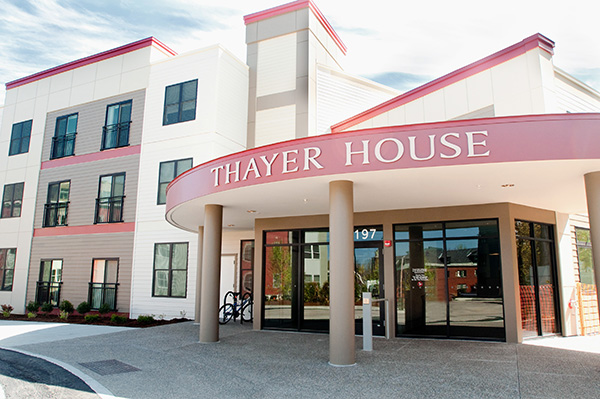
“We think we’ve really hit upon something because we’ve gotten rid of this kind of stigma, structural barriers,” said Dugan, the SASH director.
The program also works to address escalating behavioral issues within the two living communities and provides knowledge and comfort to staff in addressing challenges. So far, it’s helped prevent two residents from being evicted.
The concept for the on-site clinician came to fruition after Cathedral Square approached OneCare’s CEO at the time with the idea. The care organization liked the idea and decided to fund it for a year as a test, according to Bodette.
“It removed barriers to access,” she said. “For some people there is still a stigma with accessing mental health services. With this, it was bringing mental health services right to where people are living.”
With funding uncertain for the program’s future, both the Howard Center and Cathedral Square say they are examining various funding models and they are in talks with OneCare about what support they might receive.
“It’s extremely important to have a mental health clinician in that program, to provide all the services and address all the mental health needs of the of our seniors,” Brooks said. “We definitely hope and think that it will continue.”
Dugan said she is confident Cathedral Square will be able to maintain some presence of a clinician even if it is unable to secure the same level of funding. The director hopes to see the program eventually expand through SASH to senior living communities around Vermont, although the present focus is keeping it going in Burlington.
“The most important feedback I get is from the participants and I know from what I hear that this has been incredibly positive for them, and I really feel life changing,” she said. “That’s the true test from my perspective.”
