

[S]OUTH BURLINGTON — The University of Vermont has used a federal grant to upgrade its supercomputer, an enhancement that faculty and students say will significantly increase their research capacity.
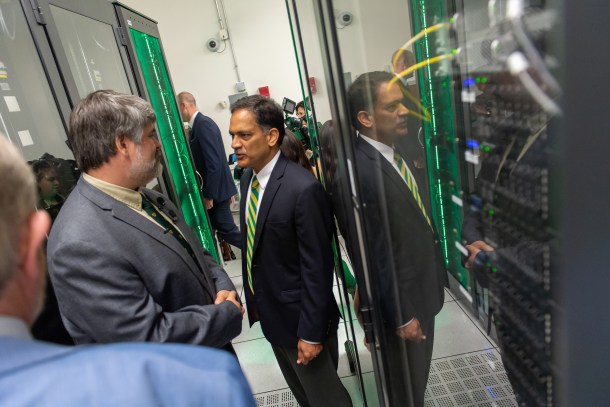
The university unveiled the new technology, which will increase the supercomputer’s speed by over 200 times, at an event Wednesday at the university’s primary data center in South Burlington.
Suresh Garimella, UVM’s recently hired president, said the technological improvement would be beneficial for students.
“There’s a lot of areas in which this capacity will help our students, and truly position them to be very highly sought-after folks for companies to hire and hopefully attract companies here,” he said. “Hopefully some or most of them will stay in the state and be an asset to the state as well.”
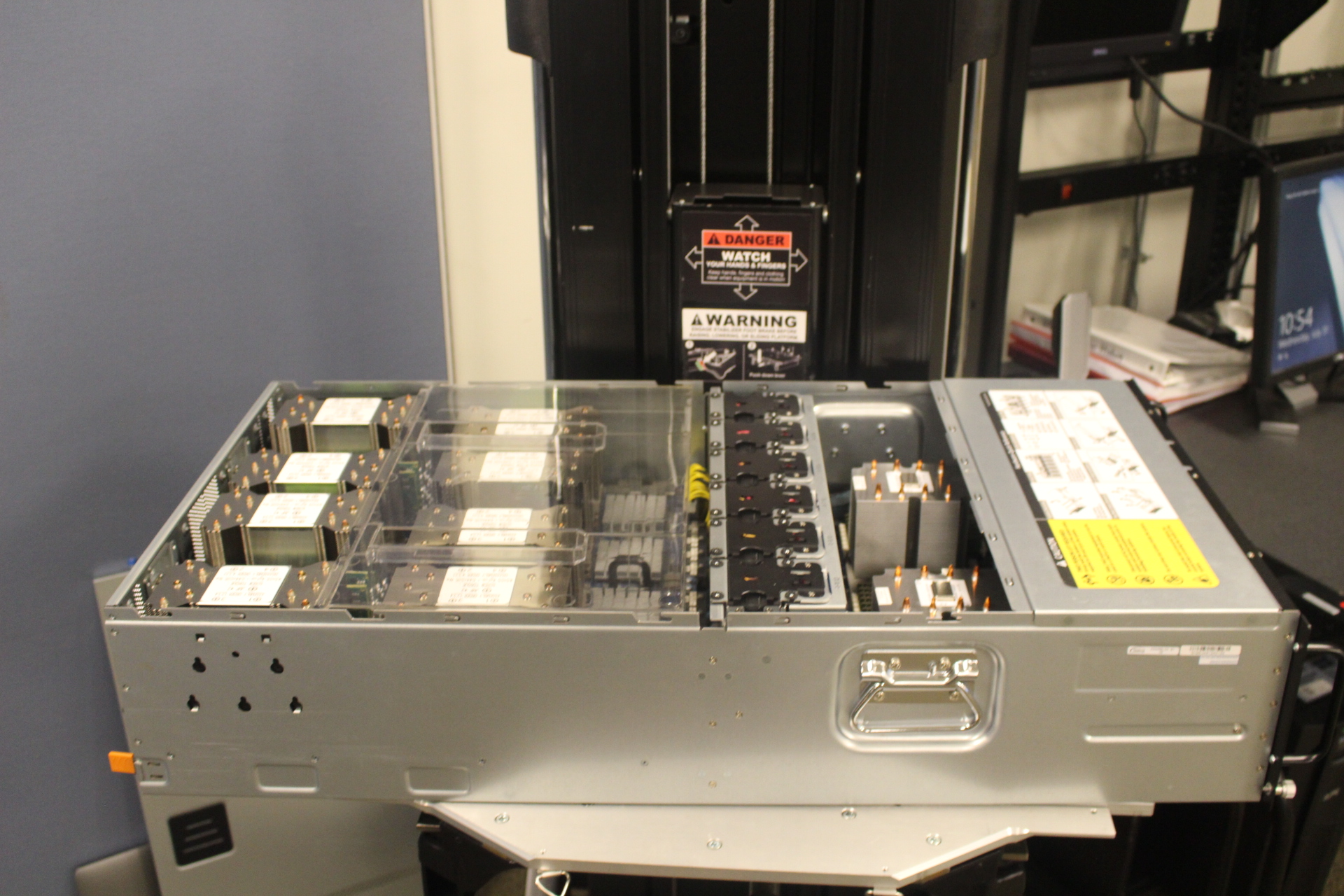
The university used a $1 million grant from the National Science Foundation to purchase a cluster of 80 graphic processing units, which has been named DeepGreen.
DeepGreen can achieve a speed equivalent to 20,000 laptop computers working together. The upgrade makes UVM’s supercomputer one of the fastest in New England.
Adrian del Maestro, associate professor of physics, is the director of the Vermont Advanced Computing Core and was the principal investigator on the National Science Foundation grant.
Del Maestro said an example of research DeepGreen could make much easier is a project from the Vermont Advanced Artificial Intelligence Lab, which is evaluating the conditions of highway signs across the state.
In the past, a group of individuals would likely be sent to drive across the state and take notes on the condition of the signs.
DeepGreen can take high-speed automated video of the roads, identify the signs and geo-locate them throughout the state, building a real-time map showing the location and condition of each sign.

“What would have potentially taken months or longer and cost a lot of money can now be done across the hall on the [DeepGreen] equipment,” Del Maestro said.
The upgrade will also aid research on safety in human-robot interactions and research on the effects of substance abuse on adolescents using brain imaging, among others.
Graduate student Jonathon Ferrell, who does a variety of research with chemistry assistant professor Jianing Li, said a lot of his research depends on GPUs, and the increased capacity will be very helpful.
“GPUs help accelerate a lot of the tasks that traditional computing is fairly slow with,” Ferrell said. “They are these little cards you basically drop into computers to make them faster.”
Ferrell said that the upgrade was a major improvement over the previous capacity.
“It allows us to model things, to visualize things, to simulate things in biology and physics, and deep learning, which we could not have possibly done before,” Ferrell said. “The computational power will be a boon for research for sure.”
Del Maestro said undergraduate students will have access to DeepGreen this fall.
“When we start working on problems that are so hard that they have to keep their laptops open for a week to keep it running, that kind of thing we can do on DeepGreen … in a couple of hours,” del Maestro said.
The technology will also make students more competitive in the job market, del Maestro said.
“Even having any exposure to deep learning technologies will allow them to be very competitive,” del Maestro said. “We’re really excited for, in addition to the research side of things, what it’s going to mean for students on campus.”

