[I]t’s wedding season in Vermont.
The statewide wedding planning website Vermontweddings.com is filled with photos of summertime love. There are lit sparklers and cornfields; linen tablecloths and leafy arbors; tiered cakes and mason jars. There are elaborate wedding dresses with cascading lace, and abundant arrays of sunflowers and sweet peas and dahlias.
There are also a lot of barns.
Grant Allendorf, who has worked in the Vermont wedding industry for 42 years, said one industry term for the movement is “vintage.” Others have used the word “rustic.”
Allendorf, a DJ with SuperSounds Entertainment and now the proprietor of his own wedding barn, said he has seen a dramatic increase in barn weddings of late. In Vermont, they’ve become commonplace: for the past three years, Seven Days has listed barns as four of its top five most popular wedding venues.
“All the weddings used to be in hotels, and now hardly any of them are,” Allendorf said. “They’ve gone to barns, and they’ve gone to inns and more one-of-a-kind type properties.”
But the wedding barn phenomenon comes with its own set of complications, especially in a state where many barns double as historical sites. Barns have to respect not only safety but history and romanticism, and some say the state’s rules for modernization are not applied equally.
According to wedding barn owners, however, the result is worth the effort. The trend is a way of preserving historical buildings, keeping family farms solvent, and celebrating love in true Vermont style — it just requires a lot of forethought first.
“We see some of these barns all over Vermont, and they’re beautiful structures,” Allendorf said. “It’s a way to save these structures, and make them cost effective as well. So we’re happy that the state worked with us on this to make it happen.”
Now trending
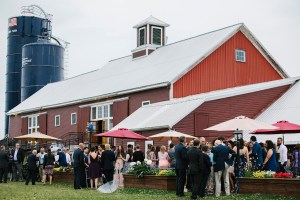
While there have long been weddings in barns, the location has only become popular in the past decade. In 2017, a wedding planning website called the Knot found that the number of barn weddings rose from 2% of all weddings in 2009 to 15% in 2017. Of the five wedding barns included in this story — all of which are at least a century old — four of them began offering weddings in 2008 or later.
Take Cambridge’s Boyden Farm, a sprawling property in the Lamoille River valley. Over the years, its output has included beef, dairy, maple products, wine, and a corn maze. It has been in the Boyden family since 1914, but it was only 11 years ago that the family turned into a wedding space.
“I think they [wedding barns] were just on the cusp of becoming popular at that time,” venue coordinator Lauri Boyden said. “I really didn’t know that then. The barn opened in the fall of 2008, but since then, it seems like barn weddings are trending.”
Allendorf hypothesized that barns like Boyden Farm — with its maple products and mountain views — are part of the iconic Vermont brand, a factor that makes it popular with locals and out-of-state couples alike.
“They are quintessential Vermont,” Allendorf said of barn weddings. “From Citizen Cider, to Prohibition Pig, to the breweries, the cage lighting … all that vintage stuff seems to be capturing a lot of millennials’ attention.”
In addition to their appeal to nostalgia, Vermont wedding barns also preserve the past very literally. As local agriculture becomes less profitable, farms are falling into disrepair and historic buildings are left with no clear purpose.
Some farmers and barn owners want to help.
Allendorf said that he and his wife drove past the wedding barn they now own, the Mansfield Barn in Jericho, for 40 years before they decided to “save” it.
“It kept getting a little worse, a little worse,” he said. “My wife and I, when we drove by, we always said, ‘hey, somebody should fix that barn up someday.’ Then it just seemed like a natural choice.”
Other barns have a more codified history to protect. The Round Barn Farm in Waitsfield is in the National Register of Historic Places. It has been around since 1910, and it was a functioning dairy barn until 1969. According to current owner Kim Donahue, “people kept driving up and asking to get married in the barn” — and the barn’s owners agreed, setting a business into motion.
Now, Donahue said that the staff at Round Barn Farm works to ensure that they maintain their property’s historical value while offering the best possible services to their guests.
“We walk this balance of this pristine building that still feels very authentic and genuinely Vermont,” Donahue said.
Both Mansfield Barn and Round Barn Farm were not in active use when their owners renovated them. In other cases, however, working barns have added a wedding business on the side. Barn owners say that the practice helps keep farms economically feasible.
One such barn, Landgoes Farm in Tunbridge, still retains its longstanding herd of sheep. John O’Brien, a Vermont state representative and one of Landgoes’s owners, grew up on the property. When the time came, he married his wife there. They began offering weddings in 2015, he said, partly because of the area’s rural beauty — but he acknowledged that there was also a financial component.
“Agritourism is a better business model than sheep farming,” he said.
Safety first
Hosting a wedding, however, is complicated — with all of the little kids and intoxicated adults and massive flower displays that make a modern wedding.
“It’s not just, you know, let’s pull out the cows and start having the weddings,” Allendorf said. “There’s so much to it. I think we put in about $600,000 into our barn.”
Eliot Lothrop, the owner of a historic building preservation business called Building Heritage, said the biggest changes he typically makes to wedding barns are to their floors. Many barn floors were designed to hold hay, which was spread out over a large area; the barn can hold a lot of weight, Lothrop said, but that weight was widely distributed.
Event spaces have different standards.
“Very often, you end up replacing the floor system with conventional materials,” Lothrop said. “So instead of using the old timber frame, you’ve got to remove that and use new engineered lumber. That’s usually the biggest alteration.”
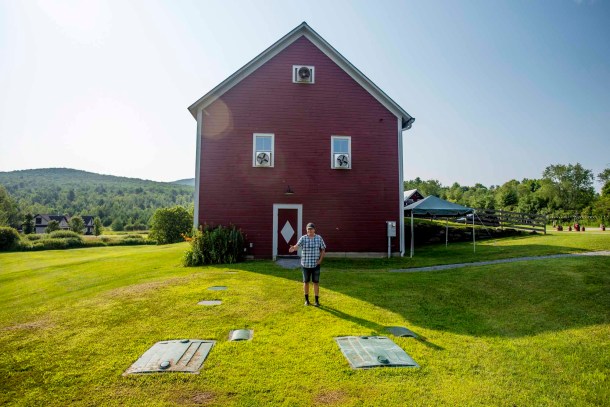
Barn owners have to meet state requirements. Barns need commercial septic systems (Allendorf said his cost $220,000), fire alarms, proper exits, and sometimes sprinklers.
All of the barn owners said that they understand the rationale behind the regulations, and that they support making wedding venues as safe as possible.

But according to Allendorf, not every barn abides by state safety regulations — and even among barns that comply with the standards, there are discrepancies in what the state requires of them.
Lang Farm has been in Jon Lang’s family for four generations. Like so many others in Vermont, it used to house cows; like so many others, he began holding weddings there around a decade ago. When Lang began his renovations in the mid 2000s, he did everything that the state asked of him. He even installed an expensive, elaborate sprinkler system — and he was, he felt, “unnecessarily put through the wringer” by the Division of Fire Safety.
“Lo and behold, as time went on, barns now have become like convenience stations,” Lang said. “Everybody’s getting to do a barn. And there isn’t one of them with a sprinkler system, because everyone has cried a financial burden and has asked for a variance. None of which was ever explained to me, none of which was ever mentioned to me.”
Lang said that the Division of Fire Safety promised to let him testify in front of one of its committees, but the opportunity never arose. He also reached out to Lt. Gov. David Zuckerman and Gov. Phil Scott individually. He said they did not help resolve the issue.
Lang knows that the state has asked a nearby barn to install a sprinkler system. But the barn owners haven’t yet done so, and they are operating with no consequences, he said.
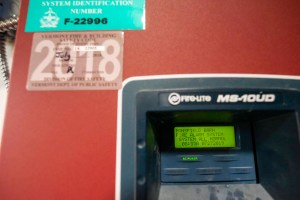
According to Allendorf, if he had also been required to put in sprinklers, the cost would have been prohibitive.
“It would be $200,000. We probably never would have done the project because we simply don’t have that kind of money,” Allendorf said.
The Division of Fire Safety did not respond to request for comment.
But regardless of the financial and logistical burdens, many wedding barn owners said that their safety systems go far beyond what the state requires.
“We take all of these precautions, not because we want to be licensed — but we follow all the safety precautions, and because we do, we are able to be licensed. It’s a difference in perspective,” Donahue said.
O’Brien agreed. He recently made the call to ban sky lanterns — “really beautiful” paper lanterns with candles in them — for safety and environmental reasons. It wasn’t something that an official asked him to do, but O’Brien said it seemed like an obvious precaution.
“A couple of the first weddings, we did release them, and they floated over our maple trees and out of sight,” he said. “But when we had some wedding guests who had too much to drink who were releasing them, they were running into trees and getting too close to our barn. So we said that we’d better not do this anymore.”
Regardless of the challenges of barn weddings, all of the wedding barn owners said that, with a little bit of preparation, engaged couples should get ready for a beautiful experience. All spoke glowingly of the weddings held at their barns; all said that barns make for a special venue.
Donahue — like all of the other wedding barn owners — emphasized that every wedding, rain or shine, is its own kind of beautiful.
“We have a center silo in our round barn,” she said. “Our center silo — we say that every weekend, we get to form a new family, and the silo is just filled with joy. And that joy just keeps building.”