


Editor’s note: Mark Bushnell is a Vermont journalist and historian. He is the author of “Hidden History of Vermont” and “It Happened in Vermont.”
[V]ermont’s earliest criminals seldom went to jail, but don’t count them lucky.
Instead, they faced a combination of pain and shame.
Just ask Seba Beebe. Beebe had the great misfortune of being caught with counterfeit Spanish coins in Strafford in 1794. Authorities took counterfeiting extremely seriously. At a time with no fixed currency, the coins of numerous countries were freely traded in Vermont. They were essential to keeping the economy fluid, which explains why officials treated counterfeiting as such a grave offense: It could undermine people’s faith in the economy.
As such, Beebe was sentenced to have his right ear cut off, be branded on the forehead with the letter “C” for counterfeiter, and pay a fine of five pounds. As a 40-something-year-old veteran of the Vermont militia during the American Revolution, Beebe could surely count on leniency. Well, actually not. Authorities carried out the punishment on Feb. 28, 1795. And when Beebe couldn’t come up with the five pounds, they threw him in the Newbury Jail. He was eventually released and somehow got on with his life. He moved to Beebe Plain, which straddles the Vermont-Quebec border and is named for his family, and lived another four decades.
But Vermont was not without mercy. For minor offenses, like ignoring the Sabbath, the state relied on shame, and skipped the disfigurement, sentencing violators to punishments like being forced to sit or stand stooped in public while locked in the stocks that each town was required by law to maintain.
Harsh punishment was reserved for more serious offenses. Whippings were common and mutilations not unheard of. Sometimes, as in Beebe’s case, criminals would have the lower part of an ear cut off, a physical stigma they would carry forever as a warning to others. In addition to the “C” that was branded onto the foreheads of counterfeiters, authorities also used an “R” for robber, “HT” for horse thief, etc. to give the public fair warning of whom they were dealing with.
Many crimes were punishable by death. In fact, Beebe was fortunate to escape with his life. In addition to counterfeiting, the state Legislature made capital punishment an option for such crimes as murder, rape, treason, blasphemy, robbery, burglary and maiming. Even sodomy was punishable by death.
Vermonters, at least initially, did not shy away from executing felons. Ethan Allen, the state’s famed founder, acted as prosecutor in the 1778 trial of British sympathizer David Redding, who was accused of stealing horses for the British army. Redding was convicted twice of the same crimes. The first time, however, the jury — contrary to English common law — had only included six members. Gov. Thomas Chittenden agreed that Redding deserved a second trial, this time with 12 jurors.
Allen quickly won a second conviction. Chittenden and the Legislature were part of the large crowd that watched Redding hang. As historians have pointed out, it didn’t bother officials of the then-independent republic of Vermont that Redding had committed his crimes in another state and that Vermont wasn’t even a part of the United States, in whose interest they acted. The point was to show the republic’s authority over such weighty matters.
Though brutal, the state’s early forms of punishment were consistent with the era’s belief in swift retribution. Harsh penalties were seen as a practical way of dealing with crime. Punishment, whether corporal or capital, was meted out quickly, and at almost no cost.
The nascent state had no jails, only the counties did. And those were reserved mostly for debtors, who would work off their debts in the community during the day and return to their cells at night. County jails would occasionally hold felons while they awaited their punishment. Society had no use for long prison terms.
Soon, Vermonters began to consider new ways to deter crime. Many were taken with the idea of the penitentiary, literally a “place to do penance.” The belief that time in prison could reform criminals swept the country in the late 18th and early 19th centuries.
Pennsylvania built the first state prison in 1790. Gov. Israel Smith, who was elected in 1806, proposed doing the same thing in Vermont. The state had already created a state university in Burlington in 1791, a state capital in Montpelier in 1805, and branches of the state bank in Middlebury, Burlington and Woodstock in 1806. Each had brought prestige to its host community. Now towns across Vermont vied to be the home of the newest state institution.
A commission toured the state, considering different locations. The editor of the Middlebury Mercury complained that the committee had made only a token visit to that town. Groups in Ryegate were divided over the benefits of hosting a prison.
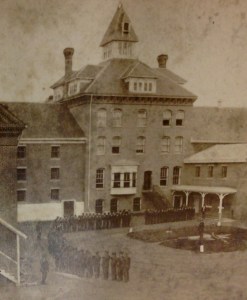
The distinction eventually went to the prosperous town of Windsor. Perhaps people felt it was Windsor’s turn, since it had lost out on the chance to host other state institutions. When it was completed in 1810, the prison was Vermont’s largest and most expensive building. It was also only the fourth state prison built in America.
Prisoners were expected to be treated well. Since the purpose of imprisonment was to improve the character of the inmates, guards were ordered not to swear around them or strike them, except in self-defense. Guards were hardly defenseless, however. They wore swords to protect themselves and discourage bad behavior.
Prisoners were shaved regularly, given fresh shirts weekly and got haircuts once a month. Their diet was plentiful, if not exactly gourmet, consisting mostly of milk, molasses, rye meal, beef, pork, potatoes, bread and coffee. As a perk, prisoners were rewarded for good behavior by being moved to larger cells.
To keep the inmates busy, and to pay for the cost of their upkeep, prison officials put them to work making nails and shoes. Prisoners sometimes acted out, intentionally producing bent nails and defective shoes. Officials eventually decided to put inmates to work making cloth on looms, because the work was easier to monitor.
The prison became a local attraction. As many as 1,000 visitors a day toured the facility in 1812. A visitor from Boston complained that the prisoners “appeared comfortable … too much so … they fare better and undergo less absolute hard labour than one half the population of the country.”
But prison life was far from easy. The buildings were barely heated in winter and jailhouse diseases like tuberculosis occasionally killed inmates.
And from time to time, however, the state killed prisoners. In 1838, Gov. Silas Jenison had tried to abolish the death penalty. His proposal passed the House but the Senate defeated it by six votes. If the state was going to continue executing people, Jenison told the Legislature, then let it do so in private, behind the walls of the state prison. Public executions, Jenison said, were “demoralizing” to the general public. The Legislature agreed. It was a moot point for the next quarter century, as successive Legislatures commuted every death sentence handed down.
Things changed towards the end of the Civil War. Vermonters suddenly seemed comfortable with capital punishment. Perhaps they became inured to violence. Whatever the reason, between 1864 and 1882, Vermont executed 12 people, nearly half the total number it has put to death in its history.
In their zeal to bring justice to the guilty, Vermonters might have done a grave injustice to the innocent as well. Some researchers believe that the evidence against at least two of the men executed during this period left doubts about their guilt. In one of those cases, another person confessed to the crime years after the execution.
This period was an aberration, however. Vermonters have generally had little stomach for executions. Since it was founded in 1777, Vermont has sentenced 55 people to death. Only 27 of those sentences were ever carried out.
Vermont eventually acknowledged its discomfort with the death penalty. The Legislature drastically shortened the list of capital offenses in 1965 before abolishing capital punishment in 1987.
As the state entered this new era in criminal justice, it left behind a vestige of its past. Vermont shipped prisoners from Windsor to other state facilities and to federal penitentiaries out of state, then closed its now empty and outdated prison in 1975. A Massachusetts construction company soon bought the property. With no inmates left eager to escape, the company removed the bars from the windows and converted the structure into apartments.

