


[A]deline Druart was working on a cheesemaking degree at the national dairy school of France when a fellow student who had interned in Putney suggested she check out Vermont.
“He came back and said, ‘This place looks like France; it looks like our region,’” said Druart, who grew up in Franche-Comté region, near the Swiss border. Seeking an internship herself, she searched online with terms like “Vermont fromage” and “Vermont crème” and the name of the Websterville cheesemaker Vermont Creamery came up.
An internship on Vermont Creamery’s cheese production floor followed. After earning her cheesemaking degree from the École Nationale d’Industrie Laitière, the national dairy school in France’s Savoie region, and then a master’s in biotechnology, Druart spent 16 years rising through the ranks at Vermont Creamery. Now she is president of the state’s largest goat cheese producer as it undergoes a sizeable expansion fueled by capital from its new owners, Land O’Lakes, Inc.
Vermont Creamery is increasing its plant and headquarters by nearly 40% with construction underway now. And the company expects to produce 5.5 million pounds of its high-end cheese, sold nationally, this coming year. It’s the most ever, said Druart.
“If you put it on the scale to compare it to Cabot Creamery, it’s teeny tiny,” said Druart of Vermont’s largest cheesemaker. “But these products are handmade; they’re very precious. They’re not big chunks.”
Vermont Creamery’s founders, Allison Hooper and Bob Reese, changed Vermont’s agricultural landscape with the cheese company they founded in 1984. From the start, the two business partners wanted to buy all the Vermont goat milk they could find, and they encouraged farmers to try milking goats — a mission the company continues to pursue today. The company now accepts an equal amount of cow milk and goat milk, buying much of its goat milk from Quebec.
“We buy all the goat milk available to us in Vermont, but it’s certainly not enough,” Druart said. She expects the company to need one-third more goat milk by the time the expansion is completed.
Over the decades, as Vermont Creamery grew, Vermont’s goat milk production grew too, and new goat cheese companies entered the market.
Tom Bivins, the executive director of the Vermont Cheese Council, worked for years as a chef in Vermont and remembers when Vermont Creamery was one of just a few Vermont goat cheese producers.
Now 14 of the 52 Cheese Council members use goat milk, he said. He attributes much of that increase to Vermont Creamery. Hooper is an artisanal cheesemaker of some renown who served as president of the American Cheese Society for three years.
“Some of the folks who are now making cheese probably started out producing goat’s milk for Vermont Creamery,” Bivins said. “The quality of the goat cheese you’re able to get is pretty spectacular.”
One of Hooper’s sons is operating a 400-goat dairy in Randolph; another is running a company that makes goatskin gloves.
Druart noted that while it’s far more efficient to get milk from a cow than from a goat, cow’s milk is now selling for about $13 per hundredweight, while Vermont Creamery pays an average price of $50 per hundredweight for goat milk.
“It doesn’t fluctuate like cow’s milk does,” she said of the price.
French cheesemaking in Vermont

Both sets of Druart’s grandparents operated cow dairies in eastern France, “in a village with more cows than people,” and with a passion for science and microbiology, Druart headed straight to cheesemaking school.
“I never thought I would become the president of a company and lead people and strategy, and in the U.S.,” said Druart. She didn’t speak English when she arrived as an intern; she learned as she worked in the cheese plant. Hooper spoke French to her, she said, which helped.
At age 21, she was project manager for the construction when the then-$10 million Vermont Creamery completed its first expansion.
She then applied herself to making the cheese called Bonne Bouche that she had made as a student. It was more difficult than she had expected. The company imported the tools from France that it needed to control the temperature and humidity in the cheesemaking cave, but the milk was different, and not just because the pasture was in Vermont, not France.
“The science of it is the same, but you’re in a different environment: different pasture, different climate, a different sense of place. Even if it’s the same type of goat breed, they are raised differently,” she said. Bonne Bouche (“tasty bite”) has gone on to win gold medals for Vermont Creamery, which describes the small disc as its “flagship cheese.”
“I thought I’d have recipe nailed in six months; it took 10 years,” Druart said.
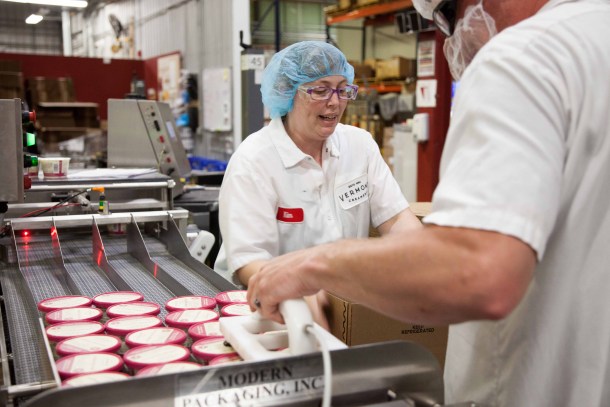
New corporate ownership
In 2014, Druart became president of Vermont Creamery. Three years later, in 2017, Land O’Lakes, a dairy cooperative in Minnesota, purchased the company. That purchase gave Vermont Creamery — a B Corp with about 120 workers — access to the capital it needs to expand.
The expansion will happen in three phases, including a full renovation of the company’s fresh cheese facility. All of the work is expected to be finished by the end of next year.
Along with enabling the expansion, the Land O’Lakes acquisition has introduced structure the company needs to grow, Druart said. Vermont Creamery employees have switched to the much larger parent company’s retirement plan and health insurance, and now have access to education reimbursement that wasn’t available before, she said. Last year, Vermont Creamery worked with a Minneapolis designer to redesign its packaging.
The company increased every worker’s starting wage by a dollar within the first few months of the sale; Druart said no worker starts at less than $16 an hour. More slowly, Land O’Lakes has added new functions, such as a new quality manager and a new safety manager.
“We were a small business, where everybody does everything, boot-strapping and duct-taping,” she said of the period before the acquisition. “At some point, we were getting too big for that; it was becoming more chaos than effective.”
Vermont Creamery has won many awards at national and international competitions, but Druart said she thinks the sale to Land O’Lakes — with 1,850 dairy producers and 10,000 employees — will also give the company added legitimacy. That might in turn help convince Vermont dairy farmers to add goats to their portfolio.
“Now we’re owned by one of the largest dairy co-ops in America, we feel we can be looked at seriously; this is no longer a hobby, making goat cheese,” she said. “It’s a real company with lots of growth potential and support from a very established parent company.”

Disclosure: Allison Hooper’s husband Don Hooper is on the board of Vermont Journalism Trust, VTDigger’s parent organization.


