

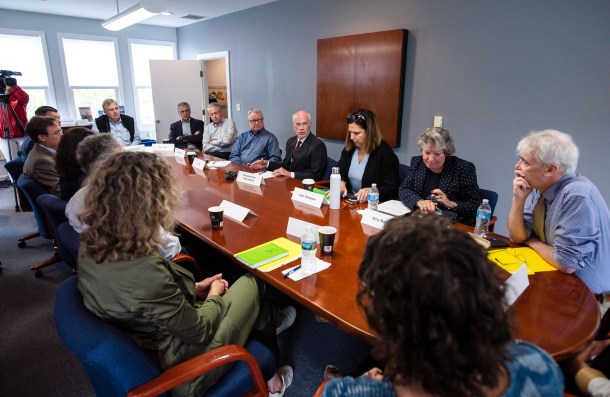
Vermont industry leaders are blaming President Donald Trump’s trade war for cutting millions of dollars from their bottom lines and adding market instability to a global economy that Vermont businesses are becoming more and more dependent on.
Businesses being forced to tighten their belts include the popular snowboard manufacturer, Burton, that reports it could lose $5 million in profits over the next year, and Cabot Creamery, which says it has almost completely lost its $3 million market for whey protein powder in China.
“We knew that the competition would attack and ramp up and displace us and that’s what is happening now,” said Jeff Saforek, chief operating officer of Cabot, told Rep. Peter Welch, D-Vt., Friday during a meeting with other business leaders at the Vermont Chamber of Commerce office in Barre.
“Our business on the particular product you are talking about, it’ll be done,” Saforek added. “So, 40 million pounds of product is gone.”
Representatives from Vermont’s retail, technology, agricultural, and trade industries met with the congressman to explain just how badly the Trump administration’s trade policies are affecting business and the state’s economy.
“We have 15 of 75 suppliers left in China,” said Josee Larocque, senior vice president of operations at Burton. “It would mean an unprecedented unforecasted hit of over $5 million this year.”
Betsy Bishop, president of the Vermont Chamber of Commerce, warned that the losses sustained by Vermont industry will not be quickly reversed.
“Even if the tariffs go away,” she said. “There is continued pain. Loss of suppliers, loss of customers, lack of payment. That’s going to be a continuing negative pull on our Vermont businesses.”
Most of 14 businesses that gathered for the meeting with Welch said they began to feel market pressure last March when the president imposed a 25% tax on steel and a 10% tariff on aluminum imports.
Since then, Trump has ramped up a trade war with China — which has no end in sight — in an effort to change the country’s market practices with U.S. businesses. Trump has also threatened tariffs against Mexico, the European Union and Canada, Vermont’s largest foreign trading partner.
Trump’s trade wars with China have had the greatest impact on the global market, and by extension Vermont.
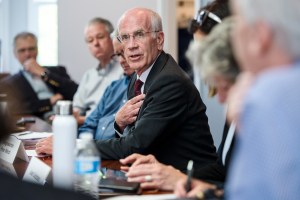
“It’s one thing to get tough on China,” Welch told members of the business community Friday. “But if the way we get tough on China is by hurting Vermonters, that’s not part of the plan that I want to support.”
Jack Glaser, the president of a medical device exporting company based in Williston called MBF Bioscience, said he has lost 10%-15% of his business in China. Glaser said that revenue lost is the difference between being able to hire four or five more people, or keeping staffing as is.
Glaser, like Bishop, also said when the trade war ends, his business will not be able to bounce back to the success it was enjoying before tariffs were levied.
“It’s not like a spigot is turned back on and we have great business again,” he said. “We actually have already taken a longer term hit than I think people realize.”
Gov. Phil Scott’s administration also voiced concern Wednesday over how the Republican president’s trade war has negatively affected the Vermont business community.

“We are concerned that ultimately this trend is going to slow down the economy,” said Joan Goldstein, commissioner of the Department of Economic Development.
Near the end of the meeting, Welch said he had known the president’s trade war had been affecting Vermonters, but that he had not fully realized the extent to how businesses were suffering.
In response to the concerns from the business community, the congressman said he has decided to support bipartisan legislation that would rein in the power of the president to levy tariffs and that he is continuing to discuss the proposal with Republican lawmakers.
“This is not a red state-blue state thing. It’s not whether we voted for Trump or Hillary. It’s your jobs, your economy, your community,” Welch said. “I’m not asking my Republican colleagues to not support the president. I’m asking them to support their local businesses.”
