


[W]hen Brendan Hadash received an email asking him to obtain $200 in Google Play gift cards for a cancer patient, he had no reason to be suspicious.
After all, the person making the request of the retired Universalist Unitarian minister was his successor at the St. Johnsbury congregation, Rev. Susan-Lynn Johns.
Hadash, who serves on the church’s caring committee that at times makes gifts to those in need, said the email also indicated he would receive a refund for the gift card.
As a result, he said, “it seemed like a perfectly reasonable email to receive.”
While Hadash considered the amount to be somewhat extravagant given the resources available at a small church like his, he went to a local store to obtain the gift cards. While there, the clerk at the front counter and a man behind him in line told him they thought the whole thing sounded like a scam.
Nevertheless, he purchased the cards and then contacted the church minister before sending along the cards. It was then that Hadash learned it was indeed a scam.
It turns out that four members had received similar emails from a phony address with Johns’ name on it from scammers in mid-May, although none lost any money.
The incidents prompted Johns to file a complaint with the Attorney General’s Consumer Assistance Office (CAP), one of seven such reports the office had received since March about what the office says is a new imposter scam with people posing as pastors.
One email to a church member said: “I urgently need to get Steam wallet gift card for a cancer patient that I promised as a birthday gift, but I can’t do this right now. Can you get it from any store around you? I’ll have it refunded. Thanks. Rev. Susan-Lynn Johns.”
The scammer said that her phone was broken at that moment, so she had requested the gift cards by email.
In an interview with VTDigger, Johns said one of those who got the email realized it was a scam right away and played around with the scammer. The member informed the person contacting her that she had done the shopping for the day and wasn’t going to go out again. She was urged to buy the gift cards online.
“She wrote back and said ‘If you’re online, why can’t you do it online?’ Then they didn’t answer back,” said Johns.
Charity Clark, chief of staff at the Attorney General’s Office, says those engaging in the pastor scam send out text messages or emails in the name of a minister or priest, saying they are raising funds for a needy child or sick person. They ask people to send gift cards and, in some cases, promise to provide reimbursement.
Clark said at least one Vermonter fell for the scam, resulting in a loss of $300. In that case, the individual had bought $300 in Google Play gift cards but realized before sending them off that it was a con game. He then tried to return the cards for a refund but the store refused to take them back.
The AG’s office told the person who complained that it would send a letter to the company that sold the gift card, asking it to respond to the complaint within 10 days. Clark said scammers are very hard to track down because most of them are not in the U.S.
“There’s nothing we can do other than educating people and trying to spread the words when there’s a scam,” Clark said.
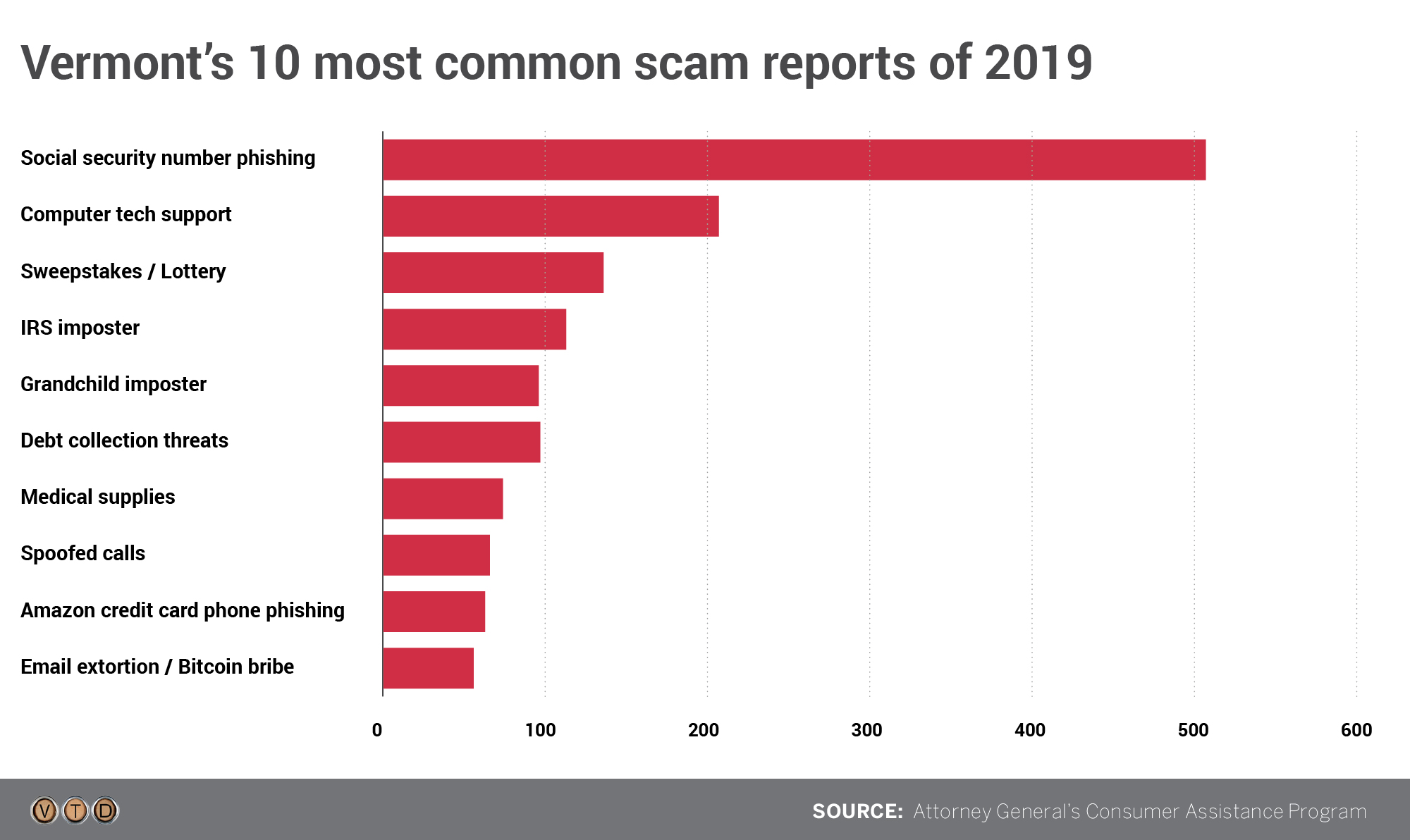
Vermonters have filed 1,415 fraud complaints this year, according to CAP. Social Security number phishing tops the list with more than 500 reports. Scammers pose as the Social Security Administration representatives or a business in an attempt to get the identifying numbers by saying they have been compromised or stolen.
The second most common scam involves tech support, with swindlers — often posing as well-known tech companies — trying to obtain remote access to people’s computers by saying there’s a problem..
CAP warns Vermonters not to respond to emails or texts from scammers and not to call them. It also urges residents to be suspicious of unsolicited communications, requests for personal information and requests for untraceable forms of payment, including gift cards or wired funds.
More information can be found at the CAP blog.
