[V]ermont ranks third in the nation for the number of people working in companies with some form of worker ownership, including Employee Stock Ownership Plans, or ESOPs, and worker cooperatives.
This year, the Vermont Employee Ownership Center will introduce lesser-known forms of employee ownership at its 17th annual conference, scheduled for June 12 in Burlington.
VEOC plans to introduce a workshop this year on structures such as the employee ownership trust, a practice now seen more in the United Kingdom than in the United States. And conference-goers will be able to learn about other forms of equity compensation for employees that are neither ESOP nor cooperative, said Don Jamison, a founding executive director of VEOC.
Interest in employee ownership appears to be rising, said Jamison, who expects 250 people to attend the conference. Normally 150 to 175 attend, he said. Jamison said he didn’t know what’s driving interest this year, but Vermont itself is a leader in the employee ownership field because it seems to have a high proportion of companies that prioritize social responsibility.
“Per capita, we probably have more members of a socially responsible organization than anywhere else,” said Jamison, adding that Vermont Businesses for Social Responsibility is an indicator.
“VBSR has a membership that other states would die for,” Jamison said.
Vermont is third in the nation per capita for the number of workers in an employee ownership company, said Nancy Wiefek of the National Center for Employee Ownership or NCEO in Oakland, California. She added that interest in employee ownership seems to be growing. The states with higher participation are North Dakota and Iowa.

“This year particularly has been a hot year for ESOPs just from talking to professionals on our network,” said Wiefek. “Our (attendance) at national conferences has been record-breaking, partly because the economy is really favorable. Stock values are high, and people are willing to lend.”
Wiefek added that people seem to be becoming more familiar with the concept of employee ownership.
“The ESOP structure is becoming more comfortable and familiar to bankers, so there are a lot of transactions happening now,” she said.
More than 40 Vermont companies with more than 3,000 workers are at least partly employee-owned, according to the VEOC. The state is also home to outposts of national employee-owned companies like Kinney Drugs, Price Chopper and Stewart’s Shops.
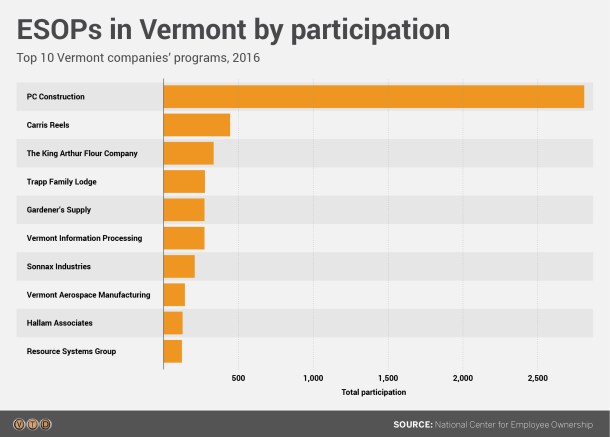
Vermont ESOPs include the Proctor-based Carris Reels, one of the state’s largest manufacturers, Chroma Technology in Rockingham, and King Arthur Flour in Norwich. This spring, the Middlesex chocolate maker Nutty Steph’s became a co-op, with an equal share going to each of the four owners.
NCEO says its research shows employee-owners are likely to have higher median incomes from wages, no matter what their wage level. The group said employee-owners tend to have better access to benefits like flexible work schedules, parental leave and tuition reimbursement, and tend to stay at their jobs longer than non-employee-owners.
Proponents of the worker ownership model say it’s also more likely to result in jobs with dignity and more opportunities for wealth and building skills. Democracy at Work, an Oakland nonprofit, works to promote more employee ownership, specifically among disadvantaged groups, with the goal of changing the economy.
Research shows that owners who sell to a cooperative or an ESOP usually get fair market value for their company, said Wiefek. The only case where an owner might lose money by choosing to convert the company to employee ownership is if they turn down a buyer offering more than market value. By law, ESOPs can only pay fair market value.
“But a lot of owners, when they think about what they want to accomplish when they sell a company, it’s not only the financial benefit: they also want to feel good about what happens to the company afterwards,” Wiefek said.