

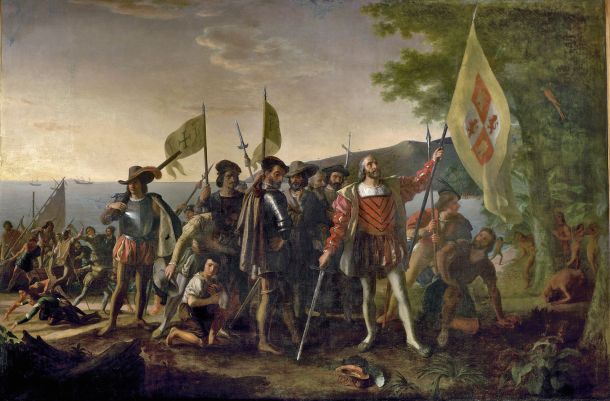
John Vanderlyn.
[G]oodbye, Columbus. And good riddance, with a few regrets.
Without fanfare or even announcement, Gov. Phil Scott signed S.68 into law last month, designating the second Monday in October as Indigenous Peoples Day.
Not Columbus Day. Not any more. Chris has been dissed.
Does he deserve it?
Maybe this is all one needs to know to answer that question: On his second voyage, one of his officers, Michele de Cuneo, “captured a very beautiful woman, whom the Lord Admiral gave to me.”
The Lord Admiral was Columbus. He gave the woman to Cuneo to be raped, as noted in “Columbus: The Four Voyages,” by Laurence Bergreen (Viking, 2011).
The Taino people who lived on the island (now Hispaniola) where Columbus landed “exhibit great love toward all others in preference to themselves,” he said, meaning “they would make fine servants. With 50 men we could subjugate them all and make them do whatever we want.”
So he did, enslaving them, forcing them to find gold, ordering the hands chopped off of those who did not find enough.
And no, this is not applying modern standards to the past. King Ferdinand had ordered Columbus to “treat the Indians very well and lovingly.” Some Europeans, like Dominican priest Bartolome de las Casas, believed the natives of the Americas were as human as Spaniards and Italians. Columbus was not one of those Europeans.
Now for the regrets. Start with some consideration for the Italian-American community. For a century, celebration of Columbus Day offered Italian-Americans succor from the slander they endured, first for being poor immigrants who spoke accented English, later from the common but false belief that they were all linked to organized crime. It’s probably time to choose another hero.
Then there’s the word – generic, abstract, and unlovely. The names of so many tribes – Taino, Abenaki, Delaware – fall pleasingly on the ear. “Indigenous” lands with a clumsy thunk.
Worse, disparaging Columbus and venerating the native tribes gives aid and comfort to one of the prevailing idiocies of the day – that the horrors of the world are the fault of those evil Europeans, who never should have come to America, imposing from sea to shining sea the horror known as Western Civilization.
It’s part of the current “Aren’t we awful?” vogue among slivers of the academic left, and while it isn’t new – back in 1885 W.S. Gilbert mocked those who “love every century but this and every country but their own” – it is inane.
We’re stuck with Western Civilization, so we might as well accept it. You are reading this thanks to technology developed by British, German, and American mathematicians and engineers.
Besides, Western Civilization has its virtues. It did produce horrors great and small: slavery, genocide, traffic jams, food courts. But also Mozart, Shakespeare, democracy, hot dogs, and baseball. So it isn’t all bad.
Nor are other-than-Western Civilizations so good. They produced the Cambodian killing fields, Mao’s Cultural Revolution, the Rwandan genocide, ISIS. Columbus did not introduce slavery to this hemisphere, where the natives had been enslaving one another, making war on one another, torturing one another, and sometimes eating one another for centuries.
The law creating Vermont’s Indigenous Peoples day asserts that “Vermont was founded and built upon lands whose original inhabitants were the Abenaki people.”
That’s debatable. Scholars think people have lived hereabouts for some 10,000 years. Those earliest folks may not have been ancestors of the Abenaki. Scarcely a square inch of this earth is not inhabited by people whose ancestors took it from another people, who were either chased away, absorbed, or exterminated.
We are all awful. But that’s all human beings, not just white Europeans. Who, transplanted to America, created a whole new animal – a system of government based on political democracy, individual freedom, the rule of law, and (in theory) human equality.
It could have been created elsewhere. There were hints – earlier republics, tribes that elected their chiefs, the beginnings (especially in England) or free institutions, a philosopher proclaiming freedom of conscience, uprisings against tyranny.
But it didn’t gel until certain people (Europeans) came to a specific place (here). Those people in this place created government by the consent of the governed, government which could not tell the governed what to say, government which (in theory) had to treat all citizens as equals, government itself governed by laws, not anyone’s whim.
For too long those rights and powers were only for white males. But that was a great step forward. Before then, no one had them except the king, the lord of the manor, or the guy with the most troops.
The rights and powers still haven’t yet been extended equally to everybody. But they are intended equally for everybody, to everybody’s benefit. It isn’t only white men who appreciate having the power to vote for their leaders and the right to say what they want.
It’s not certain that anyone would have those rights and powers had Europeans not come to America. In the process of taking it over, they committed some horrible crimes. But more people of all races live better lives with more personal and political freedom because of what they wrought.
By happenstance (remember, he thought he was in Asia) Christopher Columbus was the first of them. What he began deserves celebration, even if he doesn’t.
