


[H]ouse Democrats are poised to water down a bill that would raise Vermont’s minimum wage. Leaders say they have no choice but to cater to a moderate bloc of the caucus that would otherwise oppose the bill and make a veto override all but impossible.
It’s the latest test of a liberal “super-coalition” in the House that runs the political spectrum from Progressives to “blue dogs,” who generally join the party on social issues but are more economically conservative. Weakening the Senate proposal may win the support of moderates in the House, but it could cost votes on the left.
And it’s also a test of the already fractious relationship between the Senate and the House. Early in the session, the upper chamber passed a proposal that increases the minimum wage to $15 an hour by 2024. Senate leader Tim Ashe has made the wage hike a top priority. A watered down bill from the House could frustrate negotiations with the Senate in conference committee.
The compromise developed by the House Appropriations Committee, which took control of the bill after House General advanced the Senate’s proposed timeline, would tie a minimum wage increase to a multiplier of the consumer price index.
House committee leaders say it’s that or nothing.
“While this may be disappointing to us, especially to those of us who would prefer an even faster increase — in order to get there at all, we have to get the votes,” said Rep. Tom Stevens, D-Waterbury, chair of the House General, Housing and Military Affairs Committee.
And not just the votes to pass the bill, S.23, with a simple majority on the House floor, but with the 100 votes needed to override a veto from Gov. Phil Scott, who has made opposition to a minimum wage increase one of his signature positions over the past two years.
“I mean, not only do we have to pass it,” Stevens said. “We have to take into account, you know, if there’s going to be a veto, what does that mean? I would rather have a bill on the table that the governor has to contemplate, rather than let it die here this year.”
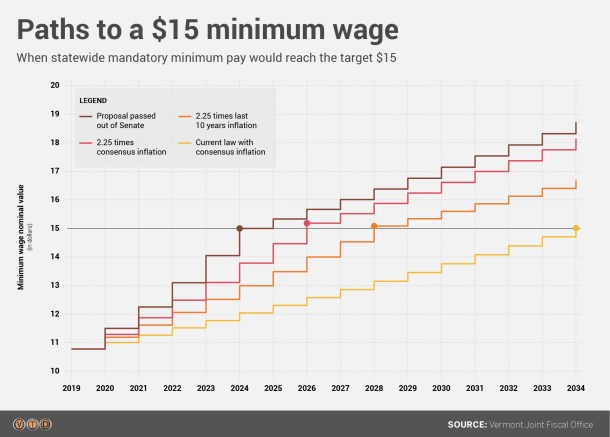
The current rate is $10.78 per hour and increases are tied to the fluctuating consumer price index, a measure of inflation. The CPI for the past 12 months is 2 percent. At that rate, under current law, the rate would increase 22 cents, bringing it to $11 an hour in 2020.
Under the House Appropriations version, minimum wage would be set each year by multiplying the CPI by a factor of 2.25. At the current rate of CPI, the increase would be 4.5% or 48 cents, bringing the current rate up to $11.26 per hour.
Left-leaning Democrats say the wage needs to increase at nearly double that rate over the next five years in order to help working Vermonters attain a living wage.
The House Appropriations proposal caps the minimum wage increase at a 5.5%. If the CPI was 8%, for example, the minimum wage would still only factor in a 5.5% increase. There is also a pause button built into the bill, so that if general fund revenue projections and sales tax drop by 2% at the same time, the minimum wage would revert to tracking directly with inflation.
Rep. Matt Trieber, D-Bellows Falls, an appropriations member, defended the compromise before House General on Tuesday. Stevens asked him why the proposal stalls at $13.01 in today’s dollars, below a livable wage.
Trieber said the livable wage is a “sticky” figure that often came under criticism in policy debates.
“This proposal in front of you may not get to the living wage, but I would say that there’s a good number of people that when we start to open up the conversation about the living wage will disagree with what that number is,” he said.
Trieber said that any effort to move the timeline up or increase the wage beyond $15 — would have scuttled the slim 6-5 majority that allowed the bill to move out of his committee with a favorable vote.
“At the end of the day we are 42 cents apart … and I am very interested in getting something through that gets Vermonters from where they are now to only being 42 cents apart for the two [proposals],” he said.
Both Trieber and Stevens said the House Appropriations amendment amounts to 97% of the Senate and House General version when both reach their plateau. But that assumes that future legislators take no further actions on the minimum wage once it hits $15.
Trieber’s amendment also depends entirely on economic performance. If there is a recession in the next few years, the Appropriations proposal might not hit $15 until 2028, according to the Legislative Council Office.
Rep. Randall Szott, D-Barnard, a House General member, asked Trieber why there was a pause button if the economy was bad, in order to cushion the blow for employers, but no similar mechanism to boost wages when the economy is good.
“Why are we only concerned at tapping the brakes instead of accelerating things?” he asked.
Rep. John Killacky, D-South Burlington, also took issue with the recessionary penalty for workers. “To me this is a very wonderful thing for business and it’s a terrible thing for people.”
Trieber said the committee did make changes to increase the potential fruits of a strong economy for workers, raising the cap on the CPI increase from 5% in current law to 5.5%.
Szott said in an interview after the committee meeting that he would oppose the amendment.
“I don’t like the idea of engaging in a phantom negotiation,” he said. “And since I don’t know what the governor’s position is, I’d rather pass a bill that we can stand behind and say it represents our values.”
But he said a “something is better than nothing” attitude was more likely to win the day.
“And so just to be clear, I’m not a fan of like, constant symbolic votes. I mean, it is important that we get actual things done and don’t just grandstand,” he added. “But there are certain core values that I feel like we have to take a very strong stand on.”
The House General committee plans to vote on the amendment Wednesday morning. It will then likely be expedited to the House floor — either later Wednesday or on Thursday.
House Progressives met Tuesday and decided to introduce an amendment that would restore the broad outlines of the Senate timeline to reach $15 by 2024. They also discussed opposing the Appropriations amendment altogether, but worried they could derail the minimum wage push entirely.

Rep. Robin Chesnut-Tangerman, P-Middletown Springs, chair of the Progressive caucus, said he wouldn’t be supporting the compromise crafted to get moderates on board.
“My fear with the minimum wage bill is that by extending the timeline out further we will say to ourselves and the general public that we don’t need to deal with this until 2026, when what we have done is woefully inadequate,” he said.
Chesnut-Tangerman said another veto this year could help build momentum to pass a stronger bill next year.
“If we don’t pass something, I see it as increased pressure next year to do something real,” he said. “If we do pass something this year, I think the pressure’s gone but we are settling for less than we can and should be doing.”
It’s also unclear whether the Senate will be willing to accept a minimum wage pegged to inflation, as opposed to a firm timeline to $15.
Senate Majority leader Sen. Becca Balint, D-Windham, said her caucus was strongly opposed to the idea, though she wouldn’t count it out. She said a CPI-based calculation would be difficult to explain to constituents, and the 2.25 multiplier was simply too slow.
“If you look at what the increases will be in the next few years for Vermonters in some cases it’s a quarter, like I can’t go back to my constituents and say that I championed a minimum wage increase that gives them a quarter, I just can’t do that,” Balint said.
“So how do I feel about what’s taking shape in the House? I don’t feel good about it. People in my caucus don’t feel good about it,” she said. “And we’re really hoping that, in the end, through negotiation between the two bodies, that we’ll get to something closer to our position.”

