

Last fall, a skit on Saturday Night Live poked fun at Vermont’s lack of racial diversity. This spring, the state Department of Tourism and Marketing hopes to set the record straight for outsiders with an ad campaign that shows that the Green Mountain State is suitable for everyone.
“We’re making a conscious point to make sure our media advertising and marketing reflects more diversity than it has historically,” said Tourism Commissioner Wendy Knight.
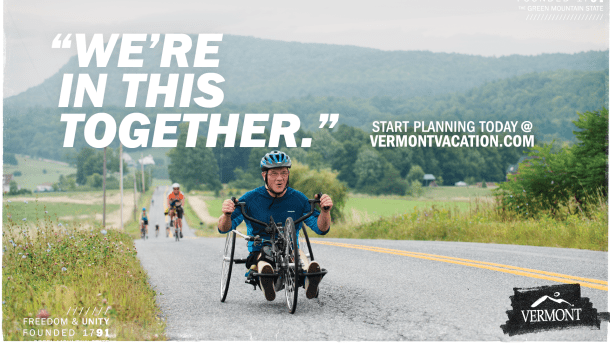
The ads rolling out this year won’t just show able-bodied white people striding across mountaintops. They’ll will also show people with a range of appearances and ways of life.
“The spectrum of physical abilities, ethnicity, skin color, family unit, sexual orientation, etc. … you’ll start to see some of that represented in our advertising campaign moving forward,” Knight said.
Many people view Vermont’s all-white reputation as a possible deterrent to outsiders who are considering a move to the state. At 94.5 percent Caucasian, Vermont is the second-whitest state in the nation after Maine. Meanwhile, the rest of the country is expected to have a non-white majority by 2045. With the Scott administration turning over every stone in an effort to recruit more workers and reverse Vermont’s population decline, non-white outsiders are an important part of the economic picture.
Knight said the summer’s advertising campaign is aimed at making all people feel welcome to Vermont. The theme is “make yourself at home” and Knight said the department is buying photos and scheduling photo shoots “to capture the range of diversity we seek to convey.”
She said she only had one image available to show so far: that of bicyclists on a country road, one of them on an adapted bike powered by arms, not legs.
Beyond advertising, a big part of the department’s overall strategy for building up Vermont’s population is getting people into the state in the first place, in the belief that they’ll like it and decide to put down roots. That’s the theory behind the state’s new Stay to Stay program, which last year recruited visitors from all over the country to spend a weekend of meeting with realtors, employers, local officials, and volunteers in various Vermont communities. That program, which will be repeated this year, did yield several new arrivals.
The key to getting more members of minority groups to visit and stay is to make Vermont more welcoming on a long-term basis, said Tabitha Pohl-Moore, the head of the Rutland NAACP. Highly publicized acts of racism such as the harassment that drove former Rep. Kiah Morris, D-Bennington, out of office don’t help, said Pohl-Moore. Morris’ harasser, a self-described “white nationalist,” wasn’t charged with a crime.
More subtle signs that minorities aren’t welcome, said Pohl-Moore, are things like grocery stores that put hair care products for African Americans in a separate section labeled “ethnic products.”
“It perpetuates the idea of ‘normal,’” Pohl-Moore said. “You are seen as someone who is not part of Vermont.”
Pohl-Moore said Gov. Phil Scott’s administration is working hard to remove obstacles to recruiting newcomers of all types. She said she’s been meeting with the governor this month to talk about ways the administration can work with groups that represent minorities to make state government more inclusive.
“They really do sincerely want to address the issue,” she said. “We can all say we’re pro-diversity, but it’s your actions that matter. He really seems to understand that.”
Other nonprofit and business groups are also getting behind the effort. Curtiss Reed of Brattleboro is a driving force behind the website IamaVermonter.org, which strives to provide help for people of color moving to Vermont. He has some important sponsors, like KeyBank, the City of Burlington, Brattleboro Development Credit Corp., or BDCC, and the Brattleboro Chamber of Commerce.
Alex Beck, a manager at the BDCC whose job is to build up the area’s workforce, said it’s important for people who are hiring to be honest with prospective employees instead of offering vague assurances.
“When they are in an interview, and the person says, ‘What is it like to live here as a person of color?’ instead of the HR person, who is more than likely Caucasian, saying ‘Everything is great,’ instead it’s, ‘I don’t think I’m in the right position to answer that question for you, but we’ve invested in a relationship so there is someone here who can help you with that,’” Beck said.
Reed said research shows tourists are much more likely to visit a new place if they see images of people there who look like them. He’s noticed an effort on the state’s part to do more.
“I have seen over the last two years an increase in the number of folks of color that have appeared in state publications,” he said. “There is a growing consciousness of the need to have a diverse workforce. We cannot ignore that black and brown people are the fastest-growing populations in the United States.”
Readers are likely to see more of that in the future. Knight said this week she’s also reaching out to journalists of color and who are part of the LGBTQ community to visit Vermont, and are planning a press trip in early June for writers to visit the Upper Valley.
Another trip is planned along the Route 7 corridor in the fall for wedding planners and writers.
“These trips will focus on reaching a diverse audience and thus our priority will be inviting journalists of color and LGBTQ writers,” Knight said. “We are being more intentional about inviting a diverse group of writers to visit Vermont.”

