

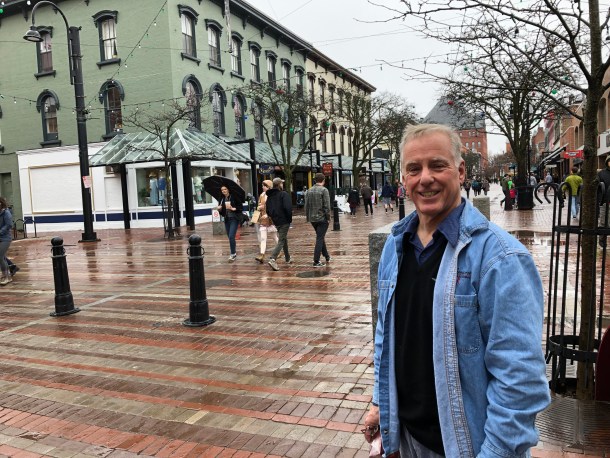
After he competed in and then left the presidential race in 2004, Dean became more of a national than state figure and faded from the Vermont landscape. He served as chairman of the Democratic National Committee between 2005 and 2009, leading Democrats during President George W. Bush’s second term.
In the years since, he’s worked for Denton’s, a Washington-based law firm that bills itself as the world’s largest. He did a regular spot on CNBC for a while. He taught at Hofstra University, and for 10 years, he’s co-taught a foreign policy course at Yale University, his alma mater. He and his wife Judy, who still works as a physician in Shelburne, launched two kids — a daughter, 34, who works as a public defender in the Bronx, and a son, 33, who works in charter schools in the Philadelphia area. Recently Dean took a position on the advisory board at Tilray, a cannabis company in British Columbia where he is receiving stock options as compensation.
And Dean recently signed on for an ambitious new project for Democrats: a data exchange aimed at enabling the party to amass the kind of voter intelligence that he said the Republicans have been using to their advantage for years.
The youthful-seeming former governor, who is 70, is confident there are plenty of experts capable of handling the data itself. He said he’s going to serve as the diplomat who helps groups to work together on a collaborative project that will strengthen them all.
In an interview with VTDigger at Dobra Tea House in Burlington, Dean shared two pots of strong black tea as he reflected on his long career.
His training as a physician, he said, helped him learn how to act decisively instead of waffling.
“In politics there is a reward for not acting,” he said. “The tendency is to push decisions off.” But in medicine, he said, “If you have a problem you fix it now rather than later, because bad things happen when you wait.”
He also feels he has a greater respect for factual evidence than some of his peers in politics because of his early training. Studies led him to change his mind about things like the efficacy of needle exchanges or the legalization of cannabis.
“Facts drive everything,” he said. “What I hate about today’s politics: They don’t care about what facts are. They don’t care about deficits. They’re the biggest deficit spenders in the history of the world. Facts matter. If you’re trained as a scientist, facts matter. You can’t wish someone’s illness away.”
Leveraging voter data
The data exchange, a for-profit entity that will be located, legally speaking, outside the DNC to comply with campaign finance laws, will allow organizations to share their voter lists and details. It’s modeled after the GOP’s Data Trust, an organization that Dean said has enabled the Republicans to leverage data much more skillfully than their Democrat peers.
“It’s too late for everyone to have their own proprietary list, so we’re setting up a mechanism where we can share between lists,” he said. “You only get out what you put in. If you want 10,000 names of pro-choice voters in Wyoming, I can get that.”
Dean’s eager to raise $10 million for the exchange and start getting political groups that gather data on voters to turn over their valuable information in exchange for other peoples’ valuable information. That’s why the Democrats hired him, he said.
“It’s a really political job,” he said. “Data is money, it’s a lot of money, so everybody is suspicious of everybody else. As is the case with many smart people, they all think they know how to do it better than the next person. My job is to get them all to talk to each other, work together and talk to each other.”
It helps that Dean has an unshakeable faith in the wisdom of the young. Dean thinks young people will be the ones who engage Democrats — especially the ones who are traditionally marginalized — to elect the next president. He’s also an adoring father who recounted how his daughter turned to YouTube to install a new pump in her washing machine. To Dean, this anecdote and others like it demonstrate the world of possibilities available to the digitally adept.
“Our party is being taken over by people who are under 40 and they are doing it their way, not our way,” he said. “The younger generation has figured out how to do these things better than we do.”
Hired gun for Denton’s
Dean spends most of his time in Washington, D.C. these days — that’s where his DNC work is based, and that’s where he’s based at Denton’s. He said he spent 188 days outside of the state last year. His annual out-of-state rate peaked at 230 nights, sometime during the last 10 years. He rents the spare bedroom at the home of a friend and her partner whenever he’s in DC.
As an expert for Denton’s, Dean — a physician, not a lawyer — provides political consulting services. He ended up at the global firm after it took over the smaller Atlanta firm where he was previously working.
“I give bad political advice to whomever wants to listen to it,” Dean said.
Along the way, Dean has made good money – enough to help his daughter and friends get two young people she knew in Honduras to the U.S. for some badly needed medical care and an education. One of those Hondurans is now a freshman at Middlebury College; the other is getting a master’s at St. Michael’s College.
“One year I even made seven figures like Bernie, from speaking; that’s where the real money is,” Dean said.
It’s well-known that Sanders is a tricky subject for Dean. The two national figures both got their start in Burlington politics, but that’s where the similarity ends. Dean, a Democrat, was occasionally excoriated by Progressives during his years as chief executive and presidential candidate for opposing marijuana legalization and gay marriage. As governor, he irked some on the left for being a fiscal tightwad, once saying the Legislature’s spending inclinations put them in “la-la land.”
Sanders is rarely criticized for not being far enough to the left, although lately he’s taken some heat for reporting more than $2.7 million in income since 2016 with his wife Jane O’Meara Sanders, most of that from sales of his bestseller “Our Revolution.”
Dean went to some lengths to separate himself from Sanders but credited his rival for shifting the party to the left. Dean endorsed Hillary Clinton in 2016. He won’t be endorsing Sanders this time around either, saying he would support a candidate “who is younger.”
“I’ve had my history with Bernie, but Bernie is saying some things right now that need to be said,” Dean said.
The Democratic Party data cooperative is in its early stages; Dean is still helping with the paperwork to get it incorporated. He wants it up and running as soon as possible.
Every once in a while, he weighs in on the Statehouse discussion, such as switching the governor’s term from two years to four years. He thinks it would be a mistake. He also has strong views on testing for cannabis-caused impairment; he thinks a roadside competence test would free policymakers from trying to come up with a saliva test that showed how much pot had been consumed.
Dean said he thought briefly about running for governor again in Vermont, but decided against it. If he did work with Vermont policymakers again, he said, he’d do things differently. He was more arrogant in the old days, he said.
“When somebody gives you as much power as patients give you, it’s easy to begin to believe your own BS,” he said of being a physician, a profession he left when he became Vermont governor in 1991. “Politicians are subject to that. There were times, more than one occasion, I was so sure I was right and smarter than everyone else I just ran over legislators and people like that. That was stupid.”
That said, Dean would consider working again in Vermont if the right job materialized.
“There’s not a big market for 70-year-olds,” he said. “I’m not besieged by job offers from Vermont.”
Meanwhile, he’s as passionate about the state as ever. His closest friends are the staffers who worked with him in Vermont, including his former chief of staff, Kathy Hoyt, and students he has mentored along the way.
“This is my home, and I’m going to retire here, and I’m never going to leave,” he said. “This is the best-governed state in the country.”

