


[T]he Scott administration has given a tepid response to requiring a warrant for saliva testing of suspected impaired motorists, a compromise supporters of establishing a commercial marijuana market in Vermont hoped would help that legislation cross the finish line this session.
Republican Gov. Phil Scott has said he wouldn’t sign a bill setting up a retail market for marijuana in the state without saliva testing to address roadway safety concerns.
Some prominent backers of legislation setting up retail markets for marijuana sales in the state have said they would support saliva testing, providing police officers first obtain a warrant to administer it.
However, Thomas Anderson, commissioner of the Vermont Department of Public Safety, says he doesn’t believe a warrant provision is needed in the legislation.
And, he added, the question of whether a warrant is required or not is a matter that should be left to the courts to decide, not the Legislature. Right now, he said, case law in Vermont on the issue lacks clarity.
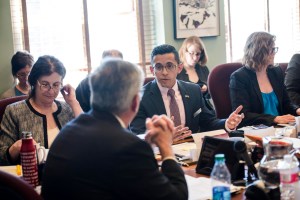
“The only question is whether it should be done with a warrant or without a warrant … that is a legitimate question,” Anderson testified Thursday before the House Judiciary Committee.
“To me, the courts are the ones that are uniquely qualified to make that determination,” the commissioner told the panel, later adding, “I don’t think it’s a political bargaining chip on legislation.”
Scott, speaking at his weekly press conference Thursday, told reporters he wasn’t yet ready to support a warrant provision to allow for saliva testing of suspected impaired motorists.
“I’m not sure about the warrant part,” the governor said. “I’m saying I’m willing to listen.”
If the Legislature did pass legislation allowing saliva testing of motorists suspected of impaired driving, but only with a warrant, Anderson said he would have to think “long and hard” about whether the Department of Public Safety would set up a system to do it at all.
He said with a warrant requirement it might not be worth spending the “hundreds of thousands of dollars” needed to set up a system for saliva testing. He said he can already as for a warrant to obtain a blood test of a suspected impaired driver.
The benefits of a saliva test, Anderson said, like saving the time currently required to obtain a warrant for a blood sample, would be lessened if officers also had to get a warrant for administering a saliva test.
Obtaining a warrant would also push the test back further away in time from when an officer stopped a motorist and began to suspect that person was impaired by a drug, he said. It’s important, Anderson said, to administer the test as close to the time of the stop as possible to prevent a substance from leaving a person’s system.
The House Judiciary Committee is reviewing legislation that could be inserted in S.54, a bill that earlier this year passed the Senate establishing a system for taxing and regulating recreational marijuana in Vermont.
That tax and regulate legislation is currently being debated in the House Government Operations Committee. That panel has referred a saliva testing provision to the House Judiciary Committee for review. The requirement was not included in the version that passed the Senate.
Last year, a saliva testing bill died in the Senate after gaining approval in the House. Opponents of saliva testing say it only detects the presence of a substance, not whether someone is impaired.
Sen. Dick Sears, D-Bennington, chair of the Senate Judiciary Committee, said this week he would be open to saliva testing to gain the governor’s support of a tax and regulated market for marijuana, but only if police had obtain a warrant to administer the test.
“I don’t see any way the Senate would support saliva testing without a search warrant,” he said.
Consideration of legislation to establish a taxed and regulated marijuana market in Vermont this session follows successful efforts last year to pass a bill that legalizes the possession of up to one ounce of pot and the cultivation of a few plants. Scott signed that bill behind closed doors.
In addition to discussion over the requirement of a warrant to administer saliva testing, Anderson faced questioning Thursday from some House Judiciary Committee members over the need for saliva testing when the tests don’t measure a person’s impairment level.

Rep. Nader Hashim, D-Dummerston, a member of the Judiciary Committee and a state trooper, was among the lawmakers challenging his boss, Anderson, over the accuracy of saliva tests.
Rep. Barbara Rachelson, D-Burlington, another committee member, pressed Anderson on the value of the information obtained from saliva testing.
Anderson termed saliva testing as “relevant evidence,” along with other evidence, such as a motorist’s performance on field sobriety exercises and observation of erratic operation of a motor vehicle, of whether a motorist may be impaired by a substance.
“It doesn’t tell you the level of impairment,” he said. “To me that’s not the litmus test.”
Jurors hearing cases involving suspected impaired drivers should have access to the evidence that the presence of a drug was detected on a saliva test, Anderson said.
“More evidence is better than less evidence,” he added.
Rachelson countered that evidence obtained from saliva testing regarding the presence of a substance is more “prejudicial” than relevant to issue of whether a motorist had been impaired behind the wheel of the vehicle.
“Aren’t lots of things possibly relevant that we wouldn’t want law enforcement to be doing and asking,” Rachelson asked.
“We could set up a lie detector on the site,” she said. “We could go to great lengths to use every tool we have, but what’s reasonable?”
Rachelson also said saliva testing raised concerns about racial bias, prompting Anderson to respond that he didn’t see how that was “relevant” to the debate.
The House Judiciary Committee did not vote on saliva testing Thursday, but is expected to take action on it next week.
Xander Landen contributed reporting.
