

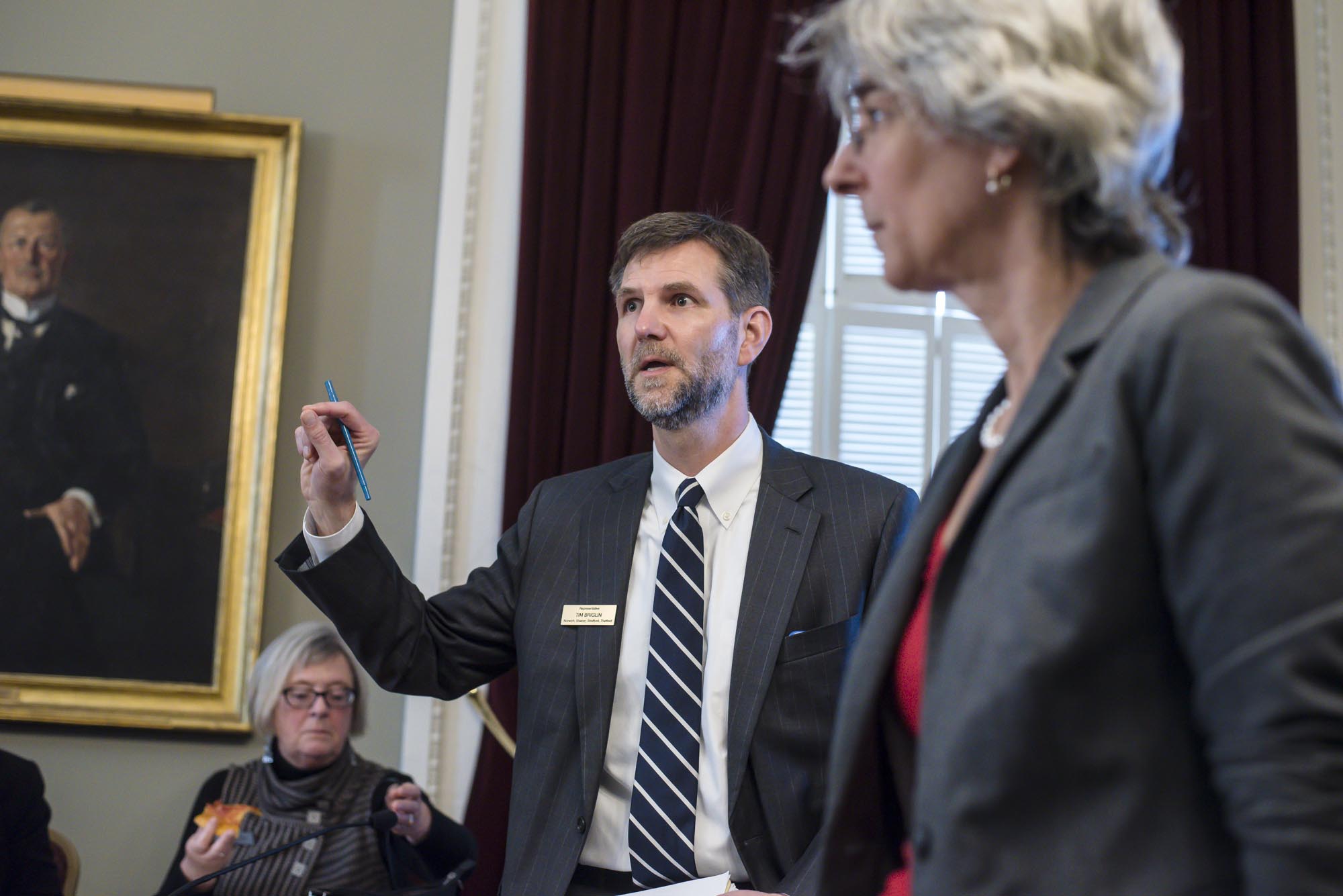
A key House committee heard impassioned testimony Tuesday night both for and against bills that would restrict fossil fuel infrastructure, though the majority of those testifying endorsed a ban on future infrastructure.
While a few people wearing yellow vests testified against the bills, the majority of the 51 people who spoke at the House Energy and Technology Committee public hearing at the Statehouse were in favor of the measures. (The yellow vests alluded to the French grassroots movement that is calling for lower fuel taxes.)
Multiple speakers cited last fall’s report from the Intergovernmental Panel on Climate Change as a reason to ban future infrastructure construction. The IPCC report stated that capping global warming at a 1.5 degrees Celsius increase would require worldwide carbon dioxide emissions to decline 45 percent from 2010 levels in the next 12 years.
The committee took testimony earlier this month from environmental advocates, the natural gas industry and fuel dealers on the bills. Committee Chair Rep. Timothy Briglin, D-Thetford, said the committee may take additional testimony on the bills in the next few weeks, but he does not anticipate voting the bills out this year.
The public hearing comes on the heels of a five-day climate solutions march earlier this month. One bill, H.51, would ban new fossil fuel infrastructure, including pipelines and distribution lines. The aim is to reduce the state’s reliance on fossil fuels and lower greenhouse gas emissions.
The other bills are H.175, which would prohibit utilities from using eminent domain for fossil fuel infrastructure, and H.214, which would require the Public Utility Commission to consider the effects of leakage and groundwater contamination when determining whether to permit a natural gas facility.
Carrie Waiter, a University of Vermont student who lives in Burlington, and other speakers expressed concerns about methane leaks from natural gas fracking.
“How can natural gas possibly be seen as a good investment when methane is the second highest contributor to climate change?” she said.
Dee Gish of Sharon said Vermont is already feeling negative impacts from climate change. Temperatures in Vermont have gone up more than 2 degrees F since the start of the 20th century, while average annual precipitation has increased by almost 6 inches since the 1960s, according to NOAA’s National Centers for Environmental Information.
“This new normal was evident during last week’s rain events that flooded homes and businesses around the state,” said Gish.
Rachel Smolker of Hinesburg spoke of the ongoing Public Utility Commission investigation into the safety of Vermont Gas’ Addison County pipeline, which extends 41 miles from Colchester to Middlebury.
“It is really incorrect to consider fossil fuel infrastructure a public good,” she said.
Rep. Mari Cordes, D-Lincoln, the sponsor of H.175, referred earlier to the bill as the “Nate Palmer bill” after a Monkton man and his wife who successfully convinced Vermont Gas to reroute the Addison County pipeline away from their farm.

Jane Palmer testified Tuesday that although the company may not often actually go through with eminent domain proceedings, the threat of eminent domain is a “powerful weapon” Vermont Gas can use.
“It is like the gas company comes into your house and puts a loaded gun on the table and says they won’t use it unless they have to,” she said.
Opponents of the infrastructure ban questioned whether it was possible for the state to meet its energy needs through renewable energy and weatherization alone. Will Angrer of Johnson said the proposed ban would be disadvantageous to those outside of the western part of the state currently served by Vermont Gas.
JT Dodge of Newbury, founder of No Carbon TAX Vermont, said that as the state’s greenhouse gas emissions are a tiny fraction of the country’s emissions, state action would have little impact on climate change.
“These types of proposals that ban Vermonters fuel choices are regressive and extreme,” he said. “They present false urgency.”

