

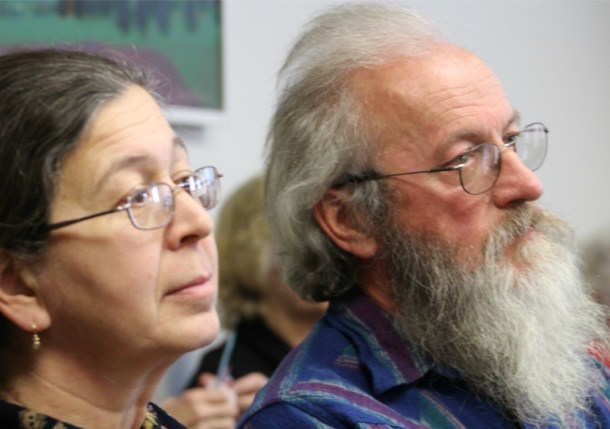
[W]hat a gas company described as a “non-substantial change” has ended a Monkton couple’s three-year battle to prevent a natural gas pipeline to go through their yard.
The change, which has not yet been approved by the Public Service Board, diverts the pipeline around Nathan and Jane Palmer’s property. Company representatives told the regulatory body that it didn’t substantially alter the project.
“For three years, they’ve been saying the only way through is through the middle of our farm,” Nathan said. “They’ve always said to route it around our property would be a monumental task.”
“They made it sound like it’s a big deal, and they’d have to go to the board and reopen the [certificate of public good], and now they’re saying it’s a non-substantial task. They put us through hell,” he said.
Vermont Gas would have buried the pipeline, which will extend natural gas from Colchester to Addison County. The pipeline originally would have been 100 feet from the foundation of the Palmers’ home.
To lay it, along the pipeline’s length, contractors strip vegetation from a 75-foot-wide swath before excavating a five-foot-wide, five-foot-deep trench, Nathan said.
That would unearth, right outside the house, the property’s best land – two acres where the Palmers have for 20 years cultivated their food. An agronomist from the University of Vermont testified to the PSB that the soil would take at least a decade to recover, Jane said.
“You look at the route they picked through our property,” Nathan said, “I looked at it and said, ‘Who did I piss off at Vermont Gas?’”
To allow the pipeline through, they were offered a pittance in return, Nathan said, approximately $3,500.

Just outside their house, marshy meadowland sweeps across the broad valley floor to the next hillside. The Palmers own this land, and years ago placed it a program that restricts development.
“This marsh is what drew us to the farm, because it’s a beautiful part of the world, and the ecosystem is just incredible,” Jane said. “So we’ve always felt protective of it.”
The conservation easement covers everything up to 200 feet from their home, she said.
“We wanted to put as much in [the easement] as we could,” she said.
That’s why engineers wanted to route the pipeline so close to their house, Jane said. Any further from the house would have encroached upon the conservation easement.
The utility did offer to purchase the home, but the $200,000 offered for the 77-acre property abutting Chittenden County’s border would have been about a quarter of what the Palmers said they would need to buy anything comparable in the area.
Plus, Nathan said, he didn’t want to leave the area.
“I’ve been here all my life,” he said. “Eight miles from where I was born – I’ve made it a long way in life.”
Company representatives told the Palmers they’d resort to eminent domain if the two didn’t cooperate, Nathan said.
“That’s what we’ve been living under,” Jane said.
Without referring to the Palmers specifically, a Vermont Gas spokeswoman said that last December the company underwent a “reset” that addressed concerns the Palmers raised.
“Included in that reset,” said spokeswoman Beth Parent, was the company’s “considering eminent domain as a last resort, working closely and respectfully with landowners, offering neutral third-party mediation at our expense, assisting landowners with their costs by offering them a stipend and agreeing to a model easement drafted by a national expert attorney picked by a group of Vermont landowners.”
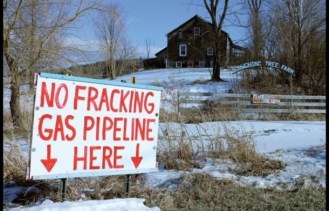
“As of today,” Parent said, “we have reached agreements with 160 out of 164 landowners along the route. We understand that the process isn’t easy. We are deeply appreciative of their time and effort to reach a resolution. We are also committed to working with the four remaining landowners who are interested in reaching an agreement.”
In addition to fighting landowners, the project has also been controversial because of its costs. In 2014, company officials projected the cost had gone from $86 million to $154 million and state regulators are reviewing the permit for the project.
As the fight went on, Nathan said he was sure someone at the state would help.
“We kept thinking, somebody’s going to come here and see this, and say, ‘this is crazy, we can’t do this,’” he said.
Although Nathan’s an auto mechanic, the Palmers don’t use much fossil fuel themselves. For the last 12 years they’ve heated their home with wood pellets made from willows raised on the property. In a still near the house, Nathan makes the alcohol on which he runs his tractors. The two drive a Prius when they go into town.
The couple doesn’t understand why politicians are supporting the gas pipeline and not pushing for more renewable energy projects.
“We thought we’d just have to show the state this is not a good idea, we have to bring out the points they’re not thinking about, and they’ll see,” she said. “Silly us.”
The governor’s office declined to offer assistance, they said.
“If you listen to the news reports from the governor,” Nathan said, “you listen to him and you think, ‘God, he’s good – I wish he was my governor,’ and then you realize: He is my governor.”
Feeling as though “everybody was out to get us, and nobody was helping us” and lacking the funds to hire an attorney, the pair spent thousands of hours over the last three years fighting for their property, Jane said.
The process before the PSB, Jane said, “that was like four hours a day we had to read and write responses, there were deadlines coming up all the time – neither one of us are college-educated, and Nate reads really slowly, so it takes him a long time to read through this stuff. It was dragging us down.”
They can sympathize with their neighbors who didn’t hold out, but the couple said they had to put up a fight. The experience, Jane said, has changed them.
“I used to be scared to death to talk in front of more than two or three people at a time,” Jane said. “I would elbow Nate, and say, ‘Hey, say this, say this.’ And then, he just couldn’t do it all, or he wasn’t around, or he was working, so I just started speaking out for myself, and it was like, ‘Holy cow, I can do this.’ I can speak my mind, and people want to hear it. I have people come up to me and say, ‘Wow, thank you, keep fighting.’”
Last summer, the antipipeline group Just Power crowdfunded $20,000 to hire an attorney, David Grayck. That’s when things started to change, Nathan said. Without a lawyer, he said, the couple was ignored.
“Until somebody pushes back with some money and legal power, they’ll just do whatever they want to do,” he said.
The couple feels the Department of Public Service, which represents ratepayers, is tilted too far toward corporations and with the governor supporting the project “why bother having the [hearing] process if they knew they’d push this thing through?”
“The way this whole thing goes now,” he said, “for the landowners, it’s like, ‘My God, they’re taking it from me with the government’s permission!’”
Just beyond Hinesburg, past apple orchards and alfalfa fields, above a bend in the unpaved Rotax Road, their modest home sits on a rise overlooking the meadowed valley. Several new houses incongruous with the pastoral scene spot the landscape, but this one looks like a farm house.
On a recent Friday morning, dressed in a mechanic’s coveralls, tall and gray-bearded, Nathan Palmer stood inside the home’s small kitchen, while the window behind him framed a verdurous field glowing in the rising sun.
He says he’s relieved, but glancing at his wife next to him, also wary.
“I’d like to think we’re at the end of it, but I don’t know,” he said.
Jane, nursing a glass of water, agreed.
“Every time we think we’re at the end of it – well,” she said, “we thought we were at the end of it in 2013, and here we are.”
Corrections, Dec. 13, 5:35 p.m.: The PSB has not yet approved the rerouting of the pipeline, as was first stated in this story. Also, it was the group Just Power that crowdsourced funds for an attorney, not the Palmers.
