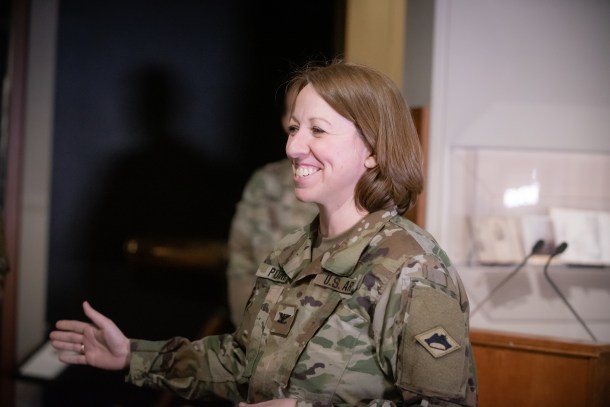
[N]ORTHFIELD — After serving active duty in the Marine Corps for eight years, and then taking time off to raise four then-toddlers, Col. Tracey Poirier came back to her National Guard roots in 2006 simply because she was looking for some “adult” time. Now, she’s the first female commander of the 124th Regiment Regional Training Institute, and the sixth female colonel in the history of the Vermont Army National Guard.
“She’s aligned for this position, she’s worked hard to get here, has the professional acumen, the expertise,” said Col. Gregory Knight, the Adjutant General, at the change of command ceremony Sunday.
Poirier, 44 of Barre, said she expected leaving active duty to be a relief, but after a few years without it, she found herself really missing service.
“It’s that sort of feeling of, I call it patriotism, which sounds a little kooky, but it is,” Poirier said. “You see the commercials where they’re talking about soldiers, and you see the recruiting commercials, and you’re like, ‘I used to do that’ and so you feel like you just have to get back into it.”
Sitting in her office at Norwich University, where she works as the vice president for student affairs, Poirier said that though the National Guard job is part time, it often feels like she has two full-time jobs. But, she said, the two jobs aren’t really all that different — they’re both about administering education.
At the Regional Training Institute, Poirier oversees three main areas of education: Army mountain warfare, information operations, and general military education.
Army mountain warfare, she said, is a very physical education, teaching soldiers about conducting military operations in a mountain environment, including climbing and medical evacuations on mountain faces.
Information operations, meanwhile, is more academically-oriented, Poirier said, dealing largely with computer systems. She said it’s all about the information that comes out of military intelligence, and how to use it to the best advantage of the United States.
The third area — general military education — focuses on teaching leadership skills to help soldiers progress through ranks, she said.
“The good part is that the RTI is in really good shape so I’m not being handed something that’s in trouble and I have to fix anything,” Poirier said. “But it doesn’t mean that there’s not still work to do.”
She said one goal is convincing the U.S. Army to let them train even more soldiers in mountain warfare, and to ensure those skills stay relevant in the modern day. Even though mountain warfare peaked in popularity in World War II, she said it’s still an important skill, noting Afghanistan as a place where mountain warfare skills were needed in the modern times.
“We want to make sure that it’s not just us — that we have a wider range of soldiers across the breadth of the United States Army who are also prepared for that sort of thing,” Poirier said. “It’s also a really good school. And it’s fun.”
In response to recent allegations of sexual misconduct in the Guard, Poirier said she does not see a culture problem. In her experience, she said the Vermont Guard had one of the best environments for female soldiers.
“The Vermont National Guard is by far one of the most accommodating from what I’ve experienced,” Poirier said. “My narrative is definitely not one of having come from some sort of negative past.”
She wants women to see that there are opportunities for them in the Guard. She said people always talk about diversity, equity and inclusion — and that those problems almost always stem from access and opportunity. In the Vermont National Guard, she said there is access to opportunity.
“We still have to grow the leaders, because it takes time to grow older — you can’t just instantly be an infantry commander,” Poirier said. “But we actually have really good access and opportunity for women, and all minorities actually.”
Poirier said society doesn’t value the military experience in the same way for young women that it does for young men. But she said the benefits — like free college tuition — are something she wants young women to see as options for them.
“That’s why I went [to Norwich] in in the first place — I was looking for a way to pay for college,” Poirier said. “And look where I am now.”
Correction: A previous version of this story incorrectly stated that Poirier served eight years of active duty in Iraq. Poirier served eight years active duty in the Marine Corps, and recently returned from a deployment in Iraq.