


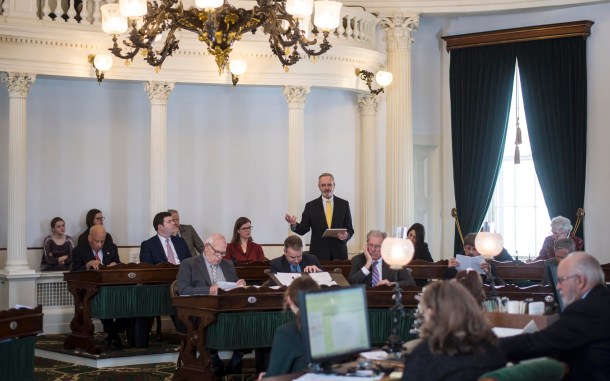
[T]he Senate has finally passed a bill that would change how clean water work is funded throughout the state, despite concerns that it sidesteps the question of funding and delegates the state’s responsibility for achieving clean water mandates.
Senators approved the bill, S.96, unanimously on Tuesday, but it received enough pushback last week to delay the vote.
Vermont has been dealing with water quality challenges for decades. In 2015, the state passed Act 64, which included new regulations and other changes to ramp up water quality efforts. In the past three years, the state has spent just shy of $100 million — with a quarter of that loans — on 1,901 projects, according to the Clean Water Initiative Program.
Sen. Chris Bray, D-Addison, chair of the Natural Resources and Energy Committee, told senators last Wednesday that the Agency of Natural Resources cannot oversee all of the clean water projects underway without major staff increases. And the state already works with partners — ranging from conservation districts to watershed groups to regional planning commissions — to carry out water quality projects around Vermont, he added.
The Scott administration and Bray’s committee have been working on a plan this session to pass money through regional entities doing clean water work who would select projects to fund in their watersheds. The boundaries for the districts would be the watershed basins that the agency already uses for water quality planning.
Different areas have different needs. Excess phosphorus is the main cause of the cyanobacteria blooms in Lake Champlain, Lake Carmi and other water bodies. The EPA has ordered that the surrounding watersheds lower phosphorus pollution coming into the lakes. The eastern half of the state must lower nitrogen in runoff going into the Connecticut River to improve water quality in Long Island Sound.
Under S.96, the state would continue to manage legally mandated programs, like required agricultural practices and stormwater permits. The regional entities would now be in charge of selecting and dishing out state money for other projects, such as ecosystem restoration, that account for 40 percent of the pollutant reductions Vermont needs to achieve.
Multiple senators questioned whether the plan would shift responsibility away from Montpelier, which is supposed to take the lead in cleaning up polluted waters.
“I feel a little like we’re punting some of the state obligation, but maybe we’re partnering in the true sense,” Sen. Chris Pearson, P/D-Chittenden, said last Wednesday.
ANR would set pollution reduction targets for each basin as part of S.96. Sen. Joe Benning, R-Caledonia, asked Bray on Friday what happens if basins do not meet those targets.
Bray said the bill enables the state to take actions to hold the regional entities accountable.
“We as a state still remain the ultimate defendant of any action, as I understand, and … we are designating sub-entities of state government as being on the hook as opposed to the state,” Benning responded.

Senate President Pro Tem Tim Ashe, D/P-Chittenden, said he wanted to be “crystal clear” that “the buck will continue to stop with the state of Vermont” to meet the pollution reduction orders.
The bill originally contained a per parcel fee on agricultural land to help fund clean water work, which was stripped out before it got to the floor — something remarked on by multiple senators when it came to the floor.
“I would just feel a lot more comfortable (about) this bill … if it actually had an assessment to fund clean water programs,” said Sen. Anthony Pollina, P/D-Washington.
The bill passed with a recommendation from the Senate Appropriations Committee that the state come up with $50-60 million annually for clean water funding. The Senate just received the budget bill from the House this week.
The Scott administration’s 2020 budget called for $48 million in clean water money, with over $19 million of that coming from the federal government. The state has largely relied on the capital bill for its share of clean water money — something both the administration and lawmakers say is not sustainable in the long run.
The governor has proposed using revenues from the estate tax — $8 million next year and as much as $13 million in years to come — to meet the clean water funding gap. In addition, Scott would step up the amount coming from the property transfer tax.
Although Democratic lawmakers have questioned the governor’s proposal to redirect existing money for water quality work, they have yet to settle on a proposal of their own.
Ashe told senators Friday that it was too soon to expect the funding question to be answered, as the Senate is just getting started on writing its budget proposal.
“In my opinion, the primary objective is cleaning up the lake and waterways,” Ashe said. “So it’s premature at this time to talk about missing money and all the other stuff.”
Correction: An earlier version of this article reflected the number of ongoing clean water projects, not the total number funded.
