


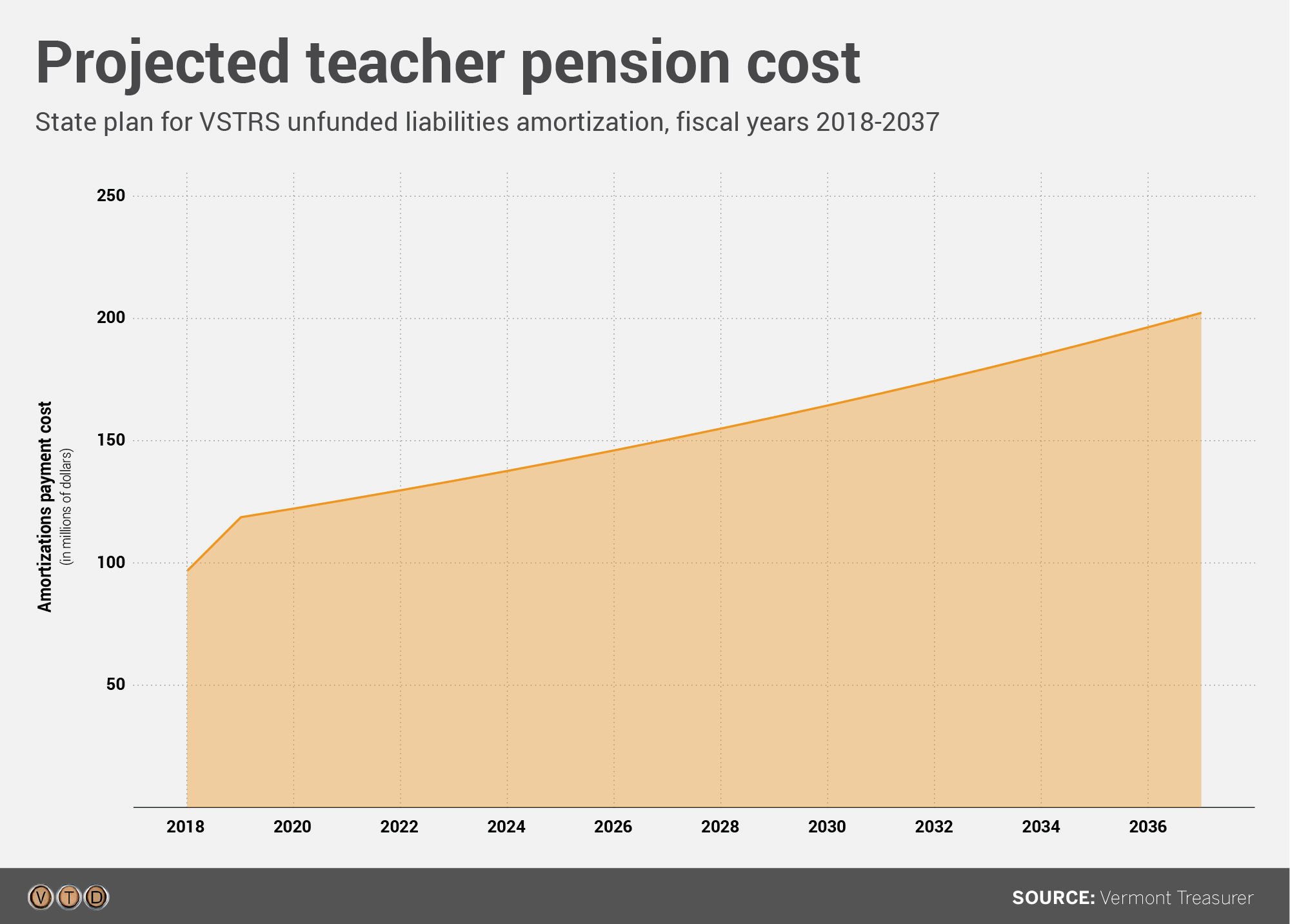
Senate Appropriations Chair Jane Kitchel reminded fellow senators again and again on Friday: the state can’t afford to expand services in the way lawmakers want to, largely because it is on the hook for $122 million for a profoundly unsexy budget item: retired teacher pension liabilities.
“It is terrible,” Kitchel, D-Caledonia, said Friday afternoon. “And people have no idea that off the top that much money just has to go to pay our obligation. It’s a contractual obligation.”
Vermont’s unfunded teacher pension payments emerged last year as a Democratic spending priority in end-of-session negotiations with Gov. Phil Scott. Finance Commissioner Adam Greshin warned ahead of this session that the pensions would quickly consume the fruits of a strong economy.
“For all this new revenue coming in, all of it, and more, is already spoken for,” Greshin told legislators in November.
The pension debt has accrued over the past three decades due to a combination of underfunding the state’s obligations, investment projections falling short and costs of pensions growing.
Kitchel is now preparing policy committees, who have spent the past two months devising new programs in their sectors, for disappointment as the appropriations committee decides what happens this year and what gets kicked down the road.
“I hope you’ve got a sense of how painful it’s going to be,” she said in an interview. “Because every policy committee is seeing what their needs within their policy area are,” and yet “we can’t fund some of our core services.”
Among programs and sectors facing financial strain are Reach Up benefits for hard-up families; residential care for seniors and mental health services across the state.
Some of the new priorities being discussed in the Legislature are weatherization for aging homes, more electric vehicle subsidies, workforce recruitment and training, dental care support and community services for recently released prisoners.
Kitchel’s committee stripped appropriations language from policy bills Thursday and Friday as it prepares to start sorting through the budget coming out of the House this week.
“Parent child centers have requested an increase and mental health services are still struggling with their salaries, and the list goes on,” she said. “And that’s going to be the hard part here because we have to kind of sort it all out.”
One area where the House, Senate and governor have agreed to increase spending this year is on clean water initiatives. Whether that money will come from the general fund or a specialized fund — and corresponding tax or fee — is unclear.

Senate Appropriations approved on Friday a $50 million to $60 million annual appropriation for clean water, adjusted for inflation. It will be up to the House to figure out where the money will come from.
The House budget includes a handful of significant boosts using the limited revenue that is available due to an increase in revenue.
The budget, much of which will be changed in the Senate, allocates $8 million in new child care subsidies, invests $3 million into the Vermont State Colleges to remove the need for a 3 percent tuition increase, and funds 22 new case aides in the Department for Children and Families, which has seen increased pressure from factors including the opioid crisis.
Rep. Kitty Toll, D-Danville, chair of the House Appropriations Committee, said the budgeting process is only going to get more difficult next year, as the economy is expected to cool down.
Fiscal analysts estimate that revenues will come in flat next year, as expenses increase. The teachers pension payment alone is projected to increase to $126 million in next year’s budget.
Toll said budget writers will face a $40-60 million funding gap — as opposed to the surplus they have enjoyed in recent years. “It makes it difficult next year,” she said, “we’ll have some difficult choices.”
Additional reporting by Xander Landen.

