

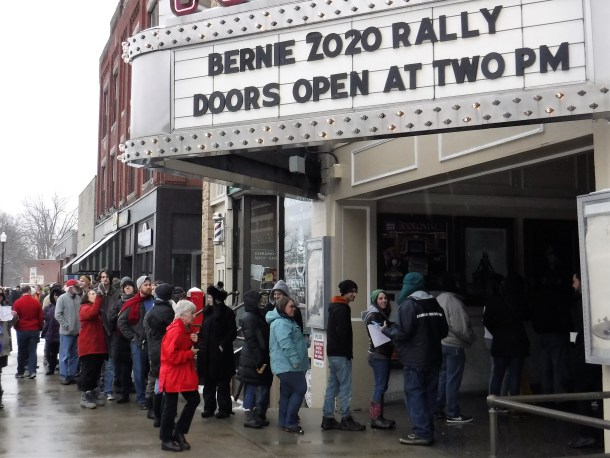
[C]limate change, workers’ rights and campaign finance reform — while Democratic presidential hopefuls pitch their ideas for tackling these issues out on the stump, some are trying to tackle them inside their campaigns, as well.
In the crowded Democratic field, 2020 presidential hopefuls, including Sen. Bernie Sanders, are trying to set themselves apart by showing their mettle in how they run their campaigns, embracing diversity, a $15 minimum wage and more.
Last week, the Vermont senator became the first primary candidate to vow to offset all carbon emissions from travel associated with the campaign, repeating a practice he used in 2016 and during his 2018 Senate run.
The previous week, the Sanders team said its workforce would unionize, making it the first major party campaign in the country’s history to do so.
Another internal campaign management announcement — his staffing line-up — underscored that Sanders is trying to incorporate more diversity into his team than the last time he ran for the White House, as campaign manager Faiz Shakir acknowledged in a phone interview Friday.
“Sen. Sanders has said that, you know, last time one of the lessons he learned was the campaign was too white and too male,” Shakir said. “I think it’s fair to say that he wanted to do things differently this time.”
Lack of diversity within Sanders’ 2016 campaign was a point of criticism in the Vermont senator’s last presidential run, when he failed to connect with minority voters. Sanders also apologized earlier this year after former campaign staffers raised issues over a culture of sexism on the trail in 2016.
Retired Middlebury College political science professor Eric Davis said through the campaign management decisions, Sanders is trying to prove himself.
“He’s trying to say, I don’t just talk the talk, but I walk the walk, too,” Davis said.
As to how much sway the internal management of campaigns will have with voters, Davis expects it will be overshadowed as voters consider candidates’ stands on policy proposals. While Sanders garnered some praise from labor leaders for the staff unionization, for instance, Davis anticipates policy ideas on addressing income inequality will hold more sway.
“I don’t think it matters all that much,” he said.
Sanders isn’t the only 2020 hopeful incorporating his campaign trail policies into his campaign management. Increasing diversity in staffing has been a major concern. Among the Democratic candidates — themselves the most diverse field in history — there’s been a marked effort to hire people of color and women for top campaign jobs.
Former San Antonio Mayor Julian Castro, who supports raising the minimum wage, has vowed to pay all campaign staff, including interns, $15 per hour. Sen. Elizabeth Warren, D-Mass., an outspoken campaign finance critic, will not hold any fundraiser or phone calls with wealthy donors.
Dartmouth College government professor Linda Fowler said she believes the campaign management efforts are part of an effort to address the “difficulties candidates face in differentiating themselves in such a crowded field.”
George Washington University professor Todd Belt said putting into practice in their campaign the issues they talk about on the trail could help them appeal to Democratic primary voters who are looking to support candidates who do what they say.
“The primary candidates are really trying to exercise their bona fides with the electorate,” Belt said.
Belt expects to see more, similar management actions by candidates, especially after they saw the attention the Sanders campaign received by announcing initiatives like staff unionization. More carbon offsetting, commitments to biodiesel campaign buses, even potentially, family leave plans could be on the horizon for presidential campaigns.
“I think they’re going to continue down this path because I think that they’re going to see that they’ll be able to make news and get free publicity out of these sort of actions,” Belt said.
Gina Ottoboni, who ran as a Democrat for a Vermont House seat last year, said the efforts by the campaigns are important and a “sign of leadership.”
“I think these things do matter,” Ottoboni said. “They are signs of commitment to principle, a way of stepping up and investing in what one says.”
But other Vermont Democrats feel that the way candidates run their campaigns isn’t a big deal to many voters.
“I really think that that’s not something that most people pay attention to,” Jack McCullough, a member of the Democratic Party in Montpelier, said.
However, McCullough said, in this cycle’s unusually packed field, it could be one way for candidates to stand out.
“There are so many candidates that everybody is looking for a way to distinguish themselves from the crowd,” he said.
Shakir insists that appealing to supporters is not driving the initiatives.
“It’s not that we were trying to win votes by unionizing, it wasn’t that we were trying to win votes by doing carbon offsets or by diversifying our campaign,” he said. “The reason we undertook those efforts is because we wanted to engage in the campaign that was a strong campaign and also reflects the values of Sen. Sanders.”
