

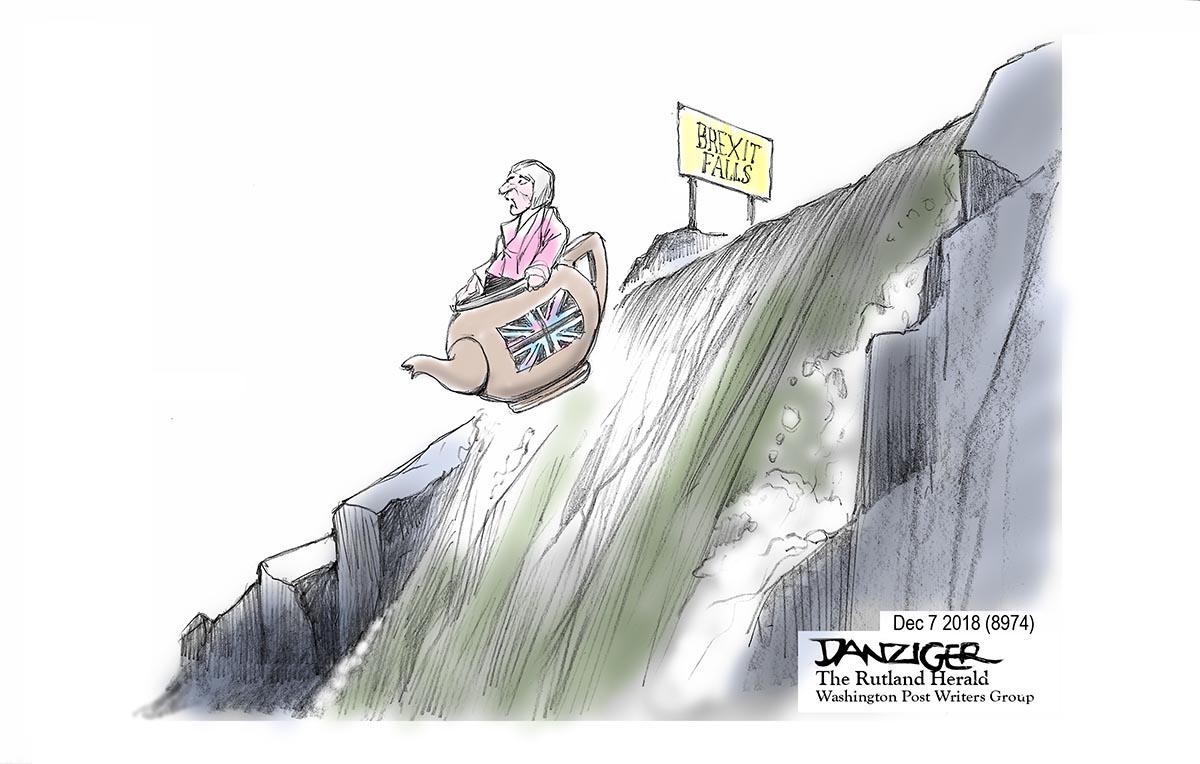
[P]enelope Wurr is already starting to see shifts in how British companies are operating in the international market. The Brattleboro glass artist and purveyor stocks unique goods she tracks down in Europe and the United Kingdom.
But now, with Brexit looming, U.K. companies seem to increasingly be interested in getting into the American market themselves — a shift that could impact Wurr’s Vermont business.
“I have noticed already that there has been a lot more interest from British companies to sell in the U.S. and open up to that market in case they European market is less strong or too complicated,” Wurr wrote in an email.
The tumult surrounding Brexit is sending ripples into the global economy. As leaders in the United Kingdom and Europe fumble through their divorce, some Vermonters are watching, aware that the outcome may impact them, but unclear precisely what the effect might be.
Three years after U.K. voters decided to leave the European Union, the country was set to separate from the economic bloc on March 29. But after years of haggling over a plan for the United Kingdom to decouple from Europe, the deal Prime Minister Theresa May negotiated flopped in Parliament. MPs voted it down by historic margins twice, most recently last week.
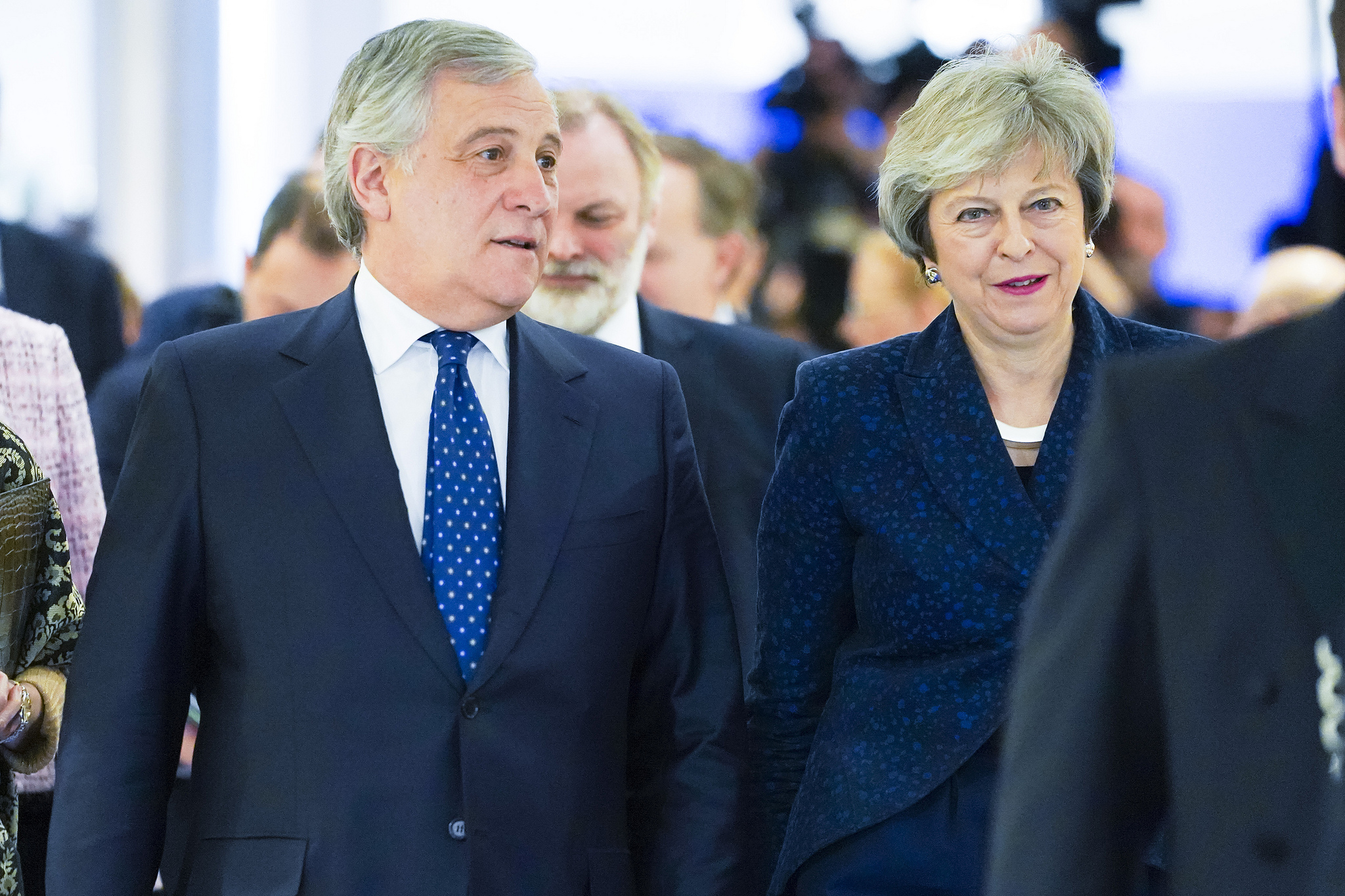
After May’s deal failed a second time, British leaders sought to delay the departure date by three months. European Union leaders agreed to a shorter extension, the length of which depends on whether Parliament will agree to May’s deal in the coming weeks. If the deal passes, U.K. withdrawal will be delayed until May 22. If it doesn’t, the U.K. has until April 12 to figure out a next course of action.
The U.K. is now seeking to postpone the departure date by three months, but it must be approved by the European Union. Without consent from the EU, the Brits could be poised to crash out with no deal in just over a week.
Kristina Sargent, an assistant professor of economics at Middlebury College, noted the talks are not just about the future of the United Kingdom.
“This is a two-sided negotiation where it’s not just what’s happening in the U.K., but it’s also really up to the E.U. to agree to this as well,” Sargent said. “The biggest goal of negotiations is to minimize the loss.”
Sargent said the events surrounding Brexit have the potential to shake up international economic dynamics in ways that will resonate in the United States, including in Vermont.
So far, Sargent said the biggest effect has been a decline in investment, noting that the United Kingdom is the “biggest single investor” in the United States. The trend of lower investment in American companies could lead to U.S. companies hiring fewer workers. It remains to be seen, however, whether the decline in investment is temporary — as investments are being postponed — or if they are being canceled.
Amid the uncertainty in Europe and Britain, the U.S. could be in a strategic position. There’s opportunity for American businesses competing with those across the Atlantic to take advantage of the chaos. The United States could also act as a force for global economic stability by moving to strengthen trans-Atlantic ties, she said.

David Blanchflower, a Dartmouth College economics professor and a former member of the Bank of England’s Monetary Policy Committee, views Brexit as “a broad international story” that provides insights into the political implications of slow economic recoveries.
Blanchflower links British voters’ support of Brexit in 2016 to a global wave of populism that emerged amid the slow economic recovery and widening inequality following the financial crisis of 2008.

With Brexit, Blanchflower said, leaders made promises they weren’t able to deliver.
“Essentially we have no credible government in the U.K.,” said Blanchflower, who described the situation in Parliament as “literally absolute total chaos.”
Similar political backlash is resonating worldwide, including in the United States, Europe and elsewhere.
“There are big implications for everybody about, you know, credibility of governments and what happens when you have long painful recoveries, and big recessions,” Blanchflower said.
The uncertainty around what the likely outcome of Brexit will be has left some in Vermont, like Wurr, questioning whether it will alter elements of how they do business.
Wurr, the Brattleboro shop owner, said British products are increasingly coming through U.S. distributors, who charge higher prices — a disadvantage for her, she said.
“I was able to purchase product in the UK at the UK wholesale price which is often considerably cheaper than a landed US price,” she wrote in an email.
A U.K. passport-holder, Wurr travels through Europe to purchase items she sells in her Brattleboro store. Now, she has easy passage, without having to show her documents.
“That may change if Brexit (happens),” she said.

Importing products for her shop has been fairly easy. Currently, it’s fairly hassle free to ship from the European Union, but she wonders if that will change too.
However, Wurr said Brexit is one of many changes that she must adapt to as a retailer.
“Every year, retail is bombarded with a whole bunch of new challenges, Brexit is just one of them,” Wurr said. “The need to be innovative and fresh in this new online market is a constant dilemma.”
The United Kingdom is Vermont’s ninth-largest export market. About $80 million worth of goods was exported from the state to the United Kingdom in 2017.

Though it appears to be a big number, University of Vermont associate professor of economics Art Woolf noted that it’s a rather small portion of the state’s total exports. In 2017, the U.K. received 2.9 percent of the $2.8 billion the state exported that year.
Vermont businesses in industries including maple and manufacturing contacted for this article said they don’t expect Brexit will have a direct impact. But changes in the global economy related to Brexit might have an effect on them.
Collins Aerospace, an international aviation technology company which has a manufacturing facility in Vergennes, said in a statement that they are watching the situation in Europe and the U.K.
“We are closely monitoring negotiations between the United Kingdom and the European Union and are taking steps to ensure business continuity across all of UTC’s business units through a ‘hard’ or ‘soft; Brexit,” spokesperson Robert Edelson said.
Brexit could bring changes to the global economy, and those shifts “filter down” to the Green Mountains, Woolf said. The world economy is not doing as well as it was half a year ago, he said. “The Brexit thing is just adding to the uncertainty and the possibility that the word economy is not going to do as well as people thought.”
One factor to watch will be the value of the pound and the Euro against the dollar.
If the pound and Euro decline in value, it could be a hit to Vermont exporters, making it more expensive for them to sell abroad.
It also could have implications for the tourism industry. If the pound loses strength against the dollar, it would be pricier for British tourists to come to the United States and Vermont, Woolf said. But conversely, it would lower the price tag for Americans on vacations to the United Kingdom and Europe.
“They’re putting a summer vacation on sale,” he said.
Country Walkers, a Vermont-based tour organizing company, hasn’t had any inquiries or concerns about Brexit. President Timo Shaw said they’re not expecting any immediate impact.
“It’s very quiet,” he said, noting they have not had inquiries from customers.
However, another company, Milne Travel, with outposts in Vermont and around the Northeast, has been getting questions about whether Brexit will impact travel plans, according to company president Scott Milne.
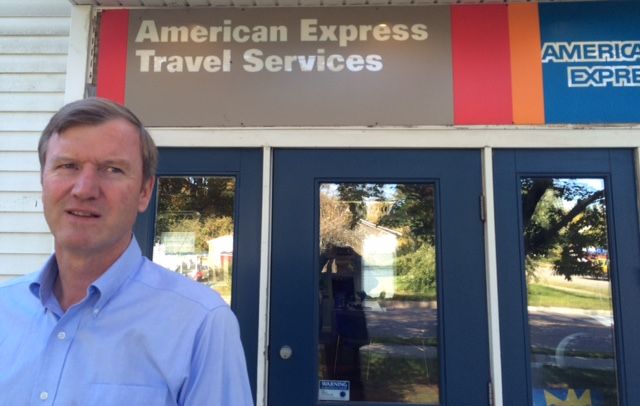
Milne doesn’t anticipate any immediate dramatic changes to travel between the United States and the United Kingdom.
“We don’t want to just stick our heads in the sand and say don’t worry, but there’s still an awful lot of unknowns,” Milne said.
The sudden cancelation of flights in case of a hard Brexit, as has been speculated, is unlikely, he said. Travel-wise, a “worst case” might be a new tourism visa requirement to enter the UK, but those would likely be low-level and easy to get for U.S. citizens, he said.
The bigger concerns, Milne said, go beyond tourism and the travel industry. In the meantime, Milne Travel will keep an eye on the situation.
“It’s just sort of one of these things, let’s just see out it turns out,” he said. “What you want is to make sure you’re not ambushed by not paying attention to changes.”
