


[S]outh Burlington officials are heading back to the drawing board to find funding sources for two major projects after voters rejected an increase in the local option tax.
City leaders were eyeing a 1 percent increase in the local option tax to pay for infrastructure projects, including the construction of an indoor athletics facility and an arts center. But 56 percent of voters opposed the increase, which would have brought the total sales tax to 8 percent.
City officials want to avoid raising the property tax to fund the projects. Private donations, commercial partnerships, regional partnerships or going back to voters with a local option tax increase tied to a specific project are other possible funding sources.
Kevin Dorn, South Burlington’s city manager, said the vote was more reflective on the funding source — the local option tax — than any particular project, especially because no projects were named in the ballot language.
“The voters did not want to have an additional 1 percent on the local option tax that was not tied to a specific project,” Dorn said. “It doesn’t mean the project or projects themselves are dead, it’s just that the voters didn’t approve this funding mechanism.”
The indoor recreation center would be built at Veterans Memorial Park and feature four high school basketball-sixed courts, one of which would be a turf field reserved for soccer, lacrosse and field hockey. It would also include offices for the city’s Recreation & Parks department and an indoor walking track.
The city arts center would be part of South Burlington’s developing downtown. The center would include a 500-600 seat performance space, a 150-seat black box studio and arts education studios.
The city also could have used funds from the local option tax increase to fund the construction of a pedestrian bridge over I-89.
Longtime South Burlington resident Annelise Koenig voted against the local option tax increase.
“There has to be another way of finding the money,” she said.
Helen Riehle, the chair of South Burlington city council, said it’s possible that the public is not interested in using a local option tax increase to fund any project. But it’s also possible that the voters just wanted more clarity on what a project would look like and how much it would cost before approving a funding source for it.
“We certainly need to do more work on both projects before we’ll bring them to the voters again,” she said.
The city could pay for the projects by increasing property taxes or tapping into other city funding streams. But Meaghan Emery, the city council’s vice chair, said that because she believes the projects would have regional benefits, she hoped the city could find a regional funding model.
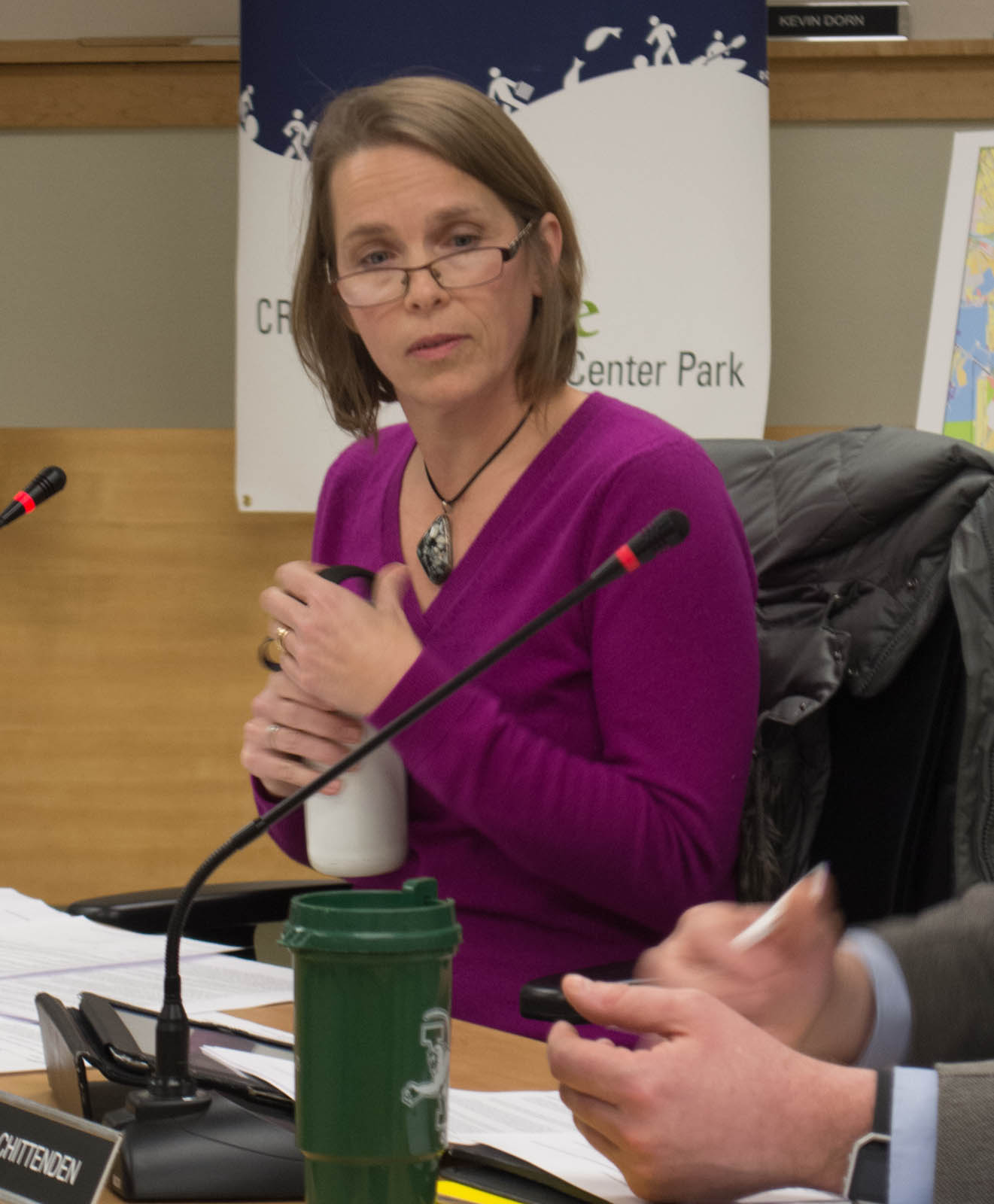
“I don’t know of any other funding mechanism that allows us to access a broader population, the population that comes here either to use our services or be entertained, these things that were really identified as the impetus behind the two projects,” she said.
The city could institute user fees for the facilities to help fund them and accept donations from private donors, Emery said. But she sees funding through a regional partnership as the most attractive option.
“My belief is that South Burlington should not be the one source,” she said. “I’m really going to … ask the question, ‘How can we make these regional initiatives, rather than just singular?’”
Tim Barden, the managing director of Spotlight Vermont, is the executive director of South Burlington City Center for the Arts, a nonprofit pushing for the project.
He said that after the Town Meeting Day vote, the group would be focusing on pursuing a regional funding model and increasing its pursuit of private donations and commercial partnerships.
“We’re not going to be looking at this point at the city being a major player, major supporter financially,” he said.
Barden said he felt the vote on the local option tax was a missed opportunity, as the center would bring economic benefits to the region.
“If we had a very forward-thinking philanthropist … we could probably get it done in a couple of years, but at this point it’s about identifying the money to get the place built,” he said.
Dorn said that the city could go back to voters to ask if they would approve a local option tax increase for a specific project.
He said that the city is hesitant to use a property tax increase to fund the projects, as property taxes are the only funding source available for the school district.
Riehle said the city needs to be sensitive about residents’ capacity to take on more taxes. She said that she wasn’t sure what a timeline would look like for either project.
Both those pushing for the indoor recreation center and the city arts center are planning on continuing to work on their projects, Riehle said.
“There is certainly continued interest with both groups to really continue with more clarity about their design, what it might cost, and make that case,” she said.
Dorn said that the indoor recreation facility is further along in its design planning than the arts center. The indoor recreation facility has some architectural renderings, while only a feasibility study has been completed for the arts center.
Dorn said that an indoor recreation facility could go before voters either at next March’s Town Meeting Day or in a special election later this year.
“The important parts of the design continue to go on, I don’t know if this has set us back,” he said. “We do know how the voters voted, and we think we know why.”
Xander Landen contributed reporting.

