

Editor’s note: Mark Bushnell is a Vermont journalist and historian. He is the author of “Hidden History of Vermont” and “It Happened in Vermont.”
[I]n an age of 24-hour news channels, Twitter feeds and online news aggregators, it is hard to imagine the isolation of early Vermont settlers. While a war of independence raged around them – their fortunes, futures and indeed their lives hanging in the balance – they had little idea what was going on elsewhere in their state, much less beyond its borders.
As they fought for their freedoms – including the freedom of the press – they had no press. Reports of events happening in Vermont might eventually make their way into distant newspapers, but there were no Vermont papers to carry the news. And what was happening elsewhere reached Vermont only by word of mouth, personal correspondence or the occasional out-of-state newspaper.
This de facto news blackout started to lift in 1781 when the state got its first newspaper. This particular paper wouldn’t last long, but it was the forerunner of countless weekly, and later daily, publications that would bring local, national and international news to Vermonters.
Journalism reached Vermont due to an odd string of events that began in New Hampshire. Dartmouth College President Eleazar Wheelock and other western New Hampshire leaders resented that state’s power elite, which promoted the interests of towns on the eastern seaboard.
In 1788, Wheelock enlisted the aid of brothers Alden and Judah Spooner of Connecticut. The Spooners owned a rare item – a printing press – and weren’t afraid to use it. Wheelock enlisted them as shock troops in his pamphlet war over the balance of power in New Hampshire.
The brothers brought their press to Dresden, as the part of New Hampshire where Dartmouth is located was then called. However, at that time, Dresden was part of Vermont. As part of New Hampshire’s power struggle, Dresden and 15 neighboring communities had just joined Vermont in the so-called East Union. The Spooners not only worked for Wheelock, they became the Vermont government’s official printers.
Two years later, Vermont dissolved its Eastern Union and Dresden reverted to its former status as Hanover, New Hampshire. Judah Spooner chose to remain in Vermont, which meant he had to move across the Connecticut River. He brought his press with him to Westminster and put it to a new use, publishing the Vermont Gazette, or Green Mountain Post Boy, the state’s first newspaper. Its motto: “Pliant as Reeds, where Streams of Freedom glide; firm as the Hills, to stem Oppression’s Tide.”

News moved slowly in that era, to put it mildly. Readers of the Gazette’s April 2, 1781, edition saw stories on the actions of traitor Benedict Arnold and his British troops as well as an account of Gen. George Washington’s passing through Connecticut. The former story was dated Feb. 27. The latter was dated March 20, just two weeks earlier, which practically made it a news flash. However late the news arrived, the Gazette and the papers that soon followed connected Vermonters to the world in a way they never had been before.
But the Gazette was not only the state’s first newspaper; it also proved the first one to close. The paper stopped printing in 1783 after only two years.
Later that year, Alden Spooner took over where his brother had left off, moving the printing press north to Windsor, where he published Spooner’s Vermont Journal, later simply The Vermont Journal. The paper, with several lengthy interruptions, was published until 1965.
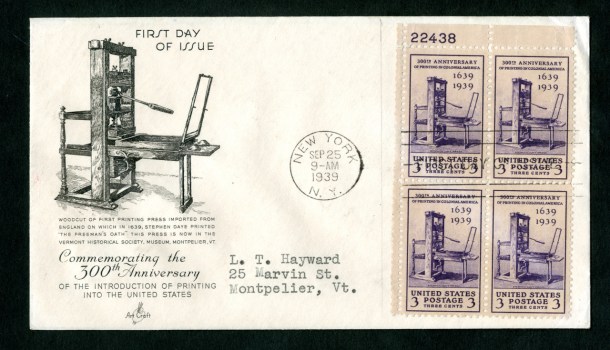
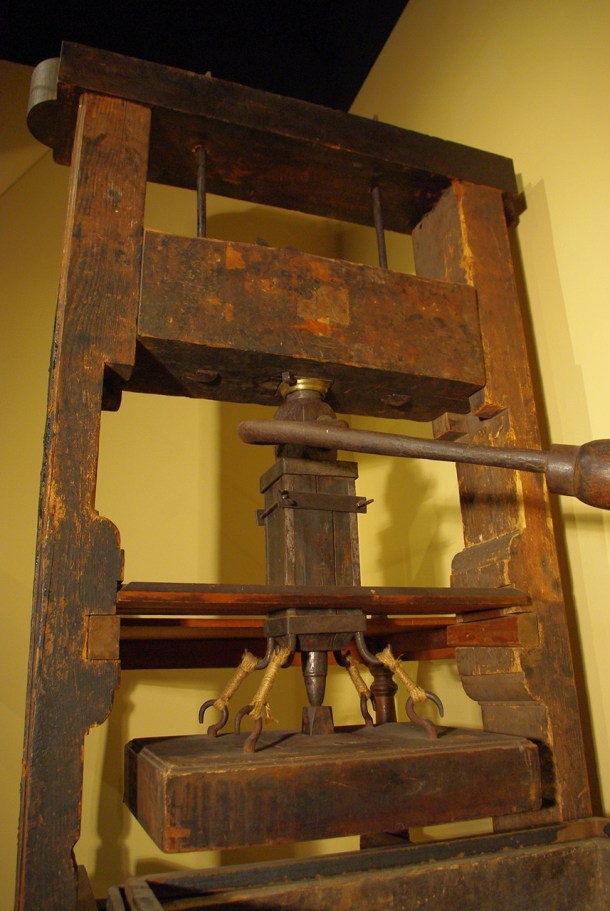
(The press that printed both the Journal and the Gazette is on display at the Vermont Historical Society’s museum in Montpelier. It dates back at least to 1714. Before being hauled to Vermont by the Spooners, it was used by Connecticut’s first printer. Some believe the press, which is known as the Dresden Press for its service in that town, has a more ancient history. They say it was brought from England to the Massachusetts Colony in 1638 and that printers used it to produce almanacs, bibles and other publications before ownership passed to Harvard College. The U.S. Postal Service put its stamp of approval on the press’s history by putting it on a stamp to celebrate it tricentennial, but many historians remain reluctant to make such claims.)
Alden Spooner picked fertile territory for a newspaper. Towns in the Upper Connecticut River Valley were among the most literate communities in the Western world, according to the late historian William Gilmore.
In the Vermont Journal’s masthead, Spooner promised readers “knowledge from distant climes.” The problem was finding news worth printing. During the mid-1780s, Gilmore wrote, “… the Windsor Vermont Journal frequently complained that there were too few important events to report.”
Fate soon provided news that gripped readers. The paper’s front page became filled with stories about Shay’s Rebellion, an uprising in Western Massachusetts over widespread debt foreclosures, and about the Constitutional Convention and the ratification process.
Reports from those distant climes didn’t come from the paper’s own correspondents. Stories were shamelessly copied from other newspapers. It’s just what papers did in those days.
The Vermont Journal also ran stories promoting the emerging market economy, which was replacing the old ways of self-sufficiency. “Its basic stance fully supported commercial activity and through advertisements the Journal profited directly from an increase in commodity exchange,” Gilmore wrote in his study of commercial culture in the Upper Valley, “Reading Becomes a Necessity of Life.” “The Journal gained nothing from economic self-sufficiency.”
This commercial activity helped spawn other Vermont newspapers. As communities grew, they became able to support newspapers of their own. And the newspapers supported the communities, providing vital links. Their foreign and national coverage connected readers with the outside world. Their state and community news kept readers informed about more local affairs. And their advertisements linked readers with local businesses.
The same year Spooner started his Vermont Journal, Anthony Haswell launched the Vermont Gazette, or Freeman’s Depository in Bennington. Other papers soon sprang up. Some proved long-lived; others less so. Most appeared along the eastern and western fringes of Vermont, where the bulk of the population was located. During the 1790s, entrepreneurs started newspapers in Putney, Windsor, Bennington, Rutland, Fair Haven, Vergennes, Burlington, and, far to the north, in Peacham.
Some towns proved better able to support newspapers than others. Windsor seemed only able to sustain the Journal. Rival papers, the Morning Ray and a second Vermont Gazette, lasted less than five years between them. Two early papers in Fair Haven – the Fair Haven Gazette and the Farmer’s Library, or Fair Haven Telegraph — lasted about as long.
After a couple of false starts, the Rutland market proved more fruitful. Publishers began trying the area in 1792. Haswell started the Herald of Vermont, or Rutland Courier (not to be confused with the Rutland Herald), but had to close the paper three months later when a fire consumed its offices. Haswell’s Herald was followed the next year by the Rutland-based Farmer’s Library, or Vermont Political and Historical Register, which lasted less than two years. It was sold in 1794 to distant cousins, both named Samuel Williams (one a minister, the other a judge), who renamed it the Rutland Herald, which today is the state’s oldest newspaper.
The success, or at least survival, of some of these early papers emboldened others to launch their own ventures. Papers took such eccentric names as The Tablet of the Times of Bennington, which was a continuation of Haswell’s Gazette, beginning (and ending) in 1797. It was followed by such papers as the Federal Galaxy (Brattleboro, 1797-1802), the Weekly Wanderer (Randolph, 1801-11), the Northern Memento (Woodstock, 1805-08), the Vermont Precursor (Montpelier, 1806-07), and another iteration of Haswell’s Gazette, the Epitome of the World (Bennington, 1807).
Papers expanded across the state, following the population. Joining what became a crowded field, newspapers owners increasingly chose to specialize. Many papers supported a particular political party, like the Anti-Mason Republican (Middlebury), the Harrisonian (Montpelier), and the Henry Clay and Advocate of the American System (Woodstock). Others advocated for religious or social movements of the day, like the Journal of Temperance (Windsor) and the Christian Luminary (Stowe). And still others reached out to certain populations, like La Revue Canadienne (Burlington). These niche papers were mainstream journalism in early 19th century Vermont.
By 1850, nearly 150 weekly newspapers had been started in Vermont and the isolation felt by the state’s early settlers was old news.


