

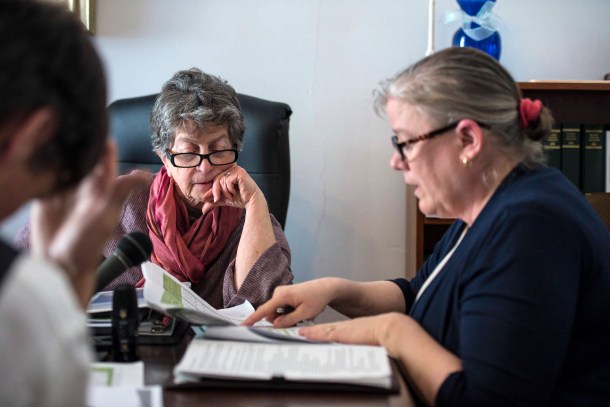
[S]enators in two committees called the head of Vermont’s E911 board to testify this week, hoping for answers on how the state can make sure that anyone who calls emergency services gets through to someone who can help.
They didn’t get very far.
“If something terrible happens, who do we blame?” Sen. Randy Brock, R-Franklin, asked Barbara Neal, executive director of the state’s E911 board, in a meeting of the Senate Finance Committee on Wednesday.
“Is there anybody in charge of the whole piece of ensuring that when a person picks up the phone, they get somebody on 911 to respond?” he asked. “Is there an overall in charge, and if so, who does that person report to in state government that we can blame?”
Neal responded: “I would say that…the 911 board is responsible for the statewide 911 system.”
But only part of the system, she added. Much of the state’s landline system is operated by Consolidated Communications. And Neal said failures in the “originating network” — telephone lines breaking, for example — are outside her board’s control.
So is the E911 board to blame, Brock asked, if a call fails and people with an emergency can’t get through to emergency responders?
“In cooperation with other state and federal agencies that govern the originating service providers,” Neal said.
Over the past two years, about 50 outages were reported in communities across Vermont. Most impacted dozens of residents at a time for up to a few hours. An outage in Peacham in July 2017 lasted for more than 28 hours.
Not all of these outages were caused by isolation, and Neal said it’s not possible to know how many individual calls were been blocked during these events.
One incident spoken about in both committees was an outage in Alburgh in 2007, when there was a medical emergency at an elementary school and 911 calls failed.
During the last meeting with the E911 board a few months ago, Neal strategized at length with board members on how she would respond to questions about isolation, without setting the board up for blame or encouraging lawmakers to spend loads of money on the problem, according to a recording of the conversation.
The E911 board, which operates independently of Vermont’s telecoms regulators, is weeks away from finalizing its next five-year contract for a vendor to build and manage the state’s landline network for communication in an emergency.
Brock asked Neal Wednesday if the new contract would make any material difference in resolving the isolation issue. She said it wouldn’t.
Stephen Whitaker, a volunteer citizen advocate focused on tech and telecoms, has been pestering policymakers and bureaucrats to come up with a solution to the E911 “isolation” issue the new contract if signed.
“The ongoing risk to public safety caused by telephone ‘remote’ switches being disconnected from their ‘host’ thus blocking all calls to 911 or any calls outside of the local exchange must be resolved now!” he wrote this week to Speaker of the House Mitzi Johnson, D-South Hero.

“Lives are at stake and this is nothing to minimize or to kick down the road as a new 911 contract is pending as well as a renewal of Consolidated’s Incentive Regulation Plan,” he added.
The regulation plan outlines the relationship between the state and Consolidated Communications, the state’s dominant wire line provider. The current plan expires later this year.
Whitaker delivered this message in testimony to both the Senate Finance and Institutions Committees this week. (He also provided many of the documents cited in this article.)
The issue of isolation has been talked about for more than a decade.
In 2006, David Serra, the former head of the E911 board, wrote to Peter Bluhm, then the policy director of the Public Service Board (now called the Public Utility Commission), asking him to force private companies to fix the issue of “standalones,” areas in the state that may become isolated when a phone line is cut or damaged.
“We request the PSB to create a rule that obligates telcos to provide a fail-over method of getting out of a given calling area in the event a stand-alone situation develops that cuts off 911 access,” Serra wrote. “This is a technological problem that the E911 Board cannot be expected to remedy, but that denies access to E911 services.”
Sen. Joe Benning, R-Caledonia, chair of the Senate Institutions Committee, read that letter to Neal during testimony on Friday and asked her if anything had been done to fix the issue since then.
Neal said meetings had taken place to talk about it, and she was currently looking into what possibilities were discussed, and what — if anything — was done about it.
The E911 board won’t say which company it’s negotiating with on its next contract to manage the E911 system. But Neal did tell legislators that she intends to close the deal by the end of March.
In an interview on Friday, Neal said changing the pending contract would make it impossible to get a new system up and running before the current contract expires. She said the state could instead write new rules, or come to new agreements, with Consolidated to fix the issue and build “diverse paths” so that calls can quickly redirect if a line goes down.
“So my understanding is the cost to actually build in the diverse paths would be a lot, you know, in the millions,” she said.
As for other solutions, such as combining efforts to fortify the E911 system and expand broadband, she said more information was needed.
“What is that cost?” she said. “And who would bear that cost? And is it reasonable? So those are all questions I think that need to get back out on the table.”
During an interview on Friday, Brock said he hadn’t entirely made up his mind about whether signing a new E911 contract now was prudent, but was inclined to look for solutions elsewhere.
“I do think that just telling them to come up with a new contract in the short run is not a practical solution, because it’s too complicated and it…potentially extends the reach of some of state government beyond what it’s able to do with this point,” he said.
Another solution, which Brock said he’s working on, is drafting legislation that would change the governance of the state’s 911 network and other telecommunication systems so that Vermont was better equipped to deal with problems when they come up.
“It’s these things that are sort of outside of the mainstream in which everybody’s in charge and nobody’s in charge. That’s a concern to me,” Brock said.
“We have these individual centers of responsibility, but without what’s necessary in order to carry out their duties and that again looks like, in a sense, the expertise, and the E911 board doesn’t seem to be there,” he said.

Neal said in that meeting that she expected the issue of isolation to come up in the Legislature because the board released a report on the redundancy and resiliency of its system.
“Consolidated, who would have the bulk of those locations, had indicated that in order to really study how to address those vulnerabilities would cost several tens of thousands of dollars just to identify how to fix, potential fixes,” Neal said. “And in many cases they were quite clear that it’s not going to be feasible to fix these locations.”
Neal told the board she anticipated questions on that issue, and asked what they would like to do to address it. “I think you, the Board, would want to tread carefully because you can throw a whole lot of money at not good answers or solutions here,” Neal said.
“Not that every 911 call isn’t equally important,” she adds, “but these areas…definitely represent a low call volume.”
Neal then discusses public relations strategy with Joel McCamley, president of the 911 Authority, a private consultancy, and members of the E911 board. One of their priorities is making sure they don’t get blamed for potential problems.
“My question, really it’s there’s two issues here that I see immediately. One is that when – if something bad happens in one of those places, we’re going to get the blame,” says Steven Gold, a board member. “It’s not our problem, but we’re going to get the blame.”
Gold suggests coming up with an alternative plan that at least requires Consolidated and relevant officials to educate residents in at-risk areas to know that if they get a fast busy signal, it means the phone lines are down and they should call a neighbor, as isolation still allows local calls.
“In these situations if you’re calling your neighbor, you’re going to get through,” Neal says. “The problem is you can’t get through to 911, so there’s really no indicator that something’s up with your service, which is also of concern.”
“I would testify that — I would I think we ought to pull the covers off of that one if you get a chance,” Gold says.
“Just don’t make us responsible,” he adds.
“Okay,” Neal responds. “I’m getting better and better at that.”
Corrections: Barbara Neal’s last name was spelled incorrectly twice in an earlier version of this article. Consolidated Communications is the dominant, not the only, wire line provider in the state.

