

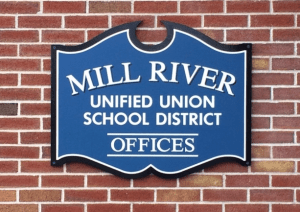
The Mill River Unified Union School District is in hot water with Vermont Legal Aid and the American Civil Liberties Union of Vermont after one of its administrators installed an unofficial moratorium on special education evaluations.
In a Dec. 7 email, Coral Stone, the district’s director of student services, told several top administrators that the district’s lone school psychologist had too much on his plate.
“At the current time, we are essentially ‘maxed out’ on the number of student evaluations that we can reasonably conduct,” Stone wrote in the message that was copied to superintendent Dave Younce, each of the district’s five building principals, and several top administrators.
“I’d like you to make every effort to curtail evaluation requests coming from your (Education Support Teams) for the time being. I expect this moratorium to last perhaps through mid-February,” she said.
Stone’s email also directed administrators to “please not make any kind of formal announcement” to staff that the district was not accepting evaluation requests “as this would violate the law in a number of ways.”
Instead, Stone said, administrators should “help teams and teachers devise interim supports that students can receive until such a time as we get ahead of our backlog.”
A tip about the email landed at the Disability Rights Project of Vermont Legal Aid and ACLU-VT, who jointly wrote to Younce on February 11 to tell him the directive was an “indisputable violation” of the federal Individual with Disabilities Act as well as state regulations.
The IDEA, a landmark piece of disability-rights law, mandates that school districts identify and evaluate all children with disabilities within their borders. Under the law, schools must also evaluate children for special education services upon a parent’s request.
“Under no circumstances may a district deny, delay, or otherwise thwart a parent’s request for an evaluation,” Nancy Breiden, the director of the Legal Aid’s Disability Rights Project and Jay Diaz, an ACLU-VT staff attorney, wrote to Younce.
Pietro Lynn, Mill River’s attorney, wrote back on Feb. 21 to say that while the district disagreed with ACLU-VT and Legal Aid’s “characterization” of the directive, Stone had nevertheless issued a subsequent email reaffirming the district’s commitments to performing such evaluations.
“I write to affirm that any request for an evaluation, either internal or from a parent, shall be pursued consistent with our obligations under Vermont and Federal Law,” Stone wrote in an email sent to school staff on Feb. 12.
Lynn also said he had reviewed special education evaluation requests submitted after Stone’s email, and that none had been denied.
“I can imagine that it would be concerning if a District refused to comply with its legal obligations. Fortunately, that is not the case here,” he wrote.
Younce declined a phone interview with VTDigger, and in an email declined to say whether he condoned Stone’s directive.
“As this relates to a confidential internal communication, I have no comment,” he wrote.
He also refused to say whether such moratoriums had been put in place in the past, and when asked if such moratoriums might be put in place in the future, he declined to answer directly.
“As a district our work, expectations, and priorities have been and will be to take the best and most appropriate actions for our students, our community and our system. With that, we have and will consistently operate within the constraints of district policy and the law,” he replied.
Stone declined an interview, and referred questions to Younce.
Diaz, of the ACLU, said he doesn’t yet consider the matter settled. The district hasn’t said it will proactively notify all parents of their right to request such evaluations – and receive a written response – which he said is necessary to make sure any parent informally dissuaded from requesting evaluations during the moratorium knows their rights. And the district, he added, also hasn’t said how it plans to address its apparent staffing shortage.
“It’s not very hard to rescind an email while still having an unwritten policy of continuing that practice,” he said.
Karen Price, the director of family support at the Vermont Family Network, wouldn’t comment on the Mill River case directly. But she said the group, which helps families with children with disabilities, often hears from parents that have been discouraged by school staff from having their children evaluated for special services.
“It’s not uncommon for parents to not even know how to ask for an evaluation, and using the right words to ask for it,” she said. Parents also often make these requests verbally – which means that denials aren’t then documented.
Price was emphatic that students are legally entitled to these services. Still, she expressed some sympathy with schools that struggle to pay for the cost of special education, which she called an “underfunded mandate.”
“That really is a major piece — that parents feel that the school is stonewalling them, and that the real reason that they’re being stonewalled is lack of resources,” she said.
