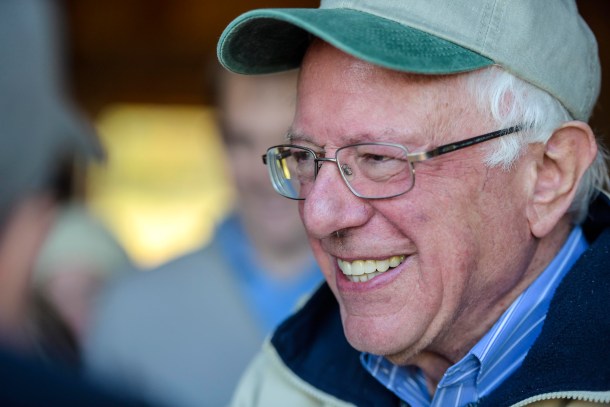
[S]en. Bernie Sanders, I-Vt., announced his bid for president in an interview with VPR Tuesday morning.
Sanders told reporter Bob Kinzel that he “wanted to let the people of the state of Vermont know about this first.”
Sanders promised “to take the values that all of us in Vermont are proud of — a belief in justice, in community, in grassroots politics, in town meetings — that’s what I’m going to carry all over this country.”
The 77-year-old junior senator from Vermont will make a national announcement via video today, according to Politico. He also spoke to CBS This Morning’s John Dickerson about the announcement Tuesday morning.
Sanders told Kinzel he is running to oppose President Donald J. Trump, who he calls a “pathological liar” and an “embarrassment to our country.”
“It gives me no pleasure to say that. I also think he is a racist, a sexist, a homophobe, a xenophobe, somebody who is gaining cheap political points by trying to pick on minorities, often undocumented immigrants,” Sanders said.
“I cannot recall a moment in modern history where we have had a president who actually goes out of his way to try to divide the American people up based on where we were born or the color of our skin or our gender or whatever it may be,” he continued. “I think a president should bring people together not divide people up. That’s why I’m running for president.”
The senator from a New England backwater surprised political watchers in 2016 when he nearly won the Democratic nomination for president against mainstream candidate Hillary Clinton with a progressive message that ran counter to mainstream Democratic business interests. He won 23 primaries and caucuses.
This time around, Sanders faces at least a dozen other challengers, several of whom have adopted his progressive approach to politics. There could be as many as 20 candidates. Still, he is widely seen as a front-runner in the field.
He acknowledged in his interview with Kinzel that this campaign will be different.
“What distinguishes my candidacy from others … what I believe very strongly if we’re going to make change in this country, if we’re going to move to Medicare for all, if we’re going to take on the drug companies, if we’re going to take on the fossil fuel industry and the military industrial complex, you can’t do that by just operating inside the beltway. What I have asked today, in an email to millions of people, I have asked folks to get on board this campaign to the tune of at least 1 million.
“We’re trying to get 1 million not only to win the Democratic nomination and the general election but also to get involved in a process that transforms the government and creates a country that works for all of us,” he continued.
In that email to supporters and his new campaign website which is emblazoned with the slogan “Not me. Us.”, Sanders says he wants to build an “unprecedented grassroots movement from coast to coast” to defeat Donald Trump and “take on the powerful special interests that dominate the economic and political life of our country.”
Sanders said he would “guarantee health care as a right, raise workers’ wages, make public colleges and universities tuition free, address the crises facing rural America, transform our energy system to combat climate change, lower prescription drug prices and defeat the forces of racism, sexism and xenophobia.”
“Three years ago, when we talked about these and other ideas, we were told that they were ‘radical’ and ‘extreme,’” Sanders wrote in the email. “Well, three years have come and gone. And, as result of millions of Americans standing up and fighting back, all of these policies are now supported by a majority of Americans.”
Many of these “radical” and “extreme ideas” were adopted by younger, female and racially diverse candidates who were successful in the 2018 mid-term election.
“Many of the ideas I talked about that we have to move to Medicare for all, our single payer program, very very popular,” Sanders told Kinzel.
“Our idea that we have got to raise the minimum wage to $15 an hour there are now five states that have passed that legislation and I hope Vermont will follow. I believe it will pass the House of Representatives,” he said. “The idea that if you work 40 hours a week you ought to be able to support a family that’s an idea whose time has come.”
“When I talked about making colleges tuition free and lowering student debt that was another issue people said was too radical,” Sanders said on VPR. “Well, that’s also happening around the country.
“Climate change. I got laughed at when I said this is one of the great crises facing our planet,” he said. “Well, people are not laughing now and they understand we have to transform our energy system.
“We began that revolution in 2016 and now it’s time to move that revolution forward and make sure those ideas, that vision are implemented,” Sanders said.
When Kinzel asked whether his age is an issue, Sanders deflected by couching ageism as a diversity issue and said he had very good health thanks to his interest in long-distance running as a youth. He said he has a high energy level and shouldn’t be judged on “one criteria.”
Ironically, Sanders will be up against younger challengers in the Democratic primary who are telegraphing the very same messages.
More than 10 Democratic candidates have announced bids for the Democratic primary, including a number of Sanders’ colleagues in the Senate, including Kamala Harris of California, Cory Booker of New Jersey, Kirsten Gillibrand of New York, Amy Klobuchar of Minnesota, and Elizabeth Warren, of Massachusetts. Julian Castro, former mayor of San Antonio and an Obama administration official, has also joined the race.
Former vice president Joe Biden, 76, is considering a run.
Sanders is an independent, not a Democrat, though he regularly wins and then declines the Democratic nomination in his home state. When Kinzel asked if that was an issue for his campaign, Sanders said he had caucused with the Democrats for years and has raised millions of dollars to the Democratic Party “to help elect Democrats.”
In 2016, Sanders famously raised millions of dollars in support from small donors. Sanders had $9 million in his campaign war chest as of Feb. 1, as reported by Seven Days.
Earlier this year, aides for Sanders’ 2016 run were accused of sex discrimination and sexually harassing women who worked for the campaign. After press reports came out about the misconduct, Sanders met with the women and apologized in a closed door meeting.
The women — leaders and field organizers — complained in an anonymous letter to Sanders that there was a pervasive climate of toxic masculinity on the campaign, according to a Politico report. They asserted that the campaign staff was too white and too male and they objected to the “Bernie Bro” culture.
Robert Becker, the campaign manager for the Iowa race, was accused of sexual harassment during the campaign and settled with the woman for $30,000.
In comments to Kinzel, Sanders said “that reality hurt very much and upset me and it never should have happened.”
“We started that campaign for like four or five people, our ideas exploded, we ended up winning 22 states, and we hired people in a rapid way. We had a few people and in a few months we had like 1,200 people and frankly as I have since learned some of those people never should have been hired.
“In 2018, in my re-election for the Senate we established protocols that are as strong as any in the country making sure that anybody who believed he or she was harassed there was a mechanism outside the campaign to address their concerns,” Sanders continued. “We are going to be providing a whole lot of education and training to all of our employees.”
Sanders was first elected to the U.S. House in 1990. He was elected to the Senate in 2006 and has just started his third term as a senator.