

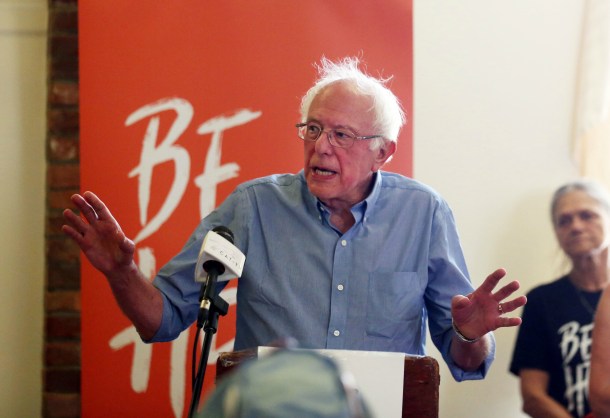
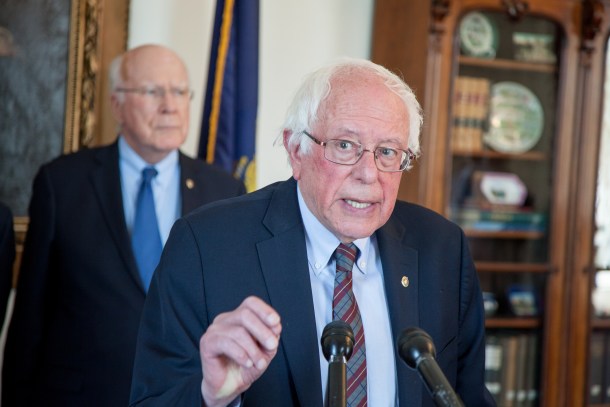
[H]ours after announcing his candidacy for president Tuesday, Sen. Bernie Sanders I-Vt., secured the endorsement of his seatmate, Sen. Patrick Leahy, D-Vt., who backed Hillary Clinton in the last Democratic presidential primary.
In a reversal from 2016, Leahy immediately threw his support behind Vermont’s junior senator and his campaign for the White House.
“We have a strong field of candidates, and Bernie’s entry makes the field even stronger,” Leahy said. “I’m proud to support my fellow Vermonter, a proven leader with a strong message.”
Sanders joins a crowded, high-profile group of 2020 candidates that is only expected to grow in the coming months.
Five of Sanders’ Democratic challengers are sitting senators: Kamala Harris of California, Cory Booker of New Jersey, Amy Klobuchar of Minnesota, Kirsten Gillibrand of New York and Elizabeth Warren of Massachusetts. Former Vice President Joe Biden, who previously served in the Senate, is still considering a run for president.
Ahead of the last presidential race, Leahy pledged to support Clinton in 2014, before she had even announced her candidacy.
Vermont’s sole member of the House of Representatives, Peter Welch, who supported Sanders in 2016, again endorsed the senator on Tuesday.
“Bernie Sanders is a welcome voice in this campaign. He has a proven, powerful, and compelling message of economic fairness and environmental justice that will resonate across America,” Welch said in a statement.
In 2016, Sanders’ presidential platform was well left of Clinton’s, the front-runner in the race. But that’s not the case this time around.
After his unsuccessful run for president, many credit Sanders with moving the Democratic party’s politics further to the left and making progressive policies — like Medicare for all and a $15 minimum wage — standard planks among Democrats with White House aspirations.
Terje Anderson, chair of the Vermont Democratic Party, said Wednesday that Sanders still had the advantage of name recognition and a nationwide political infrastructure built for 2016, but was no longer distinct for his political platform.
“Whoever runs is going to be running on a relatively progressive populist platform. That’s the path that all Democrats need to take,” Anderson said.
“It certainly changes the dynamic. He’s going to be competing for the same voters with a lot of these folks.”
Kit Norton contributed reporting.
