


[A] proposal from the Scott administration to find money for the cash-strapped Department of Public Service and Public Utility Commission with a fee on new solar and other electricity generation projects received an initial thumbs up from lawmakers.
But a representative from the renewable energy industry contends that a project application fee — which could range from $100 up to thousands of dollars per project — could further discourage new in-state solar projects.
Gov. Phil Scott held fast during his first term to his campaign promise not to raise taxes or levy new fees. During his second term, Scott has changed course, and the administration put forth a fee bill to raise revenue for state agencies.
The administration wants to increase funding for both entities with a new application fee for non-utility electricity generation projects, such as solar arrays, wind turbines, and hydropower. For energy generation projects 50 kilowatts and under, the application fee would be $100, and for facilities over 50KW, the fee would be $4 per KW.
The majority of both the department’s and the PUC’s revenue comes from the gross receipts tax, which is a tax on the revenues of all utilities that are regulated by the commission. That revenue has been declining in recent years largely because of fewer phone lines being used. The department has a $800,000 combined deficit for fiscal year 2019, while the Public Utility Commission has a $127,000 shortfall this year.
Riley Allen, deputy commissioner of the department, said in an interview Wednesday that a “disproportionate share” of the department’s and commission’s work in recent years has come from solar and other forms of distributed electricity generation, which do not pay into the gross receipts tax.
“It comes down to a basic issue of fairness,” he said.
Although the fees do not apply exclusively to solar projects, solar makes up a significant majority of the projects to which they would apply — 95 percent for net metering and 91 percent for standard offer, according to Anne Margolis, renewable energy development manager with the Department of Public Service. Standard offer projects are renewable energy generation facilities; in net-metering projects, unused electricity goes bak on the electric grid.
Olivia Campbell Andersen, executive director of Renewable Energy Vermont, said during testimony Tuesday before the House Energy and Technology Committee that the state should not do anything to discourage solar installations given Vermont’s goal to derive 90 percent of its energy from renewables by 2050.
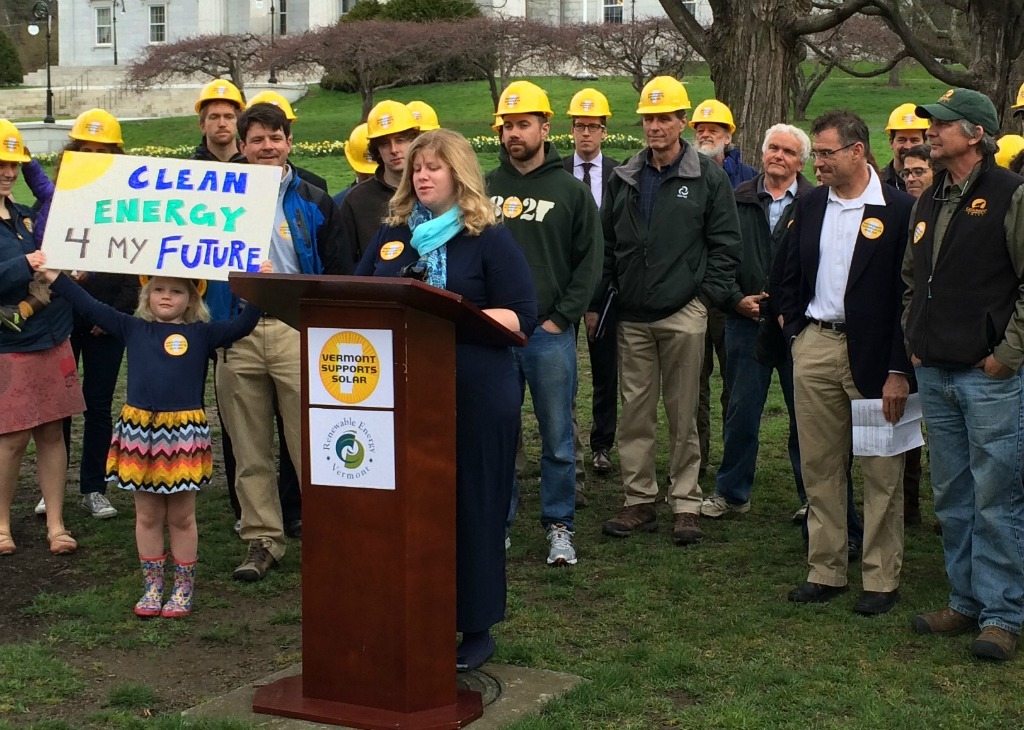
She said the state had another “significant shedding” of solar jobs last year, pointing to a recent report from the Solar Foundation, which says Vermont lost 306 solar-related jobs in 2018. Solar installations declined in Vermont by 9 percent from 2017 to 2018, according to a report commissioned by the state’s Clean Energy Development Fund.
“What we do know is that the impact on solar (jobs) is directly related to the number of new installations in the state,” she said.
Campbell Andersen argued that relying on fees from fluctuating applications would not bring long-term financial health to the state agencies. Vermont should instead increase the gross receipts tax levied on the state’s lone natural gas utility, Vermont Gas, which currently pays less than electrical utilities, she said.
The Public Utility Commission thinks there should be both an increase to the gross receipts tax for gas and an application fee for renewable energy projects, which committee members agreed with.
Anne Bishop, operations director for the PUC, referred to the tax as a more stable funding source because net metering has had “bubbles” of applications in recent years with changing state regulations.
Under the PUC proposal, the $100 application fee would apply to all rooftop solar projects, regardless of size, while larger non-rooftop solar projects would pay a $5 per KW fee.
Committee members [opted to go with the PUC’s proposal] on Thursday in their report back to House Ways and Means.

Rep. Robin Chesnut-Tangerman, P-Middletown Springs, said he feels larger solar projects should pay into the gross receipts tax while smaller projects should be exempt from any application fees.
“I think the smaller rooftop projects — a lot of people do them because it’s the right thing to do,” he said Wednesday.
Toward the end of her testimony Tuesday, Campbell Andersen said renewable energy developers feel any new project fees should be accompanied with greater certainty about the timeline for project review by the utility regulator.
“One of the challenges that I hear about chronically from folks is that it takes a significant amount of time to process and review applications that are … non-contested and no one is opposing the project,” she said.
The House Energy and Technology Committee agrees.
“It makes sense to us that the establishment of new regulatory fees are accompanied by a commensurate increase in regulatory accountability,” wrote the committee in their letter to House Ways and Means.
Bishop said the fluctuations in the number of solar project applications received at different times of the year poses a challenge for the commission.
“It’s very hard when you get 12 months work of work in one month to allocate personnel,” she said Tuesday.
Rep. Laura Sibilia, I-West Dover, who has been active in pushing for reform in the telecom sector, questioned whether the proposed level of funding would actually address the issue of delays in project review.
“I wonder if they have enough people in that building,” she said Tuesday. “What we’re seeing in front of us, I believe, are proposals to keep things static in terms of staffing levels.”
The House Ways and Means Committee will review the committee’s proposal Friday.
