


This story by Jordan Cuddemi was published by the Valley News on Feb. 11.
[W]HITE RIVER JUNCTION — A 38-year-old Vermont man serving 26 to 33 years in prison for unintentionally hitting and killing a state trooper from Bradford during a high-speed chase on Interstate 91 in 2003 is seeking to have his sentence vacated or reduced.
Eric Daley, who pleaded guilty in 2004 to involuntary manslaughter and other charges in connection with the death of Trooper Michael Johnson, is claiming his lead defense attorney, Matthew Harnett, was ineffective and made poor decisions that contributed to his lengthy sentence.
Daley, formerly of Springfield, appeared on Monday in Windsor Superior Court for a post-conviction relief hearing, and testified to why he feels Harnett failed him. Daley, who has served 15½ years of his sentence in various prisons both in and out of state, hopes Judge Timothy Tomasi will grant him a new sentencing hearing, or even allow him to withdraw his guilty pleas and start his case over.
During his sentencing hearing in September 2004, Harnett instructed Daley to take the stand — something Daley, his new attorney Robert Appel and defense-hired expert Paul Volk claim was improper and negatively impacted Daley.
“It was Harnett’s idea to have me get on the stand,” Daley said in response to questioning from Appel, adding that he didn’t know he had the option not to. “There wasn’t much discussion about it.”
Volk testified that it is rare for an attorney to encourage a defendant to take the stand during a sentencing hearing, but state-hired expert Colin Seaman testified that it may have been Harnett’s strategy in the case.
Harnett died in 2012 at the age of 54 of cancer, so just what his thinking was isn’t entirely clear.
Daley’s defense also alleges Harnett erred by not filing motions to suppress information in the case on two different topics.
First, Harnett should have filed a motion detailing the “prolonged detention” of Daley during a traffic stop that preceded the chase and crash on June 15, 2003. Second, he should have filed a motion about Vermont State Police’s decision to deploy spike stripes after Daley left the traffic stop, something Volk said the police didn’t have legal justification to do.
Had he filed those motions, Daley’s case could have been dismissed, or his sentence length might not have been so long, Volk said.
A Vermont State trooper pulled Daley over on the interstate in Thetford for speeding that day and asked him several times for consent to search his vehicle. Daley, who had a prior record of drug offenses and eluding police, denied that request and the trooper ultimately handed him a ticket for speeding and walked back to his cruiser, according to Daley’s testimony. Daley then thought he was free to leave, but the trooper told him to wait and that he and another officer were locating a K-9 to search the vehicle.
Daley had marijuana, LSD, cocaine and pills in the trunk, but contends the police didn’t have probable cause to search the vehicle. Daley decided to “drive off;” the circumstances of how he pulled out — calmly or erratically — are disputed.
The officers pursued him at a high rate of speed on the interstate, and the chase came to an end on I-91 in Norwich when Daley recalled seeing “an obstruction” in the roadway and brake lights. Johnson had laid down spike strips to stop him. Daley swerved into the median, but when he did so, he hit and killed Johnson, who was outside of his cruiser. Daley, who suffered some injuries but fled to Pennsylvania, where he was apprehended the next day, repeatedly had said during the case that he didn’t think he had hit anyone.
Volk testified that there are “reasonable limits” to roadside detentions and that the police violated those in this case, something Harnett should have highlighted in a motion.
Volk claimed the police didn’t have a legal basis to pursue Daley after he denied consent and the traffic stop seemingly wrapped up.
“There is a possibility that the case would have been dismissed,” Volk said. “Short of that, I believe there is a reasonable probability that the parameters of the sentencing agreement that was reached … would have been arrived at in a formula more favorable to Mr. Daley.”
The state, through Windsor County State’s Attorney David Cahill, saw things differently.
Seaman, the state’s expert witness, said he doesn’t think filing motions to suppress would have impacted the outcome of Daley’s sentence.
Although he said police may have gone “a little far” during the traffic stop, they made the right decision by deploying the spike strips, he said. Stopping a speeding driver from putting other motorists in harm’s way is “greater than the intrusion” into a “person’s liberty,” he said.
“I think it’s pretty clear it’s a loser,” he said of the motions.
Seaman theorized that Harnett put Daley on the stand in order to humanize him in the face of many people who saw him as a villain.
The court already had all of the facts of the case, so Daley couldn’t have harmed his case by taking the stand, Seaman testified.
Daley told the judge he ultimately took a plea agreement after consulting with his parents and Harnett, a decision that was made after he learned his case could be tried federally with the possibility for the death penalty.
Tomasi took the matter under advisement on Monday. If he denies Daley’s petition, Daley has the right to appeal.
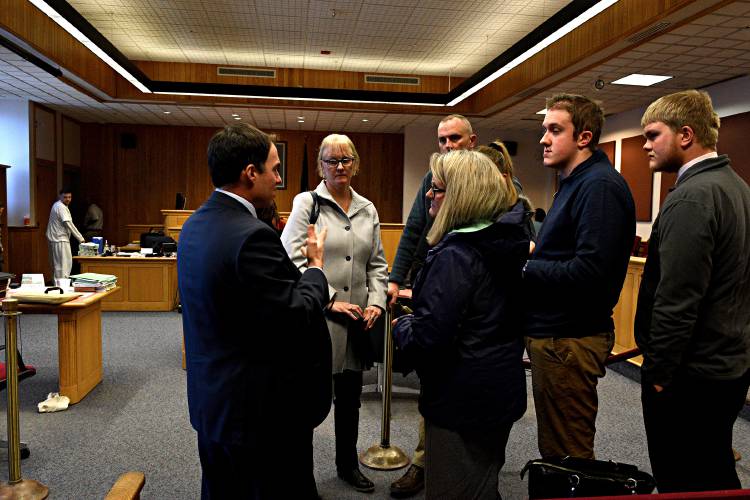
Nearly three dozen people attended Monday’s seven-hour hearing in the White River Junction courthouse, including Johnson’s family, Daley’s family and several police officers.
Daley was returned to Southern State Correctional Facility in Springfield. He has served time in three different prisons in Vermont, as well as in prisons in Kentucky, Michigan and Pennsylvania.
He was 23 when the incident took place.
“Do you believe you are a different person at this point and time?” Appel asked Daley.
“Absolutely,” Daley replied.
