

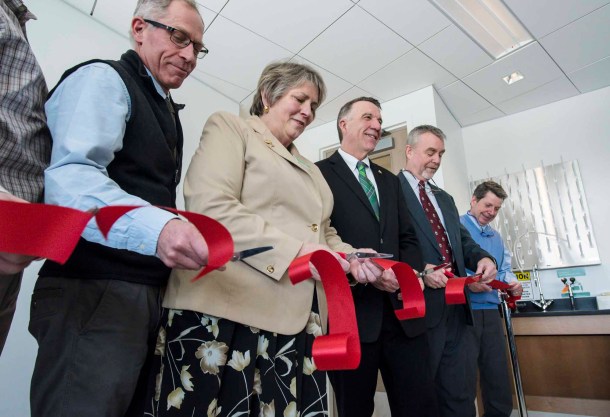
[T]he new laboratory for the state Agency of Agriculture and Department of Environmental Conservation, which opened Monday in Randolph, will be ready to start taking samples for testing on March 7, state officials said.
The $21 million, 30,000-square-foot lab, built on the campus of Vermont Technical College, will be the site for food, agriculture, and environmental testing. It replaces the scattered locations, including University of Vermont, that had served those functions since Tropical Storm Irene destroyed the state laboratory in Waterbury in 2011.
State officials decided to combine the DEC and Agriculture labs to eliminate redundancies, said Agriculture Secretary Anson Tebbetts, who spoke at a ribbon-cutting Monday.
“There were many hard decisions that had to be made after Irene,” said Tebbetts. “Our employees overcame a tragedy, many watching their life’s work washed away in Waterbury.”
State officials looked at 19 possible sites for the new lab before choosing the VTC campus, said Guy Roberts, the lab’s director.
At the new site, the Agency of Agriculture will carry out its routine testing on agricultural products like milk and maple syrup, and will track insects and other pests, including invasive species like ticks. The DEC will test air and water quality, among other things. Roberts said the DEC receives samples every 12 days from three sites in the state for analysis. It also tests samples from 16 watershed management associations.
The hemp industry is growing rapidly in Vermont. Since the beginning of January, 91 processors, 211 growers and 11 laboratories have completed the annual state registration process, said Cary Giguere, director of public health, Agricultural Resource Management at the Agency of Agriculture.
Farmers and processors involved in Vermont’s cannabis industry have been pushing for independent third-party testing of the cannabis plant itself, and the THC and CBD derived from it, among other things. CBD, or cannabidiol, is the non-psychoactive compound, derived from the cannabis plant, that is believed by many to have healing properties. It is now being sold in oils, lotions, foods, and beverages. THC is the psychoactive compound derived from a variety of the plant.
Like much in the industry, the state’s role in testing remains unclear. Carl Christianson, who started a hemp processing facility and CBD testing laboratory last year in Brattleboro, said Monday that he hopes that the state will work with his lab and other private labs to provide services such as cannabinoid profiling, terpene testing, water activity tests, solvent screens, and pesticide testing.
“Our hope is that the state will use their lab to certify other analytical labs in the state, such as ours,” Christianson said. “We believe the state’s resources are better used to certify and validate other labs then to have the infrastructure costs, hiring challenges, and liability issues that would come with making the focus of their lab be solely about serving the cannabis community.”
Bill Lofy, co-founder of Kria Botanicals in South Burlington, is hoping for something similar.

“I’d like to see more clear definition of what the agency is hoping to do with the state lab,” said Lofy, whose company tests hemp, oil and concentrates for cannabinoids. “I think the state lab can play a role in certifying other labs.
“We need to have the conversation about the proper and specific role that the state will play, and what private analytics labs will play in the coming 2019 harvest, and beyond,” he said.
State hemp testing is still a long way off. First the state has to come up with regulations for the industry and its products, and then this summer the rules will undergo administrative review, said Roberts.
“We are developing methodologies here in the lab to be able to do the potency testing and contaminate testing, and legislatively we have about a year to complete that process,” he said. “Then we’ll phase in testing as the program begins sampling. One of the biggest challenges is determining what and when to sample.”
Roberts said Vermont officials will follow the lead of other states and regulatory bodies that test cannabis and its products.
But “I think there is a lot of room for innovation here for us,” he said.

