


[T]he last time the gang members came to Bienfait’s home in Democratic Republic of Congo, demanding a large sum of money, he knew it didn’t matter if he could pay up when they returned.
“I understood that even if I paid this money, they would end up killing me anyway,” he said. “I understood that even money wouldn’t save me anymore. That’s how I left.”
A plane, a bus and a taxi ride later, Bienfait stood on the United States side of the border in Derby Line — thousands of miles away from his bedroom where the men had threatened his life — planning to cross and seek asylum in Canada.
However, Bienfait barely made it over the threshold before he was turned away, sent back to the U.S. and detained by immigration authorities. After his long journey, he was unwittingly stopped by a 15-year-old agreement that determines how many asylum cases are handled at ports of entry along the U.S.-Canada border.
The Safe Third Country Agreement was implemented as part of a suite of border security policy changes after the Sept. 11, 2001, terrorist attacks. It was aimed to regulate the flow of people seeking asylum crossing over the border between the United States and Canada.
The policy requires most immigrants seeking asylum from other parts of the world to do so in the first country they arrive in, whether it is the United States or Canada. If they show up at the border planning to claim asylum in the other, as Bienfait had, they can be turned away, back to the country in which they first arrived. Under the agreement, the two countries essentially recognize that the other’s immigration policies meet a standard they consider “safe” for refugees.
Now, the agreement is under renewed scrutiny in Canada in light of the harsher immigration enforcement policies of the Trump administration, as well as an exponential increase in the number of asylum claims in the last three years.
But Bienfait’s journey to the U.S.-Canada border began far from the roiling immigration tensions in the United States and Canada.
Kidnappings and killings in DRC
In his home country, Bienfait lived “like a quiet citizen,” he recalled, speaking in French on a recent icy January day at the headquarters of ACLU-NH in Concord.
Bienfait wore a black pea coat with a gray scarf around his neck — his presence in New England is the first time he’s seen snow, he remarked. He clasped his hands on the table, cracking his knuckles at one point, as he spoke about his life back home in Africa.
In the Congo, he worked in a bank. He is the father of eight children, ranging in age from 2 to 20. But, as a Hutu in a region long racked by ethnic conflict, life was not easy for Bienfait and his family, he said. VTDigger is not publishing Bienfait’s last name to protect the identity of his family members, who remain in DRC.
“We had a life that was not very stable,” he said. “We did not live like others who felt at home. We always felt like foreigners, even though it is our country.”
Bienfait said his ethnic identity made his family the target of intimidation, robberies and psychological torture. His cousin was killed. That cousin’s brother nearly died after he was shot. His uncle and a friend disappeared, Bienfait said, after they were kidnapped. Eleven months ago, one of his sons was kidnapped for two days, released only after his family paid the group a ransom.
Human Rights Watch senior researcher Lewis Mudge said kidnappings are “very common in Congo,” in a recent interview.
The decades-old conflict in DRC is tied to the 1994 genocide in neighboring Rwanda, which prompted an exodus of an estimated two million Hutus across the border. Clashes and violence between Hutus and Tutsis spilled over into what is now eastern DRC — a region that has been unstable since 1996, according to Mudge. Clashes also happen in other parts of the large country, whose mass approximates western Europe.
Tutsi-Hutu tensions remain a divisive factor in DRC politics, Mudge said, including in the presidential elections there late last year.
Mudge is not familiar with Bienfait’s specific case. He said it is difficult to know motivations behind an individual’s asylum claim. However, he said, instances of intimidation and targeted violence are regular occurrences, particularly towards people for political reasons.
“The Congo remains a very, very dangerous place for kidnappings and for killings,” he said.
The last time the militia members came to Bienfait’s home, they demanded a sum of money he would not be able to pay. They freely discussed killing Bienfait in front of his wife in their bedroom. It was then, he said, he decided it was time to leave DRC.
“I could not stay, as the head of my family, always afraid,” he said. “At a certain moment I realized I could not protect my children. That hurt me deeply. That’s why I decided to look elsewhere.”
Bienfait struck out on his own, leaving his family behind for now. They’ve also left their home but they remain in DRC. He hopes they’ll be reunited soon.
Initially, Bienfait recalled, he considered seeking asylum in the United States. But the escalation around immigration policies led him to look north instead. After securing a tourist visa, Bienfait arrived in Washington on Nov. 16.
“When I arrived in the United States, I saw my chances shrink with the problems with the refugees from Honduras. The new politics of that period — which are still here — was a politics of border security,” he said.
Another factor — language — led Bienfait to chart his course to the Canadian border in Derby Line. As a French speaker, he felt it would be easier to integrate in Montreal. After two days in the capital, he traveled by bus to Vermont. A taxi took him the rest of the way.
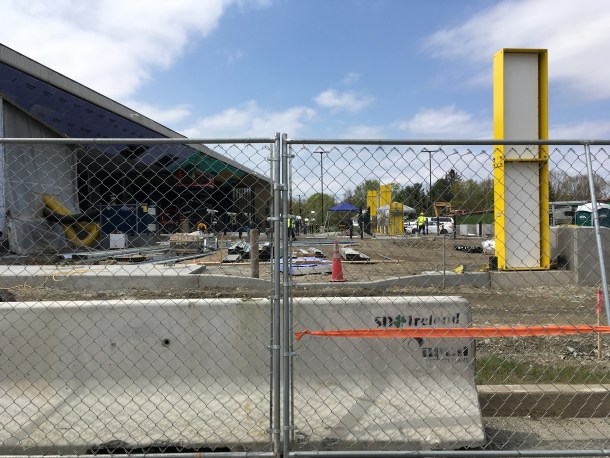
When Bienfait arrived at the border in Derby Line, his first encounter was with a U.S. border agent, who pointed him in the direction of the Canadian port of entry.
There, Bienfait planned to seek asylum. But because he was entering from the United States at a Canadian border checkpoint, he was subject to the Safe Third Country Agreement, which requires people to seek asylum in the first “safe” country they enter. In Bienfait’s case, that was the United States.
Not long after he arrived, after answering some questions, he was sent back to the American side, holding a single page document bearing a small Canadian flag in the upper left corner, indicating he was being returned to the United States. Bienfait, the document shows, did not meet any one of the 13 exceptions to the agreement that would have allowed him to enter Canada to seek asylum, including having a family member there or being an unaccompanied minor. All other claims would have to be resolved by the first country where he landed.
When Bienfait returned to the United States, Customs and Border Patrol agents revoked his tourist visa on the grounds that he had not disclosed his plans to seek asylum in Canada when he applied for it, according to ACLU-NH. He then was arrested because he did not have a visa that allowed him to be in the United States legally.
Upon questioning by U.S. border authorities, he was arrested, charged with making false statements on his application to get the tourist visa that allowed him to travel to Washington, D.C. His belongings were confiscated, and he was sent to a prison that contracts with U.S. Immigration and Customs Enforcement, or ICE, in New Hampshire.
Asylum and the U.S.-Canada border
Bienfait’s journey to Derby Line is unique, but the circumstances of his case, now in the U.S. immigration court system, are not, according to ACLU-NH.
SangYeob Kim, ACLU-NH’s first immigration legal fellow, said he has had at least five cases involving the Safe Third Country Agreement.
“The agreement was created based on the mutual understanding they trust each other’s system,” Kim said. “But if somebody’s afraid of the United States, somebody wants to go to Canada to apply for asylum and this person has never applied for asylum in the U.S., I just do not — I don’t understand.”
ACLU-NH officials launched the immigration law project to address what they say was an increase in immigration cases in the region. Not only do they handle cases from New Hampshire, they also see cases from across Vermont and Maine because most immigration detainees end up held in an ICE detention facility in the southeastern part of the state.
According to the Bipartisan Policy Center’s Theresa Cardinal Brown, who was the U.S. Department of Homeland Security’s first director of Canadian affairs, the Safe Third Country Agreement was a policy the Canadian government wanted as the two countries were negotiating a suite of security, immigration and trade measures.
Safe third country arrangements tend to benefit the country receiving the larger number of asylum claims from the other country — in this case, Canada consistently tends to see more people coming from the U.S. than the other way around, she said.
“The whole point of the Safe Third Country Agreement, honestly, from a governmental perspective,” Brown said, “is to manage migration, manage the movement of people, keep it relatively predictable.”
But the last few years have been far from predictable.
As politicians in the United States have focused on migration trends along the country’s southern border, so have Canadian politicians concerning theirs.
Canada has seen a substantial increase in people coming through the United States seeking asylum in the last two years. The increase started after the inauguration of President Donald Trump, with some people from other countries who had lived in the United States for some time believing they were no longer safe. Others just pass through the U.S. en route to Canada, which they see as a safer destination.
At ports of entry on land in Quebec alone, there were 15,040 asylum claims made in 2018. Three years earlier, in 2015, there were just 960.
At all land ports of entry in 2018, there were 20,660 claims processed — a fivefold increase over 2015, when there were 4,295 claims processed.

The dynamics of immigration policy in the United States has triggered division in Canada over the Safe Third Country Agreement — an element of foreign policy between the two countries that’s attracted little attention on the U.S. side, according to Brown.
Harsher immigration policies under the Trump administration reinvigorated an effort among some pro-immigration groups to challenge the agreement.
Three groups — Amnesty International, the Canadian Council for Refugees and the Canadian Council of Churches — launched a legal challenge to the agreement in Canadian courts in 2017. The case follows on a previous effort to overturn the agreement a decade ago.
Janet Dench, director of Canadian Council for Refugees, said many pro-immigration groups in Canada believe there are “serious flaws” in the protections for refugees in the United States.
“So on the point of view of whether or not it is correct to call the U.S. a country that is safe for all refugees, we disagree,” she said. “We think that it is not safe for certain refugees.”
Meanwhile, there are calls from the conservative groups to further tighten the border between the U.S. and Canada. Conservative MP Michelle Rempel has urged the government to renegotiate the policy so it applies to anybody crossing the border at any point to seek asylum — not just at ports of entry, as currently stands. Currently people who cross the border illegally are not subject to the Safe Third Country Agreement. To avoid the agreement, many people seeking asylum in Canada cross the border illegally, particularly at a well-known spot in Champlain, New York.
Thus far, the government of Justin Trudeau has stood by the agreement, though there has been discussion among the ruling Liberal Party about modernizing it. Immigration, Refugees and Citizenship Canada, the department of the Canadian government responsible for immigration, did not respond to multiple requests for comment.
A regional spokesperson for U.S. Customs and Border Protection was not available for comment during the government shutdown, according to an automated email reply.
‘Countries of rights’
After spending one month in detention, Bienfait was released in December. He’s currently staying with a host family in Concord. He got back some of his belongings when he was released, but others — such as his luggage — have not been found.
Bienfait is still facing removal proceedings. He also is working with a different attorney to file for asylum in the United States.
Kim, the ACLU-NH lawyer, said many people seeking asylum don’t know what their options are in the system in the United States, finding it difficult to keep up with the proposed changes and rhetoric under the Trump administration.
“It seems to me there’s a lot of confusion going on in terms of immigration policy affecting the asylum procedure, whether it is even possible to apply for asylum,” he said.
Bienfait is conflicted about leaving DRC without his family.
“Sometimes I think it was the worst decision I ever made in my life, to leave my children. Because it weighs too heavily on my conscience today,” he said. “But also, I say that maybe it was the right path. Maybe the light will come from this. And I had to try. Because it’s always better to try than not.”
His family has left their home, but remain in DRC for now, waiting to hear what will happen with Bienfait. According to ACLU-NH, there is a possibility that they will be relocated to another country in Africa while Bienfait’s asylum case plays out in the United States.
But Bienfait said that when he was considering his options for leaving DRC, he was drawn to North America, rather than Europe, because he believed he would be more likely to find help there.
“I knew that in Canada, in the United States — that these are countries of rights,” he said. “These are countries that can hear me, that can help me.”
VTDigger reporter Lola Duffort served as translator. Hear extended excerpts from our interview with Bienfait in this week’s Deeper Dig podcast:
