

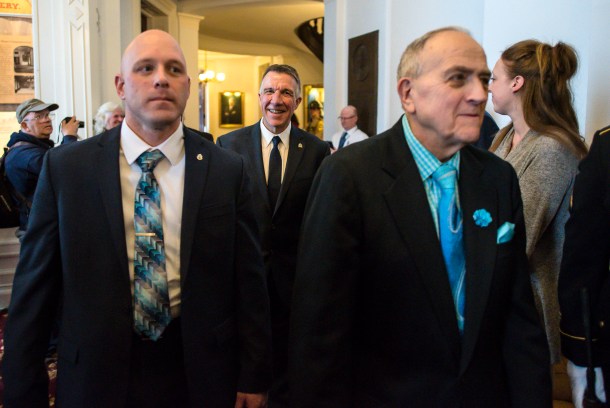
Thanks to Gov. Phil Scott, Vermonters got the same lesson on a statewide level the other day that the whole country has been getting for a month: we all need government.
Yes, it can be a pain in the neck. Sometimes it spends too much money. Always it is a center of power, and like any center of power, it has to be watched lest it abuse that power.
But as Scott’s annual budget address and the circumstances in which it was delivered made clear, government is also a necessity, often a beneficial necessity. Outside the Statehouse as he spoke, governments all over Vermont were plowing roads and sanding sidewalks, making it safe – or at least less dangerous – for people to go about their necessary tasks.
Inside, the Republican governor for whom “no new taxes and fees” has been not just a policy but a mantra, proposed new taxes and fees.
Because he wants the state government do stuff. Not just pave the roads, clean the parks, and make sure nobody starves, either. Active stuff. Affirmative stuff: test the water in all the schools for lead content; strengthen the security of the state’s computer systems; get high-speed internet connection to more rural homes; spend more on early childhood education; add $3.2 million to the state college system; care for children impacted by the opioid epidemic.
Perhaps the most expansive of Scott’s proposals (if by no means the most expensive) was his call to spend $1.5 million on tax rebates “to help more people purchase or lease new or used EVs,” plus another $500,000 to buy more EVs for the state’s own fleet of vehicles.
That’s EVs as in electric vehicles, which Scott wants to make “more affordable” because more electric vehicles “are essential to meeting our climate and energy goals.” Achieving those goals, Scott said, would require “10 percent – about 50,000 – of the cars and trucks on our roads to be electric by 2025 and 25 percent by 2030.”
Not enough, in all likelihood, for the most committed anti-global warming warriors, who insist on a carbon tax. As he has in the past, Scott rejected that tax because “transportation costs are high for rural Vermonters.” He also said nothing about expanding public transportation, which is one way House Speaker Mitzi Johnson, D-South Hero, wants to reduce greenhouse gas emissions.
Still, Scott’s proposal is worth noting, even though for the most part he has not been one of those Republicans who deny that the world is getting warmer because of greenhouse gas emissions. He did create some difficulty for himself a little more than a year ago when he suggested that climate change “could be in some ways beneficial to Vermont.”
But since becoming governor, he has consistently accepted the scientific consensus on global warming. Last August, for instance, he issued a statement condemning the Environmental Protection Agency’s decision to scuttle the Obama-era Clean Power Plan.
So the fuel-reduction proposals Scott made Thursday did not constitute a reversal. But they were a clear acknowledgement both of the reality of global warming and of the responsibility of state government to confront it, and to spend some money in the process.

Similarly, Scott was never one of those Republicans who preached that government should do almost nothing except pave the streets and enforce the law. He was a Republican who thought state government should do only what its existing tax structure allowed it to do. So he spent his first term fighting off any and all tax or fee increase suggestions from the Democratic majorities in the Legislature.
It worked. Thanks to Scott’s stinginess (and a growing economy) Vermont has, for the nonce, a budget surplus. At least in the recent past, Republican governors saw a budget surplus as an opportunity to propose tax cuts. Scott did propose some selective tax cuts, but mostly he wants tax increases.
Such is the enduring phobia of tax increases, that these are being described not as increases but as “modernizations.” They are. Or in one case – taxing e-cigarettes as though they were old-fashioned tobacco cigarettes – a “public health measure,” according to Secretary of Administration Suzanne Young.
It is. It’s also a tax increase, as are all the “modernizations,” altogether some $18 million worth of tax increases. That’s not a big increase, but some Vermonters – those who vape, those who buy some merchandise or arrange hotel reservations online – will pay a bit more in taxes.
Others will pay higher fees, which are going up about $8 million, according to Finance Commissioner Adam Greshin. These will be the first fee increases in three years, Greshin said, and most of them are paid by brokers, lenders, developers and some farmers, including the new hemp growers.
Although Greshin said “there are all different ways to measure it,” Scott’s proposed new budget seems to call for spending to grow at a faster rate than the state’s economy grew. That was another thing the governor pledged not to do in his first term.
But what he appears to have realized some time ago is what some senior officials in Washington are but dimly beginning to figure out. In this complex, intertwined world, people have to know that the airplanes are not going to bump into one another, the roads are going to be plowed, the food they buy at the grocery store is not going to make them sick, and neither will the water in the lake where they go swimming.
And if they’re lucky, maybe even that the world stops getting so hot.
For all that and more, annoying though it may be, they need government.

