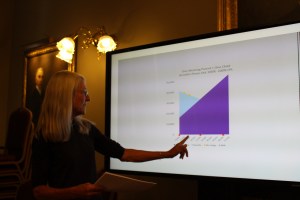
[A] newly-formed commission charged with reviewing the state’s tax system and recommending reforms to lawmakers will begin its work this month.
The three-member panel, which was created as part of the tax bill passed during the last legislative session, will meet periodically over the next two years to conduct a holistic review of Vermont’s tax structure. It will be presenting lawmakers with a report before the legislative session in 2021.
The Tax Structure Commission has been formed a decade after a panel with a similar mandate, the Blue Ribbon Tax Commission, was created.
The scope of that commission’s work focused more on examining income and consumption taxes in Vermont, and less on the property tax. Its report, including recommendations to lawmakers, was released in 2011.
The new commission will look Vermont’s tax structure as a whole. Its creation comes as discussion over how to reform the state’s tax structure —particularly the education funding system—continues to dominate debate in the Statehouse.
Deb Brighton, chair of the commission, said she believes it’s important to periodically evaluate the tax system as a whole “to see if it’s in sync with the economy.”
“Is it fair? Is it helping us deal with the future, and how well does it work as a system?” she said.
Sen. Randy Brock, R-Franklin, who proposed adding the commission into the tax bill last year, said that will make recommendations that could make taxes in Vermont more equitable, transparent and understandable. Brock believes that lawmakers have added to the complexity of the state’s tax system by making small tweaks over time.
“The only way to straighten it out is not to continue to adding to the chaos but to step back and look at the tax code in its entirety,” he said.

Brock said that for many, the education funding system, which relies on the property tax, is particularly confusing. He pointed out that towns that vote to not increase school spending in a given year often still see tax increases.
Discussion over education finance reform is expected to continue in the upcoming legislative session.
Senate President Pro Tem Tim Ashe, D/P-Chittenden, has said that many senators are interested in examining the extent to which human services spending is ramping up costs for taxpayers.
In recent years, human services expenses have become one of the fastest growing segments of education budgets, as schools are meeting demands for social services for children.
Increased human services expenses add pressure on the property tax, and Ashe said many senators are wondering if there’s a better way to manage them — whether the state, schools or both should be picking up the expense.
Brighton said examining that trend could be part of the commission’s work. It would be easier to improve the state’s tax system if legislators and officials had a better understanding of how increased expenses like human services spending are driving up costs for Vermonters, she said.
“We don’t have an accurate breakout on that and it would be really helpful to understand that,” she said.
Between now and when it publishes its report in 2021, the commission will likely refrain from making recommendations to legislators, according to Brighton.
“My sense is that as a commission we wouldn’t weigh in until we’ve finished out work,” she said.