

Editor’s note: This remembrance is by Phil Holland who lives in Shaftsbury and is the author of “Robert Frost in Bennington County.”
[W]hen Fred Hoyt, former chief custodian at Arlington High School, lay dying of cancer in 2007, his good friend Ken Nicholson, who had been a biology teacher at the school, was visiting at his bedside. Ken noticed a volume by Robert Frost on the bedside table, open at a poem called “To a Young Wretch.” Ken asked about the odd title.
“What exactly is a wretch, Fred?”
“It was me. I was the wretch,” Hoyt replied. “Seventy years ago…”
The year was 1937. Christmas was coming. Freddie Hoyt, the fourth of seven children, had just turned 10 and decided that he was ready for the man’s job of bringing home the family Christmas tree. There was no money to buy one in those hard years, so he took an axe and set forth from the Hoyt house on Church Street in Shaftsbury, crossing Route 7 and heading east toward well-forested Buck Hill. A mile up the road Freddie saw the tree he wanted, a beautiful young spruce. A few swings of the axe and the job was done, and back home he went, dragging the tree through the snow.

Whose woods those were, he evidently didn’t know. The owner, the poet Robert Frost, who had lived in Shaftsbury off and on since 1920, first at what is now the Robert Frost Stone House Museum, and from 1928 at the property known as The Gully off Buck Hill Road, discovered the theft the following morning – and the track of the missing tree across the snow. This was not the first time that trees on Frost’s 153 acres had been poached (by “riff-raff from Bennington,” as Frost once groused in a letter to a friend), and the repeated thefts were upsetting to him. The poet followed the spruce’s feathery trail toward town.
It led straight to the residence of Frank and Mary Hoyt. Frost summoned the Town Constable, who rapped on the door. Frank opened it. It seems that the poet explained the situation in very plain terms. Frank told the men that he would take care of matters in regard to his son. When young Fred came out of hiding (for he had understood that his triumph had turned to trouble), his father “gave him a whupping,” as he later expressed it to Ken Nicholson. In those days, “a whupping” was administered on the backside with a belt.
Justice was served, Old Testament style.
Or was there another way to look at the transgression? The aggrieved landowner in Frost soon gave way to the poet – and Christian – in him, and “To a Young Wretch” was born. The poem was completed in time to be printed as Frost’s personal Christmas card for 1937.
The playful title mingles affection with reproach; “wretch” is an uncommon word today, but substitute “scoundrel” and you can catch Frost’s tone. Frost pictures the boy’s cutting the tree and escorting it home as a merry adventure: “You link arm in its arm and you lean/ Across the light snow homeward smelling green.” Moreover, the tree has been won not by “charity” but by “enterprise and expedition.” Frost decides that making the boy feel bad would not be right (never mind that Freddie’s backside was already sore). There are two sides to the story, Frost says: “It is your Christmases against my woods.” With help from the Roman philosopher Boethius, the poet sees that the contest is not between good and evil but between two competing goods.
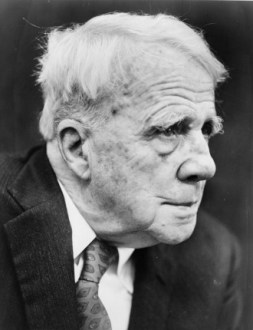
Congress photo
The last stanza takes us into the Hoyt living room, perhaps by looking in at its bay window. Frost imagines his tree as a prisoner confined in ropes of popcorn and chains of tinsel. It has “lost its footing on my mountain slope/ And lost the stars of heaven.” But nature’s loss is art’s gain: the poet concludes with the passionate wish that the “symbol star” the tree “lifts against your ceiling” will “Help me accept its fate with Christmas feeling.” The Christmas festival, the human rite with the star as its symbol, redeems not only the young wretch’s lawlessness and the sacrifice of the tree but the poet’s primitive impulse to punish an offending neighbor. One has the feeling that it took Frost’s writing the poem for him to get over being wronged; in fact, it shows him still in the process of coping, right to the end. But “Christmas feeling” has the last word.
Frost thought well enough of his poem to include it in his next collection, A Witness Tree, which won the Pulitzer Prize for poetry in 1943. By that time, following the death of his wife, Elinor, in 1938, Frost had moved away from Shaftsbury. As for Freddie, he grew up to become an upstanding citizen, serving in the Navy, taking care of Arlington High, and raising four children with his wife Connie.
Ken Nicholson is 78 years old now and living with his wife June at Brookdale in Bennington. He’s told Fred Hoyt’s story to friends before, but he wanted someone to write it down for posterity, and I was happy to oblige. Fred’s daughter Sandy Knight confirmed the story and kindly supplied pictures of her father, the self-confessed – and immortal – “wretch” himself.
Robert Frost: “To A Young Wretch” (Boethian)
As gay for you to take your father’s ax
As take his gun — rod — to go hunting — fishing.
You nick my spruce until its fiber cracks,
It gives up standing straight and goes down swishing.
You link arm in its arm and you lean
Across the light snow homeward smelling green.
I could have bought you just as good a tree
To frizzle resin in a candle flame,
And what a saving t’would have meant to me.
But tree by charity is not the same
As tree by enterprise and expedition.
I must not spoil your Christmas with contrition.
It is your Christmases against my woods.
But even where, thus, opposing interests kill,
They are to be thought of as opposing goods
Oftener than as conflicting good and evil;
Which makes the war god seem no special dunce
For always fighting on both sides at once.
And though in tinsel chain and popcorn rope
My tree, a captive in your window bay,
Has lost its footing on my mountain slope
And lost the stars of heaven, may, oh, may
The symbol star it lifts against your ceiling
Help me accept its fate with Christmas feeling.
