


Editor’s note: Mark Bushnell is a Vermont journalist and historian. He is the author of “Hidden History of Vermont” and “It Happened in Vermont.”
[T]he movie begins with a close-up of a snowy New England village. It could be Vermont. The camera pulls back and we see that it’s just a painted backdrop on a crudely built stage erected in the midst of a bombed-out town. Actors Bing Crosby and Danny Kaye, portraying soldiers, are in the midst of performing in a variety show near the frontlines during World War II.
The scene takes place somewhere in Europe on Christmas Eve 1944. Between songs, Maj. Gen. Thomas Waverly, their beloved commander who is being replaced, rises to bid his men adieu. Waverly starts becoming emotional, so Crosby allows him a graceful exit by launching into the finale, “White Christmas,” which makes all the other men emotional too. As Crosby croons that he is dreaming of white Christmases “just like the ones I used to know,” it is all the GIs can do to keep from crying.
“White Christmas” is sometimes thought of as the most famous song about Vermont, though it actually never mentions the state. But because the tune appears in both the opening of the movie of the same name and in its finale, which takes place on Christmas Eve in Vermont, the song and the state have long been linked.
The movie “White Christmas” came out in 1954 and undoubtedly boosted winter tourism in Vermont. It didn’t create the image of Vermont as a winter wonderland — the state and its burgeoning ski industry had been working for years to make this more than a three-season destination — but the movie certainly helped spread the word.
For the previous two decades, ski areas had been operating in places like Stowe, Pico, Bromley and Suicide Six. By the time the film “White Christmas” was released, skiing in Vermont was fashionable. Skiers were flocking to the original ski resorts and newer places like Ascutney, Mad River Glen and the Middlebury Snow Bowl. Soon, Okemo, Jay Peak and Sugarbush would join the list. The chic allure of skiing probably helped persuade scriptwriters to make Vermont the iconic land of white Christmases.
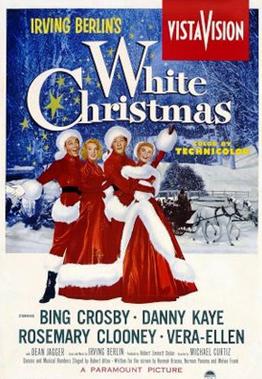
A poster advertises the 1954 movie “White Christmas.” Wikimedia Commons photo
The song’s original connections with the state are tenuous at best. Songwriter Irving Berlin wrote it more than a dozen years before the Vermont-linked movie came out. But it was Crosby’s song from the start. He first sang it publicly 77 years ago, on Christmas Day 1941. The song, with its references to Christmases of the past, was particularly poignant to listen to then. Just a couple of weeks earlier the United States had entered World War II following the Japanese attack on Pearl Harbor.
Crosby released the song on a record in 1942 and that same year he sang “White Christmas” as part of the soundtrack for another movie, “Holiday Inn,” which he starred in with Fred Astaire. In that movie, the song is sung in (and presumably about) Connecticut, not Vermont. The song was wildly popular from the start. It remains the most popular ever released, according to the Guinness Book of World Records, which bases its standing on sales of singles.
Paramount Pictures was understandably interested in making the song the centerpiece of a movie. “White Christmas,” the movie, was supposed to be a reunion of Crosby and Astaire, but illness forced Astaire to back out. Danny Kaye took his place as Crosby’s wartime buddy. The movie was filmed entirely in California, a soundstage and fake snow standing in for Vermont and the real stuff.
Which brings us back to the scene from 1944 on that battlefield stage. Just as Crosby finishes “White Christmas,” the Americans come under an artillery barrage and Kaye saves Crosby from being crushed by a tumbling wall. Kaye injures his shoulder saving Crosby and uses the fact to comic effect throughout the film. Anytime they disagree, Kaye starts to rub his shoulder, reminding Crosby that he owes Kaye his life and loyalty. The old-war-wound ruse gets Crosby to agree to Kaye’s plan to tour the country as performers after the war.
While touring, the two meet another pair of performers, the Haynes Sisters, played by singer Rosemary Clooney and dancer Vera Ellen. Eventually, and predictably, they fall in love with the sisters.
The movie’s setting moves to Vermont when the Haynes Sisters land a gig there. The four are eating in a train’s dining car when the sisters announce their plans to perform over the holidays at the Columbia Inn in Pine Tree, Vermont, both of which were invented for the film.
“Oh, well, that sounds very Vermonty,” says Crosby. “Should be beautiful this time of year in Vermont, all that snow and everything. Fir trees and clean pine air. Brrrrrr.” He shivers. “Very beautiful, just what we need,” but he’s clearly less than eager to brave the cold.
The Haynes Sisters urge him to say yes. When Crosby hesitates, Kaye rubs his shoulder. What choice does Crosby have?
“If you’re ever under a falling building and someone runs up and offers to pick you up and carry you to safety,” Crosby tells the sisters, “don’t think, don’t pause, don’t hesitate a moment, just spit in his eye.”
“What did that mean?” Clooney asks.
“It means we’re going to Vermont,” explains the chagrined Crosby. But he quickly warms to the notion: “Might not be bad at that. The snow-covered slopes, the skiing. Christianas and the stemming and the platzing and the schussing. Hot buttered rum, light on the butter. And snow.”
That’s the cue for the four to lean together over the table and break into a memorably cheesy song. Between them is a menu reading “Have fun in the snow” and “Vermont: The Winter Playground of America.” The Vermont Department of Tourism couldn’t have scripted it better. The dining car’s Vermont theme matches the train’s final destination.
The song is about how much they all love snow — skiing and making snowmen and snowballs. Clooney even sings the bizarre line, “I want to wash my hands, my face, my hair with snow.”
Then, referencing the title song, Crosby sings, “What is Christmas with no snow? No white Christmas with no snow.”
Here’s why “Snow” never quite matched “White Christmas” for popularity:

When the characters reach Vermont, they learn that the owner of the Columbia Inn is their old commander, Maj. Gen. Waverly. What are the odds? Waverly is on the brink of bankruptcy, because Christmas is fast approaching and there’s still no snow.
Crosby and Kaye contact friends from their old Army unit, who eagerly agree to help Waverly. The former soldiers and their wives surprise the general, packing the inn on Christmas Eve. Crosby, Kaye, Clooney and Vera Ellen put on an elaborate variety show at the inn that ends with another rendition of “White Christmas.”
Outside it’s snowing and all is well again. It’s as if in this season the world’s troubles can be erased by snow falling in Vermont.
