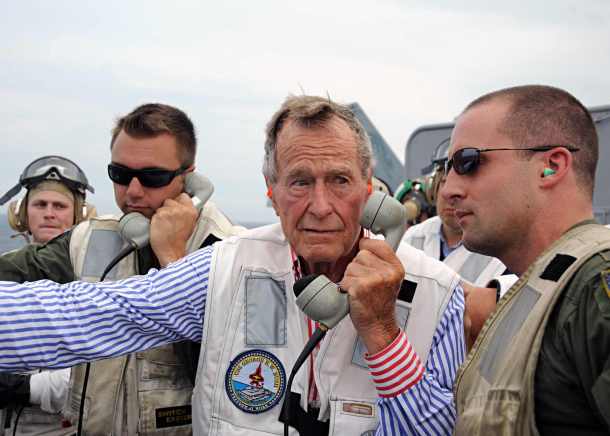
[Y]ou know why I’d like to be rich,” asked the fellow standing on the opposite side of the fuselage of a sleek, white, two-seater aircraft. “So I could afford one of these babies.”
To each his own definition of rich. By most definitions, that fellow had been since the day he was born.
He was George Herbert Walker Bush, the grandson of the wealthy banker and businessman George Herbert Walker (Golf’s Walker cup is named for him), the son of banker and former U.S. Senator Prescott Bush. On top of that, he had started (using inherited money and the connections made at Philips Andover Academy and Yale as a cushy base) a successful Texas oil drilling company.
How rich did he have to be?
Apparently rich enough to afford that plane, which at that moment he thought was out of reach.
Usually, the multi-millionaire crying poverty will seem obnoxious to the non-millionaire to whom the cry is directed. But there was something about Bush that made it less obnoxious than endearing. He was really enthusiastic about that plane, and at 55 didn’t mind sounding like a kid who wanted a toy. Besides, it was nice to see a guy running for president interested in something other than the latest polls and talking points.
This was late in 1979, at the airport in Des Moines, Iowa, where the relatively unknown Bush was meeting with influential Republicans, hoping to upset front-runner Ronald Reagan in the Iowa precinct caucuses which then and now began the presidential nominating process.
He did achieve a brief upset, landing in New Hampshire (the primary then was weeks, not days, after the Iowa caucuses), bragging that he had momentum: “the big mo.”
Then – not for the last time – he blew it. He didn’t talk about much except having that “big mo” which became tiresome. He refused to promise to cut taxes. And on the Saturday night before the February 26 primary, he got not simply outfoxed by Reagan and the other contenders at a candidate debate in Nashua, he got downright humiliated.
Reagan beat him by more than 20 points. Some big mo.
He was staying at the New Hampshire Highway Hotel in Concord, a long-gone, sprawling place in which almost every room had a door to the outside as well as one to the corridor.
I was staying in the next room, it turned out, and when I walked outside to put my suitcase in my rental car, there was Bush, in suit and tie and expensive charcoal gray overcoat, standing next to a big black car while an aide loaded it.
“Good morning, George,” I said. “How do you do this morning?”
He gave me a wry smile.
“This morning? Not so good.”
“No, I guess not,” I said. “But you’ll live to fight another day.”
I got another wry smile.
He did fight on, and won a few primaries, but never really recovered from that New Hampshire humiliation. Luckily for him, Reagan was smart enough to want to unite his party, and chose Bush as his running mate.
Learning to accept humiliation is good training for the vice presidency, and Bush handled the job well enough to win the presidential nomination eight years later. That 1998 campaign was not his finest hour. He started it irresponsibly, proclaiming in his acceptance speech, “Read my lips. No new taxes.” Later, as vice president, he never came clean about what he knew about the Reagan administration’s sneaky plot to funnel Iranian money to Central American terrorists.
Then there was the blatantly racist Willie Horton commercial, engineered by campaign manager (and – full disclosure – my friend) Lee Atwater who apologized for the “naked cruelty” of that campaign before he died, at 40, in 1991.
Bush, however, never apologized. It was as though he would do anything to get elected.
Once elected, his better qualities emerged. Because he was defeated when he ran for re-election, it’s tempting to consider Bush an unsuccessful president. But his administration was not a failure. He was wise enough to know that the “no new taxes” pledge had been a blunder, and courageous enough to abandon it. He was both wise enough and strong enough to deal prudently and effectively with the disintegration of the Warsaw Pact and the Soviet Union. Some Americans – and quite a few Republicans – wanted the United States to gloat about winning the cold war. Not Bush. He’d played baseball, not football, at Yale. But had he ever scored a touchdown, he would never have spiked the ball in the end zone. Not his style.
Nor was it his style to exceed his own goals or the United Nations resolution after the coalition had had brilliantly assembled kicked Iraqi forces out of Kuwait. That was his pledge. That was his goal. He wanted no wider war. He’d been in a war.
Perhaps nothing about Bush’s political life was more ironic and more incorrect than the frequent taunts that he was a “wimp.” Not as strong, for instance, as Reagan, who (according to conservative myth) never wavered, and would never, for instance, have agreed to a tax increase.
Reagan agreed to 11 tax increases during his eight years in office.
As to who was the stronger man, well, Reagan did all he could to avoid combat during World War II, which he spent making movies in Hollywood. Bush enlisted in the Navy, flew 58 combat missions, was shot down over the Pacific. He was, then and later, a strong man, strong enough that he didn’t have to strut.
But he could be a political klutz. That, more than the tax increase, is what did him in in 1992. The recession of 1990-91 had been mild, and was over before the election year. But the economy was still sluggish, people were out of work, and somehow Bush was never able to convince them that he cared about their plight, much less that he had a plan to deal with it.
I had taken a brief respite from covering politics a few years earlier, and among other things had written a book, “How to Fool Fish With Feathers: An Incompleat Guide to Fly Fishing,” brilliantly illustrated by the late Jeff MacNelly (Simon & Schuster, 1992). For fun, I repeated a line Bush had used in chatting with a few reporters back in 1998, when he recounted, “standing by the edge of the river, flipping my rod up and down with no effect.”
I managed to get a copy to Bush, and on April 11, 1992, he wrote to thank me.
“This is some ugly year,” he wrote. “But fishing … restores a sense of balance to things. I think I am going to win, but should fate decree otherwise I contemplate a future of hooks in the water …”
At the time, I was both pleased and puzzled that the President of the United States would take the time to write a letter to thank someone he didn’t know all that well for a rather frivolous book. Looking at it after he died over the weekend, it also struck me that it was not surprising that Bush should care about “a sense of balance.” He had one.