


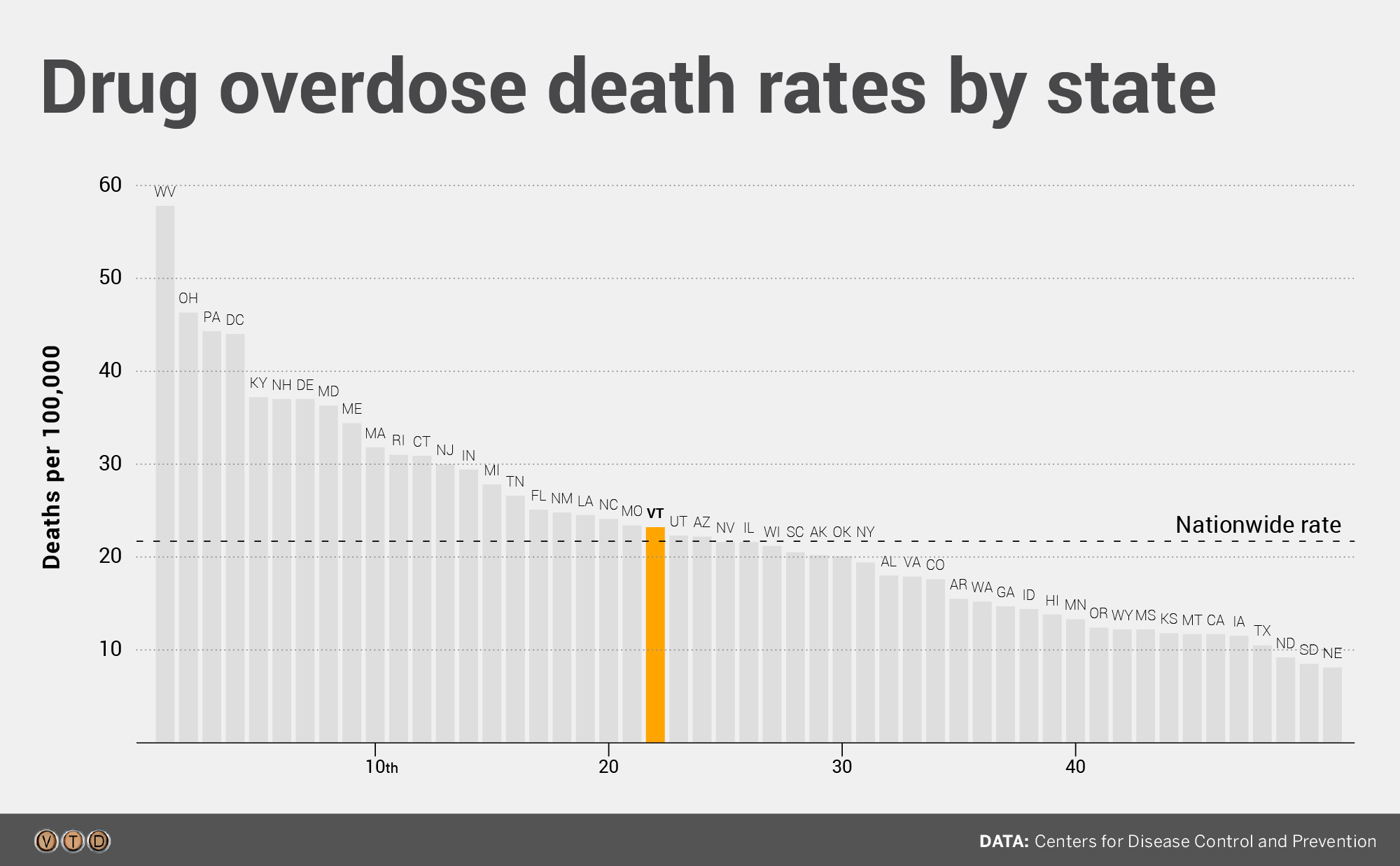
Vermont’s rate of fatal drug overdoses ranks 22nd in the country, putting the state on par with the death rate nationwide, a new federal report shows.
The report from the Centers for Disease Control and Prevention also shows that Vermont’s overdose death rate last year – 23.2 per 100,000 people, as per an age-adjusted formula – is lower than any other New England state.
Nevertheless, the federal report is “a stark reminder that we must continue to do everything we can to prevent people from starting down the destructive and often fatal road of drug use disorder, and to ensure that treatment options exist for everyone in Vermont who needs them, no matter who they are or where they are,” state Health Commissioner Mark Levine said.
In a statement issued Thursday, Levine added that “our data and that of the CDC tell me that Vermont and the nation have to be in this for the long haul.”
Prior to Thursday’s CDC report, Vermont had released fatal overdose statistics for 2017. A tally of all drug overdoses showed 124 deaths, down from 132 the year prior; the count for opioid-related deaths showed an increase from 96 to 101.
The CDC’s report considered all overdose deaths and came up with 134 such cases for Vermont – 10 more than the state’s report shows. Officials note that the state and the CDC use different methodologies when examining causes of death, which causes discrepancies in annual totals.

The federal report found that, nationally, there were 70,237 overdose deaths in 2017. That equates to an age-adjusted rate of 21.7 deaths per 100,000, an increase of 9.6 percent from the year before.
The national death rate has risen in each of the past five years. In 1999, the death rate was just 6.1 per 100,000.
Vermont’s 2017 overdose death rate is considered “statistically the same” as the national rate. And it puts the state near the middle of the pack, as a state-by-state breakdown shows that 20 states and the District of Columbia have higher rates.
The highest death rates in the country were in West Virginia (57.8), Ohio (46.3) and Pennsylvania (44.3). The lowest were found in Nebraska (8.1), South Dakota (8.5) and North Dakota (9.2).
Vermont had the lowest overdose death rate among the six New England states. The highest rate in the region was 37 deaths per 100,000 in New Hampshire.
Levine said Vermont has “hovered around the national average” for overdose deaths for several years. And he noted that the rate of increase in opioid-related deaths has slowed in Vermont.
“Even so, most important is to remember that these are people, not just numbers – members of our families, friends, loved ones and neighbors,” Levine said. “Any single death is a terrible loss, and my focus is on how we can prevent any more.”
State and federal funding has supported a wide variety of initiatives in Vermont such as the hub and spoke system of medication-assisted treatment; free distribution of an overdose-reversal drug; needle exchanges; unused medication disposal; and peer counseling.
“Vermont took steps early on to implement a number of significant actions to enhance prevention, promote screening and early intervention, monitor prescribing, expand treatment and support recovery,” Levine said. “What I see from the national figures is that our neighboring states and others around the U.S. are starting to also see the positive impact of their own programs as they get established.”
Other national findings from the CDC report included the fact that males continue to be far more likely to die from a drug overdose than females. The death rate among men was 29.1 per 100,000 last year, compared with 14.4 for women.
The CDC also found that the age groups with the highest fatal overdose rates were age 25-34 (38.4 deaths per 100,0000); age 35-44 (39 per 100,000); and 45-54 (37.7 per 100,000).
The 55-64 age group’s death rate was lower, comparatively. But the CDC noted a big jump in that segment of the population: The death rate was 4.2 in 1999 and has risen to 28.
Federal officials also said deaths related to synthetic opioids other than methadone – a group that includes fentanyl – continue to surge. The number of such deaths was 9,580 in 2015 and stood at 28,466 in 2017.
Vermont has seen a similar trend. Fentanyl was involved in two-thirds of the state’s opiate-related deaths in 2017, and Levine said he is “very concerned that it’s expanding into a broader range of drugs.”
“We are starting to see more people dying as a result of using cocaine that has fentanyl cut into it,” Levine said. “This makes it extremely important that people understand universal precautions. If you are using street drugs – any street drug – assume it has fentanyl in it … and take steps to be extra cautious if you do use.”
The Health Department also offered other precautions to drug users:
• Do not use alone – have someone with you who can give naloxone and call 911 to save your life.
• Use only one drug at a time.
• Don’t mix drugs with alcohol or benzodiazepines.
• Test the strength of the drug before using the whole amount.
• Cut the amount that you use at one time.
