

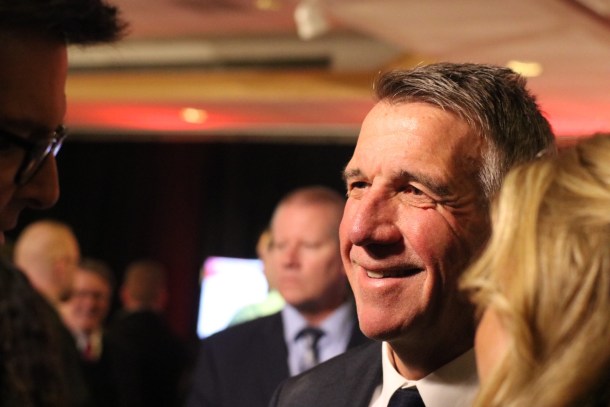
[G]ov. Phil Scott touched down in Arizona Tuesday afternoon for the Republican Governors Association’s annual two-day conference being held this year in Scottsdale.
The RGA was the top spender in this year’s election cycle in Vermont, pouring more than $800,000 into ads and mailers in support of the incumbent governor.
Scott last attended the event in 2016, after winning election to his first term. Vermont’s governor is not slated to speak at the event this year.
Brittney Wilson, who managed Scott’s campaign, said it was an opportunity to network and exchange policy ideas with other Republican leaders from around the country.
Wilson said the governor is planning on catching up with fellow New England Republican governors Chris Sununu of New Hampshire and Charlie Baker of Massachusetts to discuss regional matters.
“Kind of ironic that we’re going to Arizona to catch up on some regional issues,” Wilson said, noting that it’s been difficult for New England’s GOP governors to find time the time to get together under the same roof.
One issue that could be up for discussion is the possibility of forming a voluntary paid family leave program with New Hampshire, Wilson said.
While Scott vetoed the paid family leave bill because it was mandatory and included a payroll tax, he said he would be open to a voluntary system and forming a system with other states, such as New Hampshire, to increase the size of the program.
Scott has previously talked about making Vermont part of regional solutions to energy and health care affordability, given the economic advantages that could be gained by multi-state economies of scale and geographic alignment.
Congratulations to GOP Governor @GovPhilScott on winning re-election in VERMONT! #VTGov https://t.co/1cHZR3cQhM pic.twitter.com/7LOtbLeLZ9
— The RGA (@The_RGA) November 7, 2018
Many of the Republican governors convening in Scottsdale have more conservative views than moderates like Scott, who made national headlines earlier this year when he signed a package of gun control reforms.
Scott has been critical of GOP politics in Washington, particularly President Donald Trump’s policies and rhetoric.
During the 2016 RGA conference, before he was sworn into office, Scott said that he wouldn’t be afraid to “push back” against the national Republican agenda. And he has often made good on his word.
Scott, Baker and Maryland Gov. Larry Hogan declined to sign onto a letter with other Republican governors earlier this year urging United States senators to confirm Trump’s nominee for the Supreme Court, Brett Kavanaugh.
In 2017, Baker and Scott signed a letter urging Trump to maintain U.S. commitment to the Paris climate accord.
“There’s certainly other moderate Republican governors out there that we can build coalitions with to work together and push back on what’s going on in Washington,” Wilson said Tuesday.

Scott is also looking forward to attending panels on a variety of policy issues, including one focused on cybersecurity, she said.
Both in 2016 and this year, the RGA, a national organization focused on electing Republican governors across the U.S., has poured thousands of dollars into supporting Scott and attacking his Democratic opponents.
The RGA’s spending on Scott’s behalf has been blasted by Democrats, who have criticized the organization’s ties to corporate donors including Pfizer, AT&T and the billionaire Koch brothers.
The Democratic Governors Association, the RGA’s counterpart, has also poured millions into Vermont politics. While the organization didn’t wade into this year’s gubernatorial race, in 2016, the organization spent $1.4 million on Democratic candidate Sue Minter.
Former Gov. Peter Shumlin, a Democrat, served as the chairman of the DGA during his first two terms in office.
During a press conference last week, Scott said he wasn’t surprised to learn that the RGA was the biggest donor of the election cycle with the $826,000 spent supporting him. In 2016, they spent even more on his campaign — roughly $2.8 million.
“It’s not anywhere near where it was two years ago, but obviously it helped in our success,” Scott said.
Could he have won without the group’s largesse? “We certainly could, yes,” he said.

