


[N]ational political prognosticators will view U.S. Sen. Bernie Sanders’ new book “Where We Go from Here” as a 288-page telegraph of his thoughts on a potential 2020 presidential bid.
“I love Iowa,” he writes of the first place to hold a nominating caucus. “It is a small rural state like my own state of Vermont, with down-to-earth, hardworking people.”
Green Mountain residents who just re-elected the senator to a third term may pick up the hardcover upon its release Tuesday and see something else.
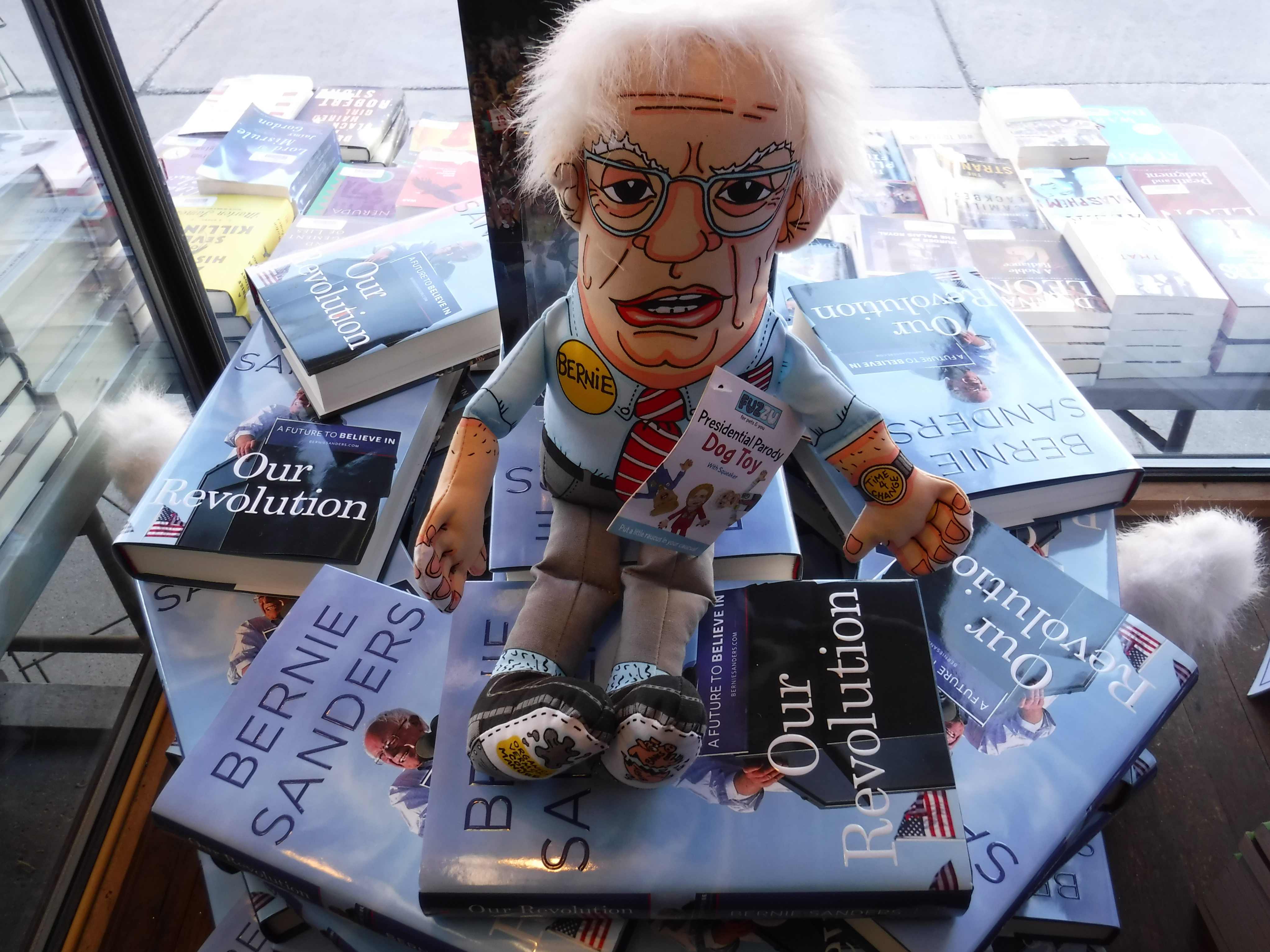
When Sanders debuted his earlier title “Our Revolution” a week after Donald Trump won the 2016 presidential election, the Vermonter’s first book in a $1.3 million, multi-title deal with global media powerhouse Macmillan skyrocketed to No. 1 on Amazon.com’s top 100 best-sellers list.
Two years later, Sanders’ latest effort is arriving with great expectations — both for sales and the fact it may signal another White House run, as Barack Obama’s 2006 “The Audacity of Hope” and Hillary Rodham Clinton’s 2014 “Hard Choices” were released two years before their own authors’ bids.
Macmillan’s imprint Thomas Dunne Books has worked to keep the contents of “Where We Go from Here” under wraps for months. But a copy obtained in advance by VTDigger shows the text to be equal parts forward-thinking and, for those who know state history, a surprising throwback.
Sanders — spoiler alert — doesn’t reveal his specific future plans in a book that, at $27.99, costs the same as the average contribution for his unsuccessful 2016 presidential campaign.
“When I announced that I would run for reelection to the Senate,” he writes, “the media’s response, both in Vermont and nationally, included the question: Would I be running for president in 2020?”

His answer: “The year 2020 remains a long way off.”
But that doesn’t stop the author from elaborating on all the reasons why someone like himself should oust Trump.
“At a time of massive and growing income and wealth inequality, as our nation moves closer and closer to an oligarchic form of society, we need an unprecedented grassroots political movement to stand up to the greed of the billionaire class and the politicians they own,” he begins the book’s introduction.
Sanders goes on to include all his greatest stump-speech hits, advocating on page 3 alone for livable wages, pay equity for women, Medicare for All, tuition-free public college, infrastructure improvements, higher taxes on the rich, climate-change mitigation and reform of the nation’s campaign finance, criminal justice and immigration systems.
‘Not a ‘now-it-can-be-told’ revelation’
Flip to the first chapter and you’ll find the book rewinds to June 14, 2016, and Sanders’ memories of “Meeting With Hillary Clinton” — just one of 38 diary-esque entries in which he chronicles what the book’s subtitle calls “Two Years in the Resistance,” from Trump’s election up to this month’s midterms.
Anyone who has read the late Vermont U.S. Sen. George Aiken’s 1976 “Senate Diary” will immediately notice a resemblance.
“This personal record spans the end of our involvement in Vietnam, our reconciliation with Russia and China, the Watergate affair, the resignation of President Nixon, and the first few months of Gerald Ford’s presidency,” Aiken wrote in the opening of his own book four decades ago. “Although I noted how I felt and what I did as a senator during this crucial period in our country’s history, what I have set down is not a ‘now-it-can-be-told’ revelation. I hope passages will not be taken out of context and magnified to sensational proportions.”

The fact Sanders would agree with the latter sentiments is just one way the seeming opposites — Aiken the native Republican and Sanders the Brooklyn-born revolutionary — are similarly frank, wild-haired figures of their times who won election by building grass-roots bases, championing the working class, challenging political party machinery and embodying the common man.
Sanders first met Aiken in 1973 when he persuaded Vermont Life magazine to pay him 10 cents a word to interview the elder statesman, and today honors their shared goals through a tribute on his U.S. Senate website.
Then again, Aiken dictated his diary once a week before the now-late historian Ralph Nading Hill edited the nearly half-million-word document into a 370-page volume. Sanders, for his part, forgoes personal insight for a manuscript heavy on bare-bone facts.
“The media often worries about personality, gossip, polling, and gaffes,” he writes on page 18. “I worry about ideas and policy that will improve the lives of the working families of our country.”
That’s why readers have to wait until page 48 to discover the book’s first of a scant three People magazine-worthy passages.
“Election night after election night,” Sanders writes, “we sit around the TV and a computer or two and, like most Americans, watch the returns come in. Nothing fancy. We munch on cold cuts, cookies, and potato chips and have some wine and beer.”
“The usual custom is that when the results become apparent, Jane and I would head downtown to a hotel ballroom to be part of the Vermont Democratic Party gathering,” he continues, referring to his wife. “On the night of November 8 (2016), we never made it downtown. We were just too depressed. Donald Trump had been elected president.”
‘One of those moments you dream of’
On page 65, Sanders recounts sitting at Trump’s swearing-in between Republican Sens. John McCain and James Inhofe, whose own recent book is titled “The Greatest Hoax: How the Global Warming Conspiracy Threatens Your Future.”
“It looked like rain,” Sanders writes. “Senate staff distributed plastic ponchos. I didn’t need one. I had my all-purpose, super-warm, hooded Vermont coat.”
“My most vivid memory of that day, in addition to getting booed by the Trump crowd when my image flashed on the large TV screen, was Michelle Obama walking down the stairs to her seat at the inauguration alongside President Obama,” he continues. “Her attire and tone said it all. The beautiful and fashionable first lady was clearly not at this event to celebrate.”
And on page 160, Sanders both reveals and revels in a glimmer of joy when he tells of visiting the spring training camp of his former hometown and current Los Angeles Dodgers.
“Frankly, it’s one of those moments you dream of as a kid — walking out onto a baseball field to a cheering crowd,” he writes. “I was delighted to sign baseballs and take selfies and recognize, somewhat belatedly, that I had chosen the wrong profession.”
Enter a sportswriter who, just by appearing, unwittingly snuffs out the light.
“I mentioned to him that the departure of the Dodgers from Brooklyn, where I was born and raised, was a major political revelation for me,” Sanders continues. “When the team moved to Los Angeles, I experienced one of my first moments of recognition of the power of corporations and wealthy individuals. Up to then, it had never occurred to me and my friends that an institution like the Brooklyn Dodgers could leave Brooklyn, any more than the Brooklyn Bridge or Prospect Park could leave Brooklyn. It turned out that for the owners of the Dodgers, there was something that mattered more than community: money.”
One page later, Sanders is back to work.
“It has been a hell of a two weeks,” he writes. “I helped write a $1.4 trillion omnibus appropriations bill, held a nationally televised town hall meeting on income and wealth inequality, and brought a resolution to the Senate floor to end the war in Yemen.”
Without further introspection to fill out his 266-page book, Sanders includes several whole speeches. “Here is the speech that I gave at the Democratic National Convention on July 26, 2016,” he writes before sharing the full text for the next seven pages. A chapter titled “A Progressive Foreign Policy” offers another “here is the speech I delivered,” this one a 2017 address at Missouri’s Westminster College that runs 18 pages.
‘A time to stand up and fight back’
“Where We Go from Here” is arriving without much of a publicity machine. The Atlantic, one of the few media outlets to have read or written about Sanders’ book in advance, sums it up as “a rundown of the ways he’s been able to keep a hold on American politics.”
“Sanders notes his successes in getting the Democratic National Committee to eliminate superdelegates and in persuading many Democratic politicians to sign on to Medicare for All,” the magazine notes. “He lays out his foreign-policy philosophy. He also devotes chapters to his support for gun-control laws, addressing a weakness in his record that Clinton exploited in the 2016 campaign, and another to Martin Luther King Jr., which seems aimed at the weakness he had attracting black voters.”

Sanders, having appeared on the CBS Sunday news show Face The Nation, is set to speak Tuesday at George Washington University in the nation’s capital before attending a three-day private Sanders Institute summit of supporters Thursday through Saturday in Burlington.
After that? Although he’s visited 32 states in support of progressive politics, Sanders has no public plans for an immediate book tour.
“The Christmas season is not a great moment for organizing anything,” he writes on page 59. “People are preoccupied with the holidays.”
Sanders, in contrast, doesn’t stop for anything. Take weekends.
“Sometimes when I’m in the DC airport heading back to Vermont, the people I talk to assume that I’m heading home for a weekend of fun and relaxation,” he writes on page 202. “The truth is that I often work harder on weekends in Vermont than I do during the week in Washington.”
“As attractive as retirement might seem,” the 77-year-old continues on page 213, “Jane and I concluded that it was just not conceivable for us to walk away from the enormous problems facing our state and nation.”
Such words don’t necessarily signal a 2020 presidential bid. Although Sanders won 23 primaries and caucuses in 2016, that was a two-Democrat race. This coming election, he’s running second in national polls but facing plenty of potential competition, with former Vice President Joe Biden leading a field of more than a dozen rumored contenders.
Where does Sanders go from here? “Where We Go from Here” only hints at a future direction.
“This is not a time for despair,” the author writes in the book’s closing paragraph. “This is not a time for depression. This is a time to stand up and fight back.”
