

Editor’s note: Mark Bushnell is a Vermont journalist and historian. He is the author of “Hidden History of Vermont” and “It Happened in Vermont.”
[S]eparating fact from fiction can be tricky business. The story of the Vermont officer and the Confederate woman who saved his life doesn’t make it any easier.
The tale, with all its stunning facets, was popularized by writer Lucius E. Chittenden in his 1893 book “The Unknown Heroine.” Chittenden wrote the book as a novel, but the most startling thing about the story is that it is true. Not every detail, and surely not the dialogue, but the basic facts, which are recorded in nonfiction accounts as well.
Mark Twain once commented that “it’s no wonder that truth is stranger than fiction. Fiction has to make sense.” In that sense, Chittenden can be forgiven for massaging the facts to make the narrative flow better. He was writing a novel, not a police report. But the basic facts were so astounding that Chittenden didn’t have to change much to keep this Civil War drama compelling.
The main characters in the story were Henry Bedell, a 28-year-old farmer from Westfield, Vermont, who had enlisted in the Union Army and risen to the rank of lieutenant; and Bettie Van Metre, a married woman, about 20 years old, living in Virginia’s Shenandoah Valley, whose husband had been captured while serving in the Confederate Army.
During fighting on Sept. 13, 1864, near Opequon Creek in Virginia, Bedell’s unit came under heavy cannon fire. “The rebs began to shell us,” wrote U.S. Army Capt. Charles Buxton, a Vermonter. “(T)he 2d shell came into our ranks & wounded Lieut. Bedell…”
The shell smashed through Bedell’s left thigh, leaving a horrific wound that bled heavily. He was also struck in the right hand, the blow shattering several bones and severing a finger.
Field surgeon couldn’t focus on treating the hand. It would have to wait. The thigh wound looked likely to prove fatal, but the surgeon set to work anyway, sawing off Bedell’s leg and bandaging the wound.
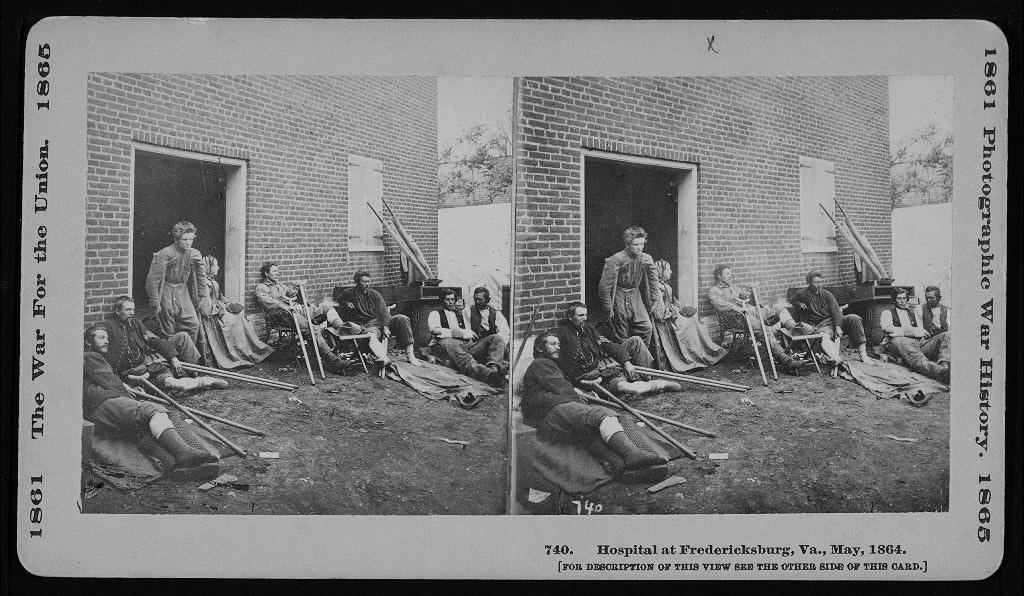
Afterwards, Bedell was carried to the second floor of a vacant nearby house and laid on a crude straw bed. He wasn’t expected to survive the night. When he did, surgeons set the bones in his hand and removed another badly damaged finger.
Two days after the battle, officers decided to evacuate the wounded to Harper’s Ferry, West Virginia, some 20 miles distant. The bumpy journey in a horse-drawn wagon seemed likely to kill Bedell, so he was left in the house.
Stories differ as to what happened next. Perhaps an orderly remained behind with Bedell, who soon told him to leave to avoid capture or death at the hands of marauding rebels. Perhaps Bedell was left in the care of an elderly couple, or just an elderly woman, who was given provisions and money to care for the wounded man. But most versions of the story say that Bedell was betrayed. Whoever was to care for him ate through the supplies and left him to die upstairs.
Van Metre, who was living on her nearby farm alone, except for an older enslaved man named “Uncle Dick” Runner, learned there was an injured Union soldier in the neighborhood.
“Neighborhood” is perhaps the wrong word, in that it suggests some sort of orderly society. Anarchy ruled in the burned-over Shenandoah Valley as the war was drawing to an end.
Rather than seek revenge for the imprisonment of her husband, Van Metre’s response was humane. She brought water and food to Bedell and cleaned his wounds. Van Metre was barely surviving on her own. Fighting had devastated Van Metre’s farm, so she and Runner were short on food, and she had no medicine with which to treat Bedell.
The only place she thought she could get supplies was from Union troops at Harper’s Ferry. So she rode the 20 dangerous miles to the Union stronghold. Nearing Harper’s Ferry, she encountered Union pickets, who took her to their commander. The general is said to have admired her courage and believed that she was who she said she was, and not a Confederate spy. He sent her off with supplies, including a large amount of liquor, both to ease Bedell’s pain and to buy the silence of others who knew of Bedell’s presence in town.
Van Metre began making weekly journeys to Harper’s Ferry for supplies and to send the letters that Bedell managed to write with his mangled hand. Eventually, letters of reply arrived from Bedell’s family in Vermont.
When Bedell regained enough strength, he and Van Metre decided to travel together to Washington, D.C. This ride was more dangerous for the Northern soldier than the Southern woman, as the route was crawling with outlaws and bands of Confederate troops.
They asked a local farmer to drive them in a wagon to Washington. The farmer had had two mules stolen by Union troops, so Bedell said that if the man took them to safety, he would help get the mules back. Van Metre was also eager to get to Washington, where she hoped to persuade officials to help her find her husband.
The farmer modified a wooden shipping container for Bedell to ride in. The farmer cut slits in the box to let in air and light, and piled hay around it to conceal it. For protection, the farmer gave Bedell a rifle and revolver.
Riding north, they were attacked by a pair of thugs from Baltimore, Chittenden writes, though this might have been a literary flourish. The men had supposedly enlisted in and then deserted from both armies, and were wanted for murder. They grabbed the horses’ reins and demanded money. In a flash, both men were dead, having been shot by the Union officer concealed in the crate.
The rest of the trip to Washington was comparatively uneventful. When they reached the capital, they told their story to soldiers they met. They got the farmer his mules back, and soon won an audience with Secretary of War Edwin Stanton. Stanton was reportedly so moved by Van Metre’s heroism that he issued an order that Van Metre’s husband, James, be released. The War Department, however, wasn’t sure where James was being held or whether he was even still alive.
Bedell, who by now was adept at using a pair of crutches, accompanied Van Metre to a prison camp in Ohio, where James was thought to be held. Upon entering the camp, Van Metre studied the haggard faces of the prisoners, hoping to recognize her husband. After several anxious moments, she recognized James, despite his thin face and new beard.
Reunited, the couple didn’t head south. It’s not clear whether Stanton’s order would have permitted that, since the war was still on. Instead, they accept Bedell’s offer of hospitality, heading north to Vermont to wait out the duration of the war with his wife, Emeline, and their four children.
When peace came, the families parted, but other published accounts say they visited each other regularly for decades afterwards.

