

[T]he federal government’s approval of a powerful new painkiller is raising alarm in Vermont, with some saying the drug may undercut efforts to reduce the number of addictive opioids in circulation.
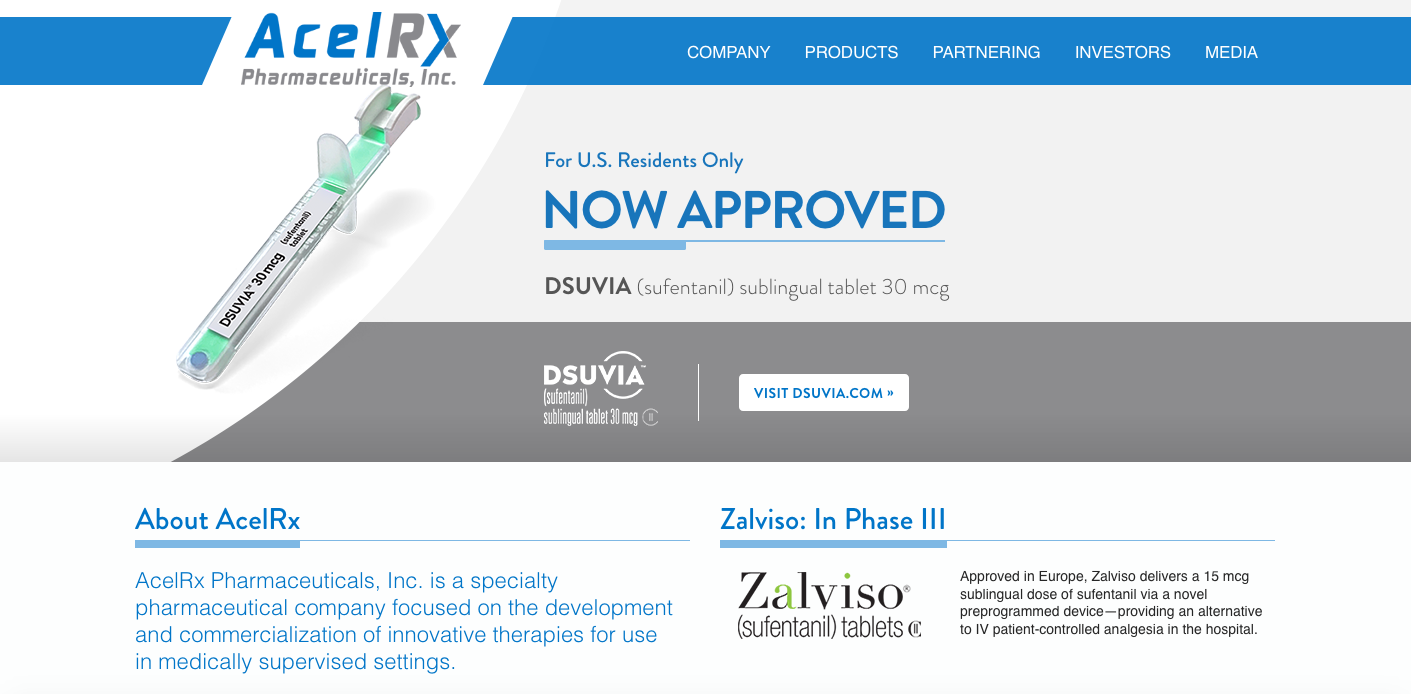
The U.S. Food and Drug Administration earlier this month OK’d Dsuvia, a new version of a drug called sufentanil that is five to 10 times more potent than the synthetic opioid fentanyl.
The news comes as Vermont struggles with a dramatic jump in fentanyl-related fatal overdoses, and as the state is pushing hard for doctors to issue far fewer opioid prescriptions.
While proponents say Dsuvia will be tightly controlled, Vermont’s top health official and its top law enforcement officer are among those expressing concerns about the drug’s potential to wreak further havoc.
“It seems counterintuitive to many of us that you would approve a very potent opioid at the same time when we’re trying to reduce overdose deaths from opioids,” state Health Commissioner Mark Levine said.

The manufacturer of Dsuvia, California-based AcelRx Pharmaceuticals Inc., paints a much different picture of its new drug. In announcing the FDA’s approval, AcelRx said Dsuvia – which comes in a single-dose tablet to be placed under the tongue – is designed to relieve severe pain in patients who may not be able to swallow a pill or receive intravenous medication.
“The FDA approval of Dsuvia is the culmination of nearly 15 years of research to improve the standard of care for managing acute pain in medically supervised settings,” Dr. Pamela Palmer, co-founder and chief medical officer of AcelRx, said in a prepared statement.
There’s a military angle to Dsuvia’s approval: The Army helped fund the drug’s development via a program that supports research related to recovering from traumatic injuries. In commenting on Dsuvia’s approval, FDA Commissioner Scott Gottlieb said the the drug “was a priority medical product for the Pentagon because it fills a specific and important, but limited, unmet medical need in treating our nation’s soldiers on the battlefield.”
On the home front, both AcelRx and the FDA are taking pains to point out that Dsuvia will be available only for administration by a health care professional in medical settings such as hospitals and surgical centers. It won’t be available in pharmacies.
Plus, Gottlieb said the FDA is requiring a “risk evaluation and mitigation strategy” with the release of Dsuvia. As part of that control program, the company has pledged to “monitor distribution and audit wholesalers’ data, evaluate proper usage within the health care settings and monitor for any diversion and abuse.”
“There are very tight restrictions being placed on the distribution and use of this product,” Gottlieb said. “We’ve learned much from the harmful impact that other oral opioid products can have in the context of the opioid crisis.”
Some aren’t so sure about that.
Prescription drugs have played a central role in an opioid epidemic that has caused a still-rising number of overdose deaths and has driven thousands of Vermonters into treatment.
Levine and others have said a majority of today’s heroin users started by abusing prescription drugs. And prescriptions are more than just a gateway: State statistics show that prescribed opioids are involved in about one-third of Vermont’s opioid-related overdose fatalities.
Fentanyl – in both prescription and illicitly manufactured forms – has emerged as a particular concern. In 2017, fentanyl was a factor in two-thirds of the state’s opioid-related deaths, and officials say deaths involving fentanyl have more than doubled since 2015.
Vermont is not the only state seeing a growing fentanyl problem: National statistics show that the number of fentanyl-related deaths is now five times higher than in 2013.
So introducing a new, even more powerful opioid into that environment frustrates some Vermont officials.

While Dsuvia may be helpful in some medical applications, “it’s still safe to wonder if this is filling some gaping void, and it shows that the pharmaceutical industry just follows the money,” said Burlington Police Chief Brandon del Pozo, who has been active in addiction policy issues.
A more appropriate investment, del Pozo said, might be in advancing addiction-treatment drugs. “To fit an extra angel on the head of the painkiller pin should not be the focus of the pharmaceutical industry right now,” he said.
And del Pozo is not convinced by the assurances of “tight restrictions” on the distribution and use of Dsuvia. “The demand for powerful, illicit opioids is so strong that we shouldn’t be dismissive of the black market’s incentive to divert or illegally synthesize this drug,” he said.
Ditto for Levine, who said he is “not comforted” by the fact that Dsuvia won’t be available for outpatient use at pharmacies.
“Every hospital has tales of (drug) diversion occurring within hospitals, often to health care workers who have substance-abuse problems,” the health commissioner said.
Levine noted that the state’s prescribing rules, put into place last year, have led to a significant drop in opioid prescriptions. “I don’t view (Dsuvia’s introduction) as something that’s going to help that cause,” he said.
Asked whether there are any actions the state might take to counteract the effect of the new opioid, Levine said he is more interested in seeing what action individual hospitals take as clinicians and pharmacists decide whether to incorporate Dsuvia into their treatment.
Vermont Attorney General TJ Donovan also said he wanted input from clinicians regarding Dsuvia.

“Given the public health crisis we have with opiates in this country, I question whether this drug is needed,” Donovan said. “I am concerned about introducing a new opioid onto the market and would like to hear more from the Vermont medical community about the necessity of this drug.”
The introduction of Dsuvia presents “a complicated scenario” for Dr. Trey Dobson, immediate past president of the Vermont Medical Society. Dobson, who also is chief medical officer of Southwestern Vermont Medical Center in Bennington and a practicing emergency room physician, said he can “certainly see times when the drug would benefit patients in acute care settings.”
While Dsuvia’s potency has caused concern, “it’s also a benefit in patients that need it,” Dobson said.
The question, Dobson said, is whether the new drug “is needed enough and advantageous enough to balance the risks of diversion.” Dobson said he had not yet done enough research to make that determination, but he said the FDA’s approval carries some weight.
The FDA’s decision sparked criticism from a physician that serves on a key advisory committee to the federal agency. But Gottlieb is trying to assure doctors like Dobson of Dsuvia’s safety and efficacy while also acknowledging that “the debate goes beyond the characteristics of this particular product.”
As part of his statement justifying Dsuvia’s approval, Gottlieb pledged that the FDA is developing a “formal benefit and risk framework” to guide the agency’s future deliberations on opioids.
“We won’t sidestep what I believe is the real, underlying source of discontent among the critics of this approval – the question of whether or not America needs another powerful opioid while in the throes of a massive crisis of addiction,” Gottlieb said.
