

Editor’s note: Mark Bushnell is a Vermont journalist and historian. He is the author of “Hidden History of Vermont” and “It Happened in Vermont.”
[H]orace Tabor was a walking, talking archetype of the American male in the 1800s. His choices in life took him on a Forrest Gump-like odyssey through some of the major moments in American life.
His life fits perfectly into the standard historical narrative of 19th century life. Here is this Vermont farm boy who finds opportunity lacking and leaves home. He lands in Kansas in time to play a role in the vicious battle over slavery that was tearing apart the region and nation. Then he heads to the western gold fields in hopes of striking it rich and finds that such ambitions can be a mixed blessing.
Tabor’s story starts in 1830 in Holland, Vermont. Born into a farm family, he was descended from a long line of soldiers and patriots, according to one of his early biographers. Yes, he became famous enough to have biographers.
But farm life wasn’t for a boy overflowing with ambition. He left home at 19 and learned the stonecutting trade in Massachusetts and Maine.

Stonecutting didn’t satisfy him either. He saw greater opportunity in the cheap land available in the Midwest. So he joined a group of 192 men, women and children caravanning west from Massachusetts to Kansas in March 1855. In Kansas, Tabor would return to farming. He started with 160 acres and soon borrowed enough to buy another 320. The 480-acre spread was like nothing Tabor could have amassed in Vermont.
The Kansas that Tabor knew was in the midst of tremendous political upheaval. The territory, not yet a state, was the focus of the national debate over slavery. Pro- and anti-slavery factions flooded the territory hoping to steer the future state to their position. Tabor sided with the Free Soilers, who wanted the region farmed only by freemen. They weren’t necessarily abolitionists, though. Many opposed slavery because they didn’t want to compete with blacks, enslaved or free. Tabor’s own views on slavery are unknown.
Politics soon attracted Tabor. He won election to the House of Representatives in the Free Soiler government. That doesn’t mean that Kansas was run by Free Soilers. Pro-slavery forces had their own government. Despite the presence of two governments, lawlessness prevailed. A mob of pro-slavery men attacked and burned buildings in the anti-slavery town of Lawrence. Abolitionists led by John Brown and his sons retaliated by dragging five pro-slavery men from their homes and hacking them to death.
In early 1857, Tabor helped drafted a letter to Congress expressing their grievances and calling for Kansas’ admission to the Union as a free state. But he had other things on his mind, too. He was soon traveling to Maine to marry his fiancée, Augusta Pierce. Remarkably, Augusta was willing to return with Tabor to violence-ridden Kansas. Augusta was disheartened by the roughness of life on the prairie, but she knew what she had signed up for when she married Tabor, so she stuck it out.
The couple struggled. Their harvest failed in 1857. The next year, the farm rebounded with a bumper crop, but everyone else’s harvests were also robust, so prices plummeted.

The Tabors just couldn’t get ahead. Then a rumor suggested a way out. People said gold had been found in Colorado. Augusta and Horace must have figured they had little to lose by trying their hands at mining. Men were said to be making as much as $10 a day, more than the Tabors could earn, even on their sizable farm. With their infant son, Maxcy, in tow, they pulled up stakes and headed for Colorado in 1859. “I came out here for the purpose of mining,” Tabor later said, “because we knew nothing of this country except as a mining country.”
When they passed through Denver, the town had about 150 houses, five stores, two hotels, two saloons, two bakeries and a printing office. The Tabors settled in a more remote spot, what is today the city of Golden. Leaving Augusta and Maxey behind, Tabor headed into the wilderness to stake his claim. He found a suitable mining camp, and retrieved his family to make the 20-mile journey back to Payne’s Bar (Idaho Springs today). The trip took about a week as they managed only about three miles a day. Theirs was apparently the first wagon to take that route. Tabor worked his claim, then traveled to Denver with his family for the winter. Returning in the spring, he found that someone had jumped his claim. He had no legal recourse; he would have to find another spot to mine.
More setbacks followed. The family kept moving in hopes of finding gold. What little they did find was poor compensations for their backbreaking labors. One day a man reached their camp with word of gold being found in abundance up the Arkansas River at a place called California Gulch, near what would become Leadville.
The Tabors acted on the rumor, which proved true, and panned out $5,000 to $7,000 worth of gold that summer, as much as $180,000 today. They wisely invested the money into a diversified family business. They would sell provisions and offer lodgings to their fellow miners at the series of mining camps that they would live in over the years. The Tabors, who also ran the local post office and owned the only set of scales in the area, made a good living from the business and maintained a reputation for fairness and honesty.
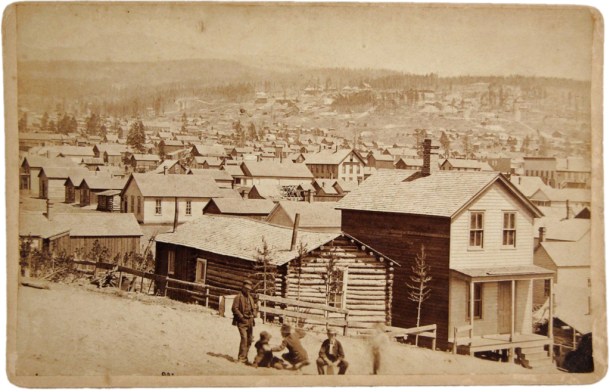
In 1877, they moved to the new town of Leadville and established their lodging and grocery business there. Horace was elected the town’s first mayor.
Opportunity walked in the door of the Tabors’ Leadville store one day in April 1878. Two German prospectors offered Horace a one-third stake in their mine if he would give them what amounted to $54 in supplies. Tabor took the gamble, and it paid off enormously. The two miners hit a massive silver deposit in what they named the Little Pittsburgh Mine. Soon the three partners were making $50,000 a month, each. Tabor eventually sold his share of the mine for $1 million (more than $25 million today) and bought the so-called Matchless Mine, which he later sold for $1.5 million. People started calling him the Silver King.
Tabor also used his new wealth to develop Leadville. He funded construction of an opera house and founded two newspapers and a bank. He became Colorado’s lieutenant governor and was later appointed to the U.S. Senate, for all of one month, to complete the term of a member who was retiring.
For all their good fortune, Horace and Augusta grew apart during this time. Money might have been part of the problem. Horace wanted the fancier life wealth made possible, so he built a mansion in Denver. Augusta chose to live in the servants’ quarters near the kitchen and kept a cow tied in the front yard for milk.
While the Tabors’ were feuding, Horace, 52, met Elizabeth Bonduel McCourt “Baby” Doe, a fun-loving 28-year-old divorcee about whom rumormongers loved to gossip. Before becoming divorced, which was bad enough in those days, she had allegedly had an affair with another man and perhaps even had a child by him.
None of that mattered to Horace, who preferred her cheerfulness to Augusta’s sternness. Horace kept Baby Doe, as she was known, in extravagant hotel suites in Denver and Leadville, and asked Augusta for a divorce. When she refused, he arranged for a divorce in far-off Durango, though a judge later ruled the action illegal.

Horace and Baby Doe traveled to St. Louis in September 1882 to be married someplace where Augusta couldn’t object, or point out that she and Horace were still legally married. The following March, during Horace’s brief Senate career, they married again in Washington. This wedding was more legit — Horace had finally managed to divorce Augusta. It was also a far more lavish affair. The invitations were written in real silver and Baby Doe wore a $7,000 dress. Even the president, fellow Vermont native Chester Arthur, attended.
Returning to Denver, the Tabors found themselves shunned by society because of their scandalous divorces and equally shocking affair and marriage. But you couldn’t ignore a man as wealthy as Horace or a woman as infamous as Baby Doe. The couple soon had a child, a daughter they named Elizabeth Bonduel Lily Tabor. When their second daughter arrived, they gave her a name to rival her mother’s, Rose Mary Silver Dollar Tabor.
Horace, who had already donated the money for the construction of Denver’s Tabor Opera House, moved with Baby Doe into a block-long mansion in the city. It seemed the Tabors couldn’t spend their money fast enough. Horace reinvested his silver fortune into other mines in the West, in Mexico and South America.
But by 1890, some of Horace’s large investments began to falter. When a financial panic struck the nation in 1893, the price of silver plummeted and the Tabors were left nearly penniless. Horace at the age of 66 was force to return to laboring in a mine for $3 a day. He labored in the mines until 1898 when he was appointed postmaster of Denver, either out of pity or in thanks for his civic mindedness.
Horace Tabor died the next year, never having regained the empire he had lost.

