

Before Your Time is a podcast about Vermont history. Every episode, we go inside the stacks at the Vermont Historical Society to look at an object that tells us something unique about our state. Then, we take a closer look at the people, the events, and the ideas that surround each artifact. Listen below or subscribe on Apple Podcasts, Stitcher, or Google Play.
[N]athaniel Brown Dodge is buried in Maplewood Cemetery, a small plot of land up the road from Barre’s better-known Hope Cemetery. Dodge was a soldier in the Revolutionary War, then lived long enough to see the War of 1812. But the marker on his grave didn’t age as well as he did.
Now housed at the Vermont Historical Society, Dodge’s original gravestone, made from slate, eroded until it was almost illegible. His family replaced it with a more durable granite stone in the 1980s. And while Dodge’s is the only gravestone in the Vermont Historical Society’s collections, it’s not the only one that’s faded over time.
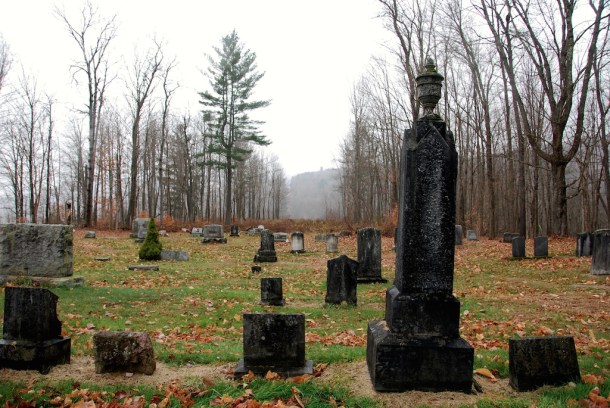
Many of Vermont’s cemeteries date back multiple centuries. They’re filled with worn-down stones that may only offer glimpses of the personal histories of the dead. But those markers still hold lessons for the people who visit and research them today.
On our latest Vermont history podcast, Dodge’s descendant Whitney Maxfield talks about caring for his fourth great-grandfather’s gravestone. Sculptor Heather Milne Ritchie talks about how cemeteries inspire her granite carving work. Composer Stan Charkey spins tombstone stories into songs. And cemetery explorer Dan Barlow finds big questions behind the graves.
Produced in partnership with the Vermont Historical Society and the Vermont Humanities Council.
[showhide type=”pressrelease” more_text=”See full transcript and photos” less_text=”Hide full transcript” hidden=”yes”]
Heather Milne Ritchie: It’s a lot of noise. It’s a lot of…it’s like it bombards your senses when you start doing this. It’s very physical. It’s very hard on your body. It’s very loud.
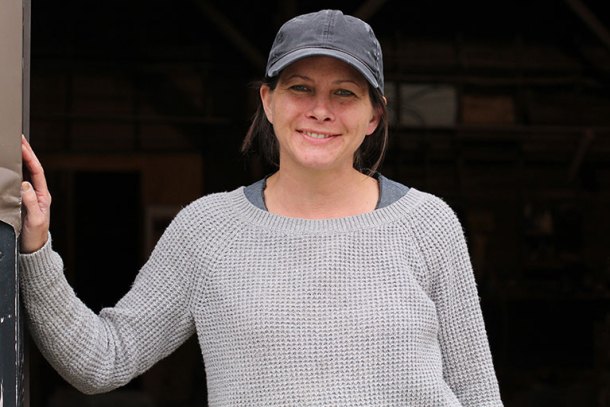
Heather Milne Ritchie works in a long shed in East Barre. The floor is concrete. There’s a wood furnace in the corner and an enormous steel track overhead. Massive blocks of granite balance on their supports.
Heather Milne Ritchie: I always start with my diamond saw, which is basically an angle grinder with a blade on it that’s tipped in diamonds.
Like you can put all of these fancy cuts in with your saw, with a diamond tip. But then you still need a basic hammer and chisel to break the stone away.
Barre residents have quarried and worked granite since the mid-1800s. Heather continues this tradition as a sculptor and a stone carver.
Heather Milne Ritchie: About 75% of my work right now, 80% of my work, is gravestones. Stones for cemeteries. Stones for people who have lost someone. People who are ordering them pre-need, so they can see it and know that they have what they wanted to represent them for eternity.
We watch her start on a memorial that will draw on her skill as an artist.
Heather Milne Ritchie: So the one I’m working on now has an angel with her knees up, and her head in her arms, and wings behind her, in profile, in three inches of relief. Not a traditional religious icon. They are mirror images, so I’ve been having a lot of fun bouncing from one to the next, to make sure that they’re lining up and measuring out.
Heather told us Vermont cemeteries are some of her favorite places to go unwind. She says the historic gravestones there inspire her work today.
Some of Vermont’s cemeteries date back multiple centuries. And while their oldest memorials may offer only faded glimpses of personal histories, they still hold lessons for the people who visit them today.
This is Before Your Time, presented by the Vermont Historical Society, the Vermont Humanities Council, and VTDigger. I’m your host, Lovejoy. Every episode we go inside the stacks at the Vermont Historical Society to look at an object from their permanent collection that tells us something unique about our state. Then we take a closer look at the people, the events, or the ideas that surround each artifact.
Ryan Newswanger: So Mary, you put this on a cart here —
Today’s object was so large that Mary Labate Rogstad had to wheel it into the room.
Mary Labate Rogstad: Well it’s on a cart because it is, for two reasons. It’s fragile, and it’s heavy.
We’re looking at the only gravestone in the Historical Society’s archives.
Mary Labate Rogstad: The top center is an urn. The other symbolism, a lot of the symbolism has worn off. The slate has flaked off, especially the lower left quadrant of the grave marker. I see August something, 1823 maybe? And he was 83 years and 5 months at his death.
Ryan Newswanger: Can you make out the name?
Mary Labate Rogstad: Oh yes, Nathaniel Brown Dodge.
Nathaniel Brown Dodge was a soldier in the Revolutionary War. One of his descendants told us his story.
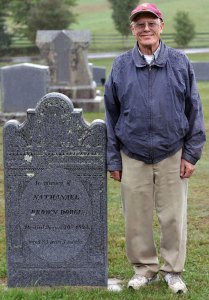
Whitney Maxfield: My name is Whitney Maxfield, my mother was Louise Dodge Maxfield, and this my fourth great-grandfather.
Whitney Maxfield: He’s noteworthy particularly because on the fourth day of July 1776, he wrote a letter to his wife back in Winchester, New Hampshire. He knew nothing at all about the Declaration of Independence. That didn’t show up here until three weeks later. Because of the date, they saved the letter.
He was a farmer, so he wants to know about how his cattle and how the farm is going, which was being taken care of by his wife and his brother. “If God spares me, I will be home when my enlistment is up.”
After the war, Nathaniel and his sons became some of the first settlers to Barre. He lived a surprisingly long life for his time. And he was still ready for battle when the next war came around.
Whitney Maxfield: He picked up his musket and kit and trucked off to Burlington in the War of 1812 and 1814 at the age of 74 years. You know, it’s 45 miles from here to the Battery so at 15 miles a day that’s a three-day march down and a three-day march back.
It was a thing. We fought this thing once, we ain’t going to let them get us again, you know?
Nathaniel’s gravestone didn’t age as well as he did. It was made out of slate, which is much softer than granite. Slate was a common material for gravestones when they were carved by hand, back before air-powered tools were invented.
Whitney Maxfield: My parents had the new memorial done specifically because this was getting into such terrible condition that it would be illegible now. And that was 30 years ago.
Whitney said he wanted to preserve the old stone because it had a story to tell. But holding onto the massive slate gravestone became a hassle.
Whitney Maxfield: Well it sat in my mother’s and father’s cellar for a long time and we were going to sell the place and had to do something with it. …so then I came to the Historical Society here and said, it’s either you guys or it’s going in the trash. Cause we’ve got no place to put it, you know?
Old headstones can mean a lot to a family. But some cemetery enthusiasts with no connections to the dead are still mesmerized by the stories behind the stones.
Stan Charkey: Every day I walked my dog in a local cemetery and saw three headstones all the time that the inscriptions I said to myself, “I should set those.”
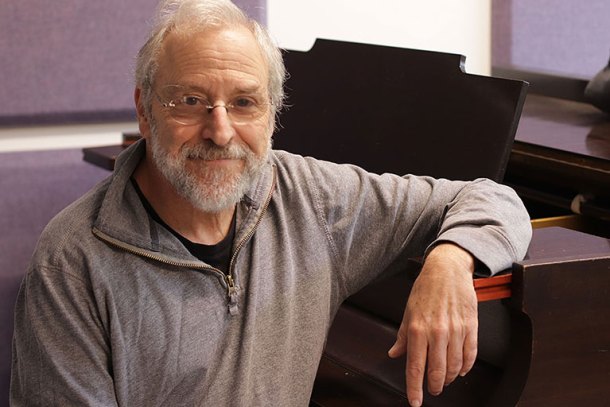
Stan Charkey recently retired from Marlboro College as a music professor. While he was there, he composed a song cycle called “Vermont Headstones”: 12 pieces for oboe, viola, and baritone voice, with lyrics from inscriptions he found in cemeteries around southern Vermont.
Stan Charkey: One of them describes an event, a historical event and it basically says the grave of Allison D. Wood who was killed instantly on this river by the explosion of the steamboat Greenfield. May 18, 1810. That’s it.
First of all, I had no idea that there were steamboats, riverboats going up and down in the 19th century on the Connecticut river that traveled between Greenfield and Brattleboro. Secondly, to be in a cemetery and be reading this inscription where it says, who was killed instantly on this river. And you’re looking at the river, it brings you into it, you become part of the narrative. You are part of this history. And it just struck me how much these headstones are not only a thing of the past but, when they invite you in that way, you’re part of the narrative as well.
The other one, this Dr. Samuel Sterns, was more biographical and it had a mystery in it. I have to read it. It says, “Sacred to the memory of Dr. Samuel Sterns who died August 8th, 1810 aged 63. Self-taught, nature was his preceptor. Philosophy his mistress, and astronomy his prompter. Disappointment ever succeeded his best endeavors. He deserved better. In gratitude was the reward of his labors. Peace to his ashes.”
Now what the heck did this guy do? I didn’t know. So, that was a mystery and I kept reading it every time I’d walk my dog. I’d go past and I’d say, “What could this guy have done?” So, I Googled the name, turns out this fellow was an incredibly well-known scientist, a member of the Royal Academy of Sciences in London, in England, had written books, was a very respected member. Problem was, he was a Tory, and this was during the revolution.
Ryan Newswanger: So some of these earlier ones captivated you.
Stan Charkey: Yeah, because of these stories! It was the stories, it wasn’t visually, although some of them were very beautiful, I wasn’t interested in the visual, I was interested in these narratives.
Dan Barlow: You know, sometimes I get yelled at wandering around in old fields looking for a cemetery.
Dan Barlow does pay special attention to the artwork on gravestones.
Dan Barlow: About eight years ago or so, I had what I call my early mid-life crisis, I found myself one night wandering around St. Augustine Cemetery here in Montpelier with a friend.
Dan’s day job is at Vermont Businesses for Social Responsibility. He’s also worked as a political reporter for the Vermont Press Bureau.
Dan Barlow: I think we were just trying to scare each other a little bit, feel alive, but I quickly discovered this whole world and this whole art form with gravestones that talk about some of life’s big questions. You know, why are we here? What happens to us when we die?
Along with Scott Baer, Dan started a project called Green Mountain Graveyards. Their mission was to “explore and photograph all of Vermont’s historic, artistic and spooky cemeteries.”
Dan Barlow: The prominent image that a lot of people associate with New England stonework is the death’s head. That’s that kind of toothy grinning skull with the wings emerging from the side of the head. That really is the iconic image for New England cemeteries.
The message to the living was, as you are, I once was too, so I am, you will be as well. We all end up in the grave. It was a very dark warning to the living that life is fleeting and make the most of what you have here.
The death’s head is more common in coastal regions, which were settled earlier. Spotting one in a Vermont cemetery is rare.
Dan Barlow: By the time that our cemeteries were established, and we had professional stone workers here making gravestones—this would be the late 1700s and early 1800s—that image had fallen out of fashion. So the start of Vermont cemetery stonework really starts at the cusp of the whole sea change of artwork within cemeteries in New England.
And so that darker artwork really fell away, and you saw the rebirth of spiritualism within cemetery artwork. It’s a lot of weeping willows or urns.
The urn served as a metaphor for the soul within the human body. It’s at the top of Nathaniel Brown Dodge’s gravestone, on a backdrop of willow leaves.
Dan Barlow: The focus is more on the idea of the spirit going to heaven as opposed to the body rotting in the ground.
Just as certain symbols fell from fashion, slate was replaced by more durable stone. And Barre, with its world-famous granite, became known for its memorials.
Dan Barlow: You were having stone workers from the bigger cities in New England move to Vermont and set up shop here, so they’re bringing their expertise and their training. Then that leads pretty directly into the granite boom for Barre in the late 1800s where we saw hundreds and hundreds of the most talented stone workers of their generation move from Europe to come to Barre to work with our granite.
Hope Cemetery was intended as a showcase for the work emerging from the Barre granite industry. You’ll see impressive statues at this cemetery, alongside detailed carvings of cars, and soccer balls.
Heather Milne Ritchie: Being from Barre, I knew it was a really important thing. I knew that lots of people’s parents, lots of my neighbors, worked in sheds. I would go to Hope Cemetery to visit my grandfather’s stone. I learned about the history of it, growing up.
We’re back in the granite shed with Heather Milne Ritchie. After her first year of college, Heather worked as an intern at the Barre Historical Society.
Heather Milne Ritchie:Part of my internship was helping to curate a show on all the granite carvers and granite carving. I thought, “Wow. This stuff is really neat. These are really beautiful.” I was actually getting to hold models and catalog things that were just incredible.
These early Barre carvers used drills, instead of the power saws and chisels that Heather uses today.
Heather Milne Ritchie:The rock pitch and scalloping that they used to do to make these monuments is incredible.
It’s raw stone looking like it’s scooped out of itself, but there’s no point marks. How did they do that? How do you get stone to look like that and not leave any marks on it? It’s just incredible.
Heather says that today, around a dozen young artists make a living carving memorials in Barre.
Heather Milne Ritchie: Learning the tools, learning the pneumatics, was really hard for me. To not push it. Now that I’ve got a handle on that, you can pretty much make them do whatever you want.
In addition to producing memorials, Heather makes stone sculptures, using many of the same techniques and tools. She carves hearts, gargoyles, torsos. She even made a sculpture of her work boots.
Heather Milne Ritchie:I come to work, and I get to make things. I get to make beautiful things. It definitely makes me feel good to know that the things that I make will probably last longer than I do.
I love that I get to make something look soft out of something that’s so hard. When I go to the cemeteries, and I look around, I do look for the lovely soft things. The beautiful weeping women, or the spray of flowers with lots of drill holes in them, and just intricate, and folding over themselves. I look for the soft, lovely things.
Heather, Dan, and Stan all find inspiration in Vermont cemeteries. But the graveyards hold other lessons too.
Stan Charkey: We learn how difficult life must’ve been. Especially for women, and for children.
And I noticed on almost all the cemeteries, unfortunately even up to almost today—although it’s changing, thank goodness—is how women are defined. They’re not defined by who they are but by their husband. By their motherhood.
Dan Barlow: Over in Barre, I live next to Elmwood Cemetery, which is the town founders’ cemetery, and I realized during my first walk through there that, “Oh, all the last names on these stones match the names of streets in the city,” and how quickly you can see the development of the community. You can see through time, almost, to how your community formed and what was happening at the time.
You know, just take a few minutes out of your day, visit your local cemetery, walk around, and start making the connections between history and your life right now. Maybe learn something about mortality and our fate.
Our fate: we don’t last forever. Even our carved stones – especially ones made from slate – fail the test of time. But we, and our stones, may leave a story or two for future generations to consider. Maybe something about love. Or friendship.
Stan Charkey: The last one is just a very…it could be story, it could be a novel, it’s such a sad story and this is all on the grave.
So, this one says, “Bathing in this river, near this spot, on the 2nd of July 1797, were drowned age 17 years Pardon Taylor. Son of Reverend Hezebiah Taylor of Newfane and Edward Palmer, son of Joseph Pierce Palmer of Amherst, Massachusetts. The former lost his own life through the generous efforts to preserve that of his youthful friend. They were lovely and pleasant in their lives and in their death were not divided.
“Reader, if you knew them, you will weep with their friends.”
Produced by Ryan Newswanger and Mike Dougherty, with help from Mary Labate Rogstad.
Subscribe to Before Your Time on Apple Podcasts, Stitcher, or Google Play. See more at beforeyourtime.org.
Music by Michael Chapman and the Woodpiles, Blue Dot Sessions, and Stan Charkey.
[/showhide]

