


[B]ENNINGTON — If Vermont selectboards are suddenly besieged by students proposing bans on single-use plastic products, thank Judith Enck.
The former regional EPA administrator urged Bennington College students and others Thursday to do just that — act on the local level to reduce the flow of plastics that are despoiling the world’s oceans.
Enck spoke during a forum at the college’s Center for the Advancement of Public Action, where she began teaching a course this fall on plastics pollution.

Most of us think of the beach as a place to be with friends or family and “to relax, to heal,” Enck said with a sigh.
“But when I look at the ocean, I think of plastic pollution,” she told the audience of students and area residents.
“And here is the shocking truth: We are turning our oceans into landfills,” she said. “We are doing the same thing with rivers and streams, and to wetlands, and all of that flows into the ocean.”
Enck described the situation as “a serious problem that hardly anyone knows about. So the question this evening is how are we going to keep 8.8 million tons of plastic from entering our oceans every year?”
Before apologizing for “depressing” everyone, Enck cited a list of harrowing statistics.
When plastic containers or other packaging gets into the ocean, she said, it typically lasts for hundreds of years.
“Remember that single-use plastic packaging may be for your delicious lunch for 15 minutes, but if it gets out into the environment it lasts for 450 years,” she said.
Enck said a study found that from 1950 to today, about 850 billion metric tons of plastic have been produced, half of that manufactured since 2004.
“I remember 2004; it wasn’t that long ago,” she said. “And the primary increase in the use of plastic is for plastic packaging.”
Apologizing again to those students she said always come to lectures fervently believing that recycling can solve this problem, Enck said, “And for those of you who walk in thinking that recycling is the solution — unh-uh. Recycling is not the solution. We only recycle about 9 percent of plastics in this country, 5 percent worldwide, but it kind of doesn’t matter.”
The solution, she said, “is obvious and it’s hard: making less plastic.”
Single-use packaging
“It’s durable, it’s cheap, it’s used in medical devices, effectively; it has made cars lighter so they use less gasoline,” she said. “But what I am really concerned about is single-use plastic packaging. That is creating a real problem, and we have non-plastic alternatives.”
Some obvious alternatives, she said, are reusable bags for the supermarket rather than using new plastic bags each trip, or to use metal utensils and avoid plastic ones at the deli or convenience store.
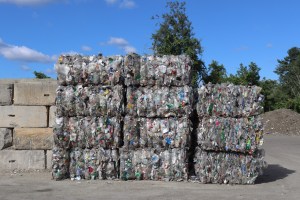
Enck stressed, however, that relying on the choices of consumers also is not an effective answer, acknowledging that even she is sometimes susceptible to the convenience of ubiquitous plastic packaging.
“Companies make plastic and sell to consumers cheaply, but once they sell it they have no economic responsibility,” she said. “So that is the economic disconnect that is a real barrier … What we really need to do is change what is done upstream, change how we design and use packaging.”
That’s where Enck said students might lead the way.
In the absence of congressional action to reduce the production of plastic materials, and with only sporadic efforts at the state level in the face of intense industry lobbying, she urged a community-by-community approach.
“This is solvable, and it’s particularly solvable if college students jump in and are leaders on this issue,” she said. “My mission is to marry college students with community leaders across the country, working together on local initiatives to reduce plastic packaging. Because the reality is we have to tackle this at the local level.”
She added, “We have to go product by product until there is political power to get environmentally sound packaging standards at the state or federal level.”
Her advice, Enck said, is to start in the Bennington area by seeking a ban on plastic shopping bags and a fee for paper bags in grocery stores, as well as a ban on polystyrene foam packaging for foods, similar to one adopted and recently expanded in Albany County, New York.
A plastic straw ban is another option, she said, or a requirement that straws are only provided when asked for by customers, not routinely.
“There is a lot we can do,” she said, “and we better get going … I would love to work with you on this.”
Enck displayed on the lecture screen her website address [https://judithenck.com], which includes an email address, and her Twitter handle, @enckj.
“Twitter can be a force for good,” she said.
Growing awareness
Governments may not be acting to address the pollution, Enck said, but the attention generated through reports about scientific studies — as well as images and video on the internet — are helping to provide a necessary first step: education about the threat to the oceans and the planet.
The June issue of National Geographic, which focused on plastic wastes in the environment, and included a photo of a sea turtle with a straw stuck up its nose had a tremendous impact, she said, adding that a video of the turtle on YouTube was viewed more than 30 million times.

Other recent studies have focused on microplastics, or tiny bits of plastic that have turned up in bottled water, salt and in seafood (“something the FDA totally is not on top of,” she said), among other areas where the particles are entering the food chain that includes humans.
Enck said the churning action of the ocean currents “acts like a paper shredder” and breaks down plastic packaging into small pieces, which in turn are consumed by fish and seabirds, whose “guts are filled with plastic.”
Microplastics are so important to focus on in that wastewater plants can’t remove them, she said, meaning they are discharged into the environment along with the treated water.
When she began researching the issue, Enck said, she was surprised to learn that 80 percent of the trash in the ocean comes from the land, not from waste materials being dumped in the water, and that 80 percent of that waste is plastics.
A third of plastic litter within 30 miles of a watershed has been shown to wind up in the oceans, she said, carried there from storm drains and in streams.
With plastic production growing about 8 percent annually since 1940, and global production up from 15 million tons in 1964 to 311 tons in 2014, Enck said the problems created are escalating.
Enck, who lives in Rensselaer County, New York, served for seven years as regional EPA administrator for the area that includes New York during the Obama administration.
She also was one of those who brought to light previously undisclosed PFOA (perfluorooctanoic acid) contamination of the Hoosick Falls, New York, water system, which in turn led to discovery of PFOA contamination in wells around former ChemFab Corp. plants in Bennington.
She has participated in some of the PFOA-related forums and discussions sponsored by the CAPA center since early 2016.
