


Though more than 70 percent of Vermont land is in large tracts, a shift toward more acres in smaller parcels could threaten the state’s forests, natural resources experts say.
A report released this week from the Vermont Natural Resources Council found that the amount of privately held land in parcels of 50 acres or greater decreased by 1.4 percent, while the total number of parcels of that size decreased by 3.22 percent from 2004-2016.
“What we were struck with is the sheer acreage of large parcels that decreased in Vermont … and, in particular, the loss of woodland parcels,” said Jamey Fidel, forest and wildlife program director for VNRC.

VNRC, UVM’s Gund Institute and other partners analyzed statewide data from the grand list and current use program to track land use changes in Vermont. The data can be viewed by town or region in an online database that the report authors hope will inform land use planning and conservation priorities, said Fidel.
Vermont’s forests have made a comeback in the past century. Reduced by logging, sheep grazing and other agricultural practices to 30 percent of the state’s land area in the late 1800s, forests once again dominate the Vermont landscape.
But Vermont’s forests are facing “slow and steady” development pressure, said Kate McCarthy, sustainable communities program director of VNRC. Although report tracks changes in parcel size and designation, not forest conversion, an annual report from the USFS indicates that the state is indeed losing forest cover, said Fidel. From 2012-2017, Vermont lost an estimated 2.2 percent of its acres of forests, according to the report.
Among the report contributors was the Department of Forest, Parks and Recreation, which has been keeping an eye on the reversal of forest growth in Vermont, said Commissioner Michael Snyder.
“In and of itself, drawing legal demarcations on a map … isn’t necessarily a conversion,” he said. “When you have 100 acres of forest in a 100 acre parcel and then, suddenly, that’s ten, 10 acres of forest, it’s still 100 acres of forest, at least for now, and functioning as such.”

“It’s just that those (smaller) lots tend to lead to other changes,” he added.
Smaller parcels are less likely to remain as intact swaths of forest — a phenomenon known as “forest fragmentation.” Forest fragmentation happens when roads, agriculture, utility corridors, homes or other human development create clearings in forested habitat.
A 2015 report to the Legislature from the state Department of Forests, Parks and Recreation states that “over time, those non-forest pockets tend to multiply and expand and eventually the forest is reduced to scattered, disconnected forest islands.” Worldwide studies have documented that fragmented forests have lower biodiversity of animals and plants and are more susceptible to invasive species and forests pests and diseases.
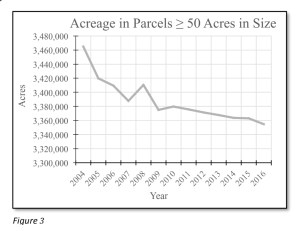
The report also found that privately held land designated in the grand list as “woodland” decreased by 14.3 percent while “residential” acreage increased by 7 percent during that 12-year period. The report notes that part of the decrease in woodland is due to land being conserved as public land.
Meanwhile, the number of parcels in the 2-5 acre and 5-10 acre ranges — sizes commonly used for rural house lots — increased by 10.25 percent and 15 percent, respectively. “We wonder if these parcels are being subdivided for residential use,” said McCarthy.
Fidel noted that a confluence of factors are contributing to the decline in large parcels of land. The market value of woodland in Vermont has skyrocketed from $584 an acre in 2004 to $1,064 in 2016 — a 185 percent increase. The “use” value, on the other hand, has only increased from $114 an acre in 2004 to $135 an acre in 2016. This puts increased pressure on landowners to subdivide land, said Fidel. He added that 15 percent of Vermont’s forest landowners are over 75 years old — a group especially likely to be selling land in the near future.
“We’re going to see, and we are seeing, transitions with the land,” said Fidel. “People are passing away, and if they haven’t planned for the future of their land and who owns it, all too often it can be the easiest route to subdivide the land among the heirs.”
But 70 percent of Vermont’s overall land remains in parcels 50 acres or larger, which report authors say presents an opportunity to combat fragmentation. McCarthy said that rural development does not have to be at odds with forest preservation, particularly if that development occurs near village centers.
“When it comes to creating really great places for people to live, those intact forests offer tremendous recreational opportunities” for people who live in rural Vermont or would want to move there, she added.
Snyder referred to loggers, foresters and other forest professionals as “one of our last best hopes” for keeping forests intact. “Good forestry protects us against fragmentation because people have holding costs for their land … they have to pay taxes, and having a viable economic alternative to subdivision is really brilliant.”
Fidel said that VNRC hopes the Legislature will “pass improvements” this session to Act 250 to better protect against forest fragmentation.
The report also recommends:
• Funding the Vermont Housing and Conservation Board to its full statutory mandate.
• Continue funding the current use program to provide tax incentives for maintaining land as working forests.
• Adoption by municipalities of subdivision regulations and increased natural resource protections within existing zoning regulations

