


[P]UTNEY — Peter Shumlin giving a speech in his hometown shouldn’t be news. The 62-year-old native has been doing so here ever since he won election to the local Select Board at age 24.
Shumlin giving a speech in his hometown to a roomful of students with learning differences shouldn’t be news either. Diagnosed with dyslexia in second grade, he went on to lure Landmark College — the first in the nation to help youth with similar challenges — to Putney in 1985 and remains a frequent presence.
And Shumlin giving a speech anywhere to anyone shouldn’t be news at all. As governor from 2011 to 2017, he gave too many to count, let alone cover. Then again, he hasn’t said much publicly since leaving office, save for a few words in an online commentary and Harvard University appearance. And so the fact he kicked off his hometown Landmark’s 2018-19 speaker series Tuesday night was, in fact, news.
“If you look at what’s going on today, you might wonder why anyone would wish that upon themselves,” he told students of politics. “What made me want to make change is my own life experience.”
Shumlin can boast of a 2017 fellowship at Harvard’s John F. Kennedy School of Government and his current position as Landmark’s visiting lecturer in politics and leadership. But a half-century ago, the self-described “local boy” hoped to hide his dyslexia, a condition in which neurological short circuits in an otherwise normal brain deter easily deciphering of the written word.
“I was dyslexic,” he told students, “before folks knew what dyslexic was.”
With early intervention, Shumlin learned to read well enough to graduate with honors from Connecticut’s Wesleyan University in 1979. After serving as a selectman, he was appointed to a vacated Vermont House seat in 1989, then won election as a state senator in 1992, became his chamber’s minority leader in 1995 and, when Democrats gained a majority, its president pro tempore in 1997. After an unsuccessful run for lieutenant governor in 2002, he returned to the Senate and his party leadership post in 2006.
“Even with all the pain and difficulty and self-doubt, I would argue my learning difference is my greatest asset,” he told students. “I’ve always wanted to fight harder for people who don’t have a voice, aren’t given a chance or are judged.”
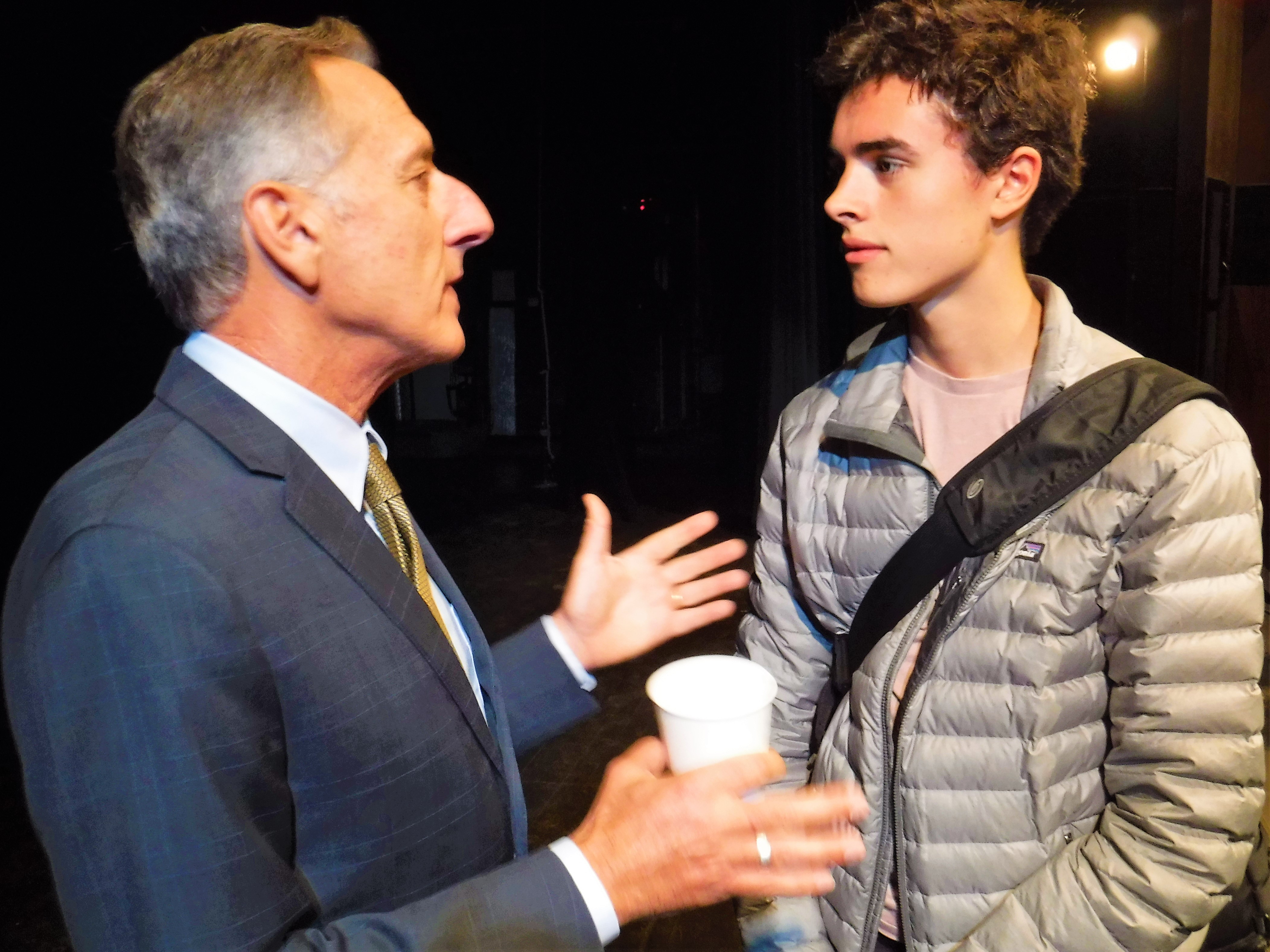
Shumlin wasn’t afraid to push ahead-of-their-time proposals inspired by his past. Championing the bills that allowed Vermont to become the first state in the nation to adopt same-sex civil unions in 2000 and to approve full marriage rights by a legislative vote in 2009, he pointed to his early struggles with reading for helping him empathize with others who are different.
In a Landmark talk titled “Climate Change and You: The Role of Engaged Citizenship,” Shumlin also focused on energy issues, having pushed for closure of the Vermont Yankee nuclear power plant in Vernon while promoting renewable sources such as solar and wind.
“One of Vermont’s challenges is keeping people like you,” he told students. “I’m convinced there’s huge economic opportunity in helping to solve this problem.”
Shumlin himself is working with his younger brother, Jeff, at their family’s Putney Student Travel, the business their parents founded in 1951.
“I’ve been in hiding since I chose not to run again.”
Shumlin explained his disappearance from the political radar screen in part out of a belief that past officeholders should respect their successors by holding their tongues. But that didn’t stop the Democrat from poking at current Republican Gov. Phil Scott’s opposition to large wind energy projects.
“That is a mistake,” Shumlin told students. “Time is running out. The clock is ticking. The stakes have never been higher. The opportunity has never been greater. Work hard here, then get on with it and go make a difference.”
