


Gov. Phil Scott has violated the state’s Code of Ethics by maintaining an ongoing financial relationship with a company doing business with the state, according to the Vermont State Ethics Commission.
The commission said Scott has a conflict of interest because he has a “financial interest” in Dubois Construction while the company has a contract to do work for the state. Under political pressure, Scott sold his half interest in Dubois back to the company after he took office in 2017.
Scott received no cash at the time of the transaction and is still owed $2.5 million by the Middlesex company.
The commission said the conflict of interest arose when Dubois won a two-year contract for $250,000 in 2017, which the commission said “provides significant income to the company, and directly assists the company in meeting its financial obligation to the public official.”
The advisory opinion stated Scott “has a conflict of interest because he is financially intertwined as a creditor, who has an ongoing financial interest in a company that contract (sic) with the State, which the public official as governor is the chief executive officer.”
The commission’s opinion carries no penalties, but was stronger than an earlier preliminary opinion from the ethics commission’s executive director, Brian Leven.
The board has no investigative or enforcement power and has little authority other than to issue advisory opinions. This was the first such opinion issued by the five-member board, which started in January. The board adopted a state Code of Ethics in June.
Scott has maintained that no conflict of interest exists because he has no day-to-day involvement in the company — he has said his only connection is holding a promissory note. Scott self-financed the sale and agreed to be paid back over 15 years. Under the terms, he would receive interest only for the first five years at a 3 percent rate. Last year, he earned $75,000 in interest.
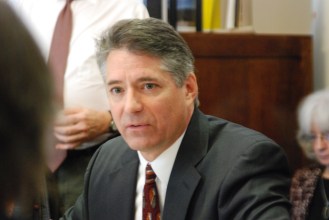
Recently, ownership of the company changed with Scott’s cousin selling his interest back to the company and a close friend of Scott’s investing in the company and being named an officer.
The commission also said Scott “triggered” a conflict of interest violation of the code every time he received an interest payment from Dubois because those payments constituted “an item of monetary value.” The commission ruled the payments did not meet the definition of a “gift.”
The commission said whether the governor had violated prohibitions on “gifts and gratuities” was not within their authority and said the language in the state contract was better reviewed by the Attorney General’s Office.
The advisory opinion noted the commission does not have the authority to investigate complaints or issue penalties, only advisory opinions.
The opinion was issued after a complaint was filed in August by the Vermont Public Interest Research Group. VPIRG called the opinion posted Tuesday a “strong rebuke” of Scott’s ongoing financial relationship.
Scott’s spokesperson called the complaint “a political attack to rehash a long-standing settled matter weeks before an election.”
“The weaponization of Vermont’s newly-formed commission should be deeply disappointing to all Vermonters,” Rebecca Kelley said Tuesday by email. She said the commission had not taken into account information provided by the governor’s legal counsel and only considered VPIRG’s view. Kelley also noted the contract process was transparent.
According to the commission, the governor’s conflict of interests is not removed because he didn’t issue the actual contract. Instead, the contract was reviewed and approved by his secretary of administration, Susanne Young, and commissioner of Buildings and General Services, Chris Cole.
Scott’s “conflict of interest is imputed to any subordinate public officials acting as the first public official’s delegate…who serve at the direction and control of the first public official, in this case the governor, who has actual knowledge of the conflict of interest,” the opinion said.
“The Ethics Commission has delivered a very clear and convincing opinion in this matter,” said Paul Burns, executive director of VPIRG. “The governor’s ongoing financial entanglements with his former business are a violation of Vermont’s Code of Ethics. The question now is, what will Gov. Scott do about it?”
“This isn’t Washington, D.C., and I don’t think ethical violations can be as easily ignored here as they apparently are there,” said Burns. “But right now the ball is in the governor’s court. Let’s see what he does with it.”
The commission concluded the VPIRG filing itself and the state contract either gave the appearance or amounted to an actual violation of the ethics code.
“The appearance of the potential or actual conflict of interest is apparent by virtue of the filing of this ethics advisory request. Furthermore, given the governor’s authority over the Commissioner of Buildings and General Services, and the Secretary of Administration, this appearance is well founded,” the commission wrote.
