


Editor’s note: Mark Bushnell is a Vermont journalist and historian. He is the author of “Hidden History of Vermont” and “It Happened in Vermont.”
[E]dwin Oakes wrote to inform the Vermont Legislature that everything was well at the state prison. It was the standard report that Oakes, the prison’s superintendent, had issued every two years, as required by law, since taking office more than 20 years earlier.
Though he wrote in bureaucratese, Oakes’ three-page report in 1904 is interesting, not for what it says, but for what it leaves out. In discussing discipline at the prison (“quite satisfactory”), repairs to the facility (“paid for out of the income of the prison”!) and religious instruction (“nearly every inmate is anxious to attend divine service”), Oakes failed to mention any of the incidents and common practices that would shock the public in the coming months.
Perhaps legislators had an inkling what had been left unsaid. Perhaps the rumors of sexual and financial improprieties at the Windsor prison were already circulating.
Oakes wrote his report in July. By December, a preliminary investigation had found serious misconduct at the prison and suggested Oakes be fired. The Legislature created a commission to make a more thorough inquiry, but in March, before the commission started taking testimony, Oakes stepped down. He apparently knew what the Legislature was about to hear.
Transcripts of the testimony are contained in eight bound books at the Vermont State Archives. They make for lively reading. Poring through the volumes, some of which run into the hundreds of pages, you are immediately made a witness to the petty rivalries and alliances that existed within Windsor prison during a time of administrative crisis. One staff member’s testimony might sound convincing until you stumble upon another’s contradictory statements. Some people are clearly lying; others obviously shading the truth to protect themselves. The record casts light on the way things were done at the start of the last century, when deals were often “gentlemen’s agreements” and government operated with much less oversight.
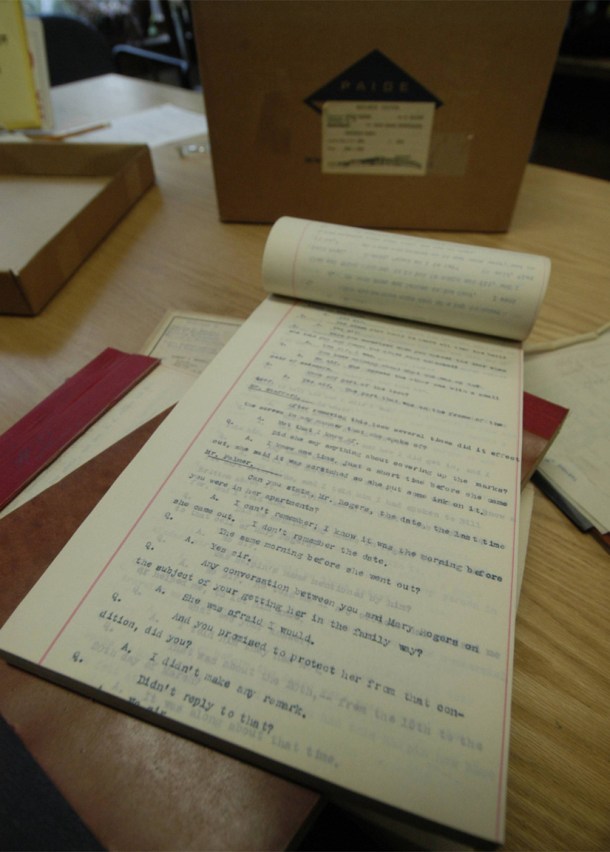
For Edwin Oakes and his prison, oversight had meant only that each year he was required to write a report and circulate it among three members of the state prison board (who rarely inspected the facility). The board would then sign off on the report and send a copy to the state auditor, who forwarded it to the Legislature.
In 1905, however, Edwin Oakes was called as the first witness in the special commission’s investigation. The investigators quickly zeroed in on questions about his financial management, and use of nepotism, at the prison.
At Oakes’ direction, the prison had purchased grain for its horses from his brother, John, without putting the contract out to bid. Nor had Oakes sought bids for other prison supplies, from coal for heating to chewing tobacco for the prisoners, who were forbidden from smoking.
John Oakes, it turned out, had for years been a guard at the prison, though Edwin Oakes somehow couldn’t recall whether he was the one who had hired him or whether John had already been on staff when he became superintendent.
Investigators also wanted to know why John was paid $30 a month when the other guards received only $25. Oakes said his brother had special responsibilities, like showing visitors around the prison and selling the “trinkets” prisoners made. When John left his job, however, his brother didn’t bother to replace him.
John had gone into farming and grew cabbages with the help of unpaid laborers – convicts from the prison – and then sold the cabbages to the prison. In using prison labor, John was hardly alone. Other prison officers also regularly used convicts to work around their homes, Edwin Oakes acknowledged.
John was also not the only other Oakes on the payroll: Oakes also hired his son to work as a guard; and for five years his wife was listed as his housekeeper and paid $25 a month.
The prison’s directors – three men from around the state appointed to oversee the facility – had approved the hiring. They had wanted to give Edwin Oakes a raise, but lacking the authority, they had decided to put his wife on the payroll. The job came with no defined responsibilities and, as a joint House-Senate committee stated, “she rendered no service to the State in return for the compensation received.”
In 1895, Oakes had purchased a summer home on Lake Sunapee in New Hampshire, where he began entertaining company regularly. He often fed them the best food that had been purchased for the prison. In the meantime, others testified, prisoners were fed corned beef and salted pork that was never rinsed and was therefore too salty to eat. Meat for the prisoners was sometimes improperly stored and became maggot infested.
The commission learned much of this from E.D. Harpin, the prison’s keeper, second to Oakes at the prison. Harpin admitted on the stand that he had been envious of Oakes and that he had always thought he would succeed Oakes as superintendent.
That hope had ended in March 1905, when Oakes fired Harpin over the most sordid incident under investigation. Inmate Vernon Rogers, a convicted rapist, had been sneaking into the cell of a murderer and having sex with her. The murderer was the prison’s most notorious inmate, Mary Rogers (no relation to Vernon), who had killed her husband and been sentenced to death. Her execution had been set for February 1905, but she had received a reprieve.
Mary Rogers’ possible motivation for having these sexual liaisons was much debated. She might have been lonely, as Vernon Rogers claimed. Or she might have hoped to get pregnant and buy herself time, since the state would not execute a pregnant woman, in order to spare the fetus. But once she gave birth, Rogers could again be killed. She may have hoped that by then a governor willing to pardon her had taken office.
Or perhaps Mary Rogers was being raped by Vernon – a possibility discussed by the commissioners, though they never chose to interview Mary.

During his testimony, Oakes blamed Harpin for not knowing what was happening between the two prisoners. From Harpin’s office window, the keeper could see Rogers’ wooden cell door, if it were wide open. Oakes said he had been ill during the time of the affair, and that Harpin should therefore have been extra vigilant, to the point of regularly looking out his window to see if anything was amiss.
Oakes said he learned about the incident from a trusted inmate, Fred Morse, a so-called “trusty.” Morse said he had seen Vernon Rogers leaving Mary Rogers’ cell, and Vernon subsequently confessed to making as many as six such visits. He had opened the cell’s outer door with a key cut from a metal bar. Mary apparently used a pair of blunt scissors, which she had been allowed to keep, to open a lock on the inner door. Vernon Rogers testified, perhaps as revenge against Morse for reporting him, that Morse had forged the key.
The investigation uncovered other scandalous matters. Prison staff revealed that some years earlier a guard apparently had had an affair with a 16-year-old girl who worked there. A Swedish housemaid at Oakes’ house told the guard’s wife of the affair and that the girl had later gone to Boston and there “been relieved of a child.” The guard’s wife, who believed her husband innocent, demanded to see Oakes.
The next morning, Oakes fired the maid, not for admitting the affair to the guard’s wife, he claimed, but for her habit of wandering around the prison grounds. During his testimony, Oakes alleged that Harpin had also had an affair – with the wife of a prisoner, who later received a pardon.
◊ ◊ ◊ ◊ ◊
The year 1905 was a difficult one in other unexpected ways for the state prison.
As the investigation continued into the conflicts of interest and administrative shortcomings at the facility, there was more unwelcome publicity about Mary Rogers, who had just won her second reprieve. State officials had hoped to keep all matters involving Rogers as quiet as possible, because the state’s plan to execute a woman had drawn strident opposition.
But a story about Rogers’ subdued reaction to the reprieve made the papers nonetheless. Journalist Anna Batchelder had witnessed the event. Wilson Lovell, Oakes’ successor, claimed he had accepted Batchelder’s request to meet Mary Rogers as a favor, because Batchelder was the state’s attorney’s sister. He said it hadn’t dawned on him that a woman might be a journalist. Batchelder contradicted Lovell, testifying that he had known all along of her profession. Batchelder’s resulting article for the Boston Journal, which had been sensationalized by her editors, was another black eye for prison officials.
The end of the year saw prison officials relieved of one of their burdens. Mary Rogers was executed on Dec. 8. Though even that had a major hitch. According to some witnesses, the rope to hang Rogers was too long. Her feet touched the floor, so two sheriff’s deputies had to hoist the rope for 14 minutes while she slowly suffocated.
Days later, the state prison received its punishment for the shoddy handling of affairs. The Legislature passed several laws more tightly regulating the prison. The laws abolished the prison’s board of directors, replacing it with a governor-appointed panel; required quarterly report on the facility; required that major purchases be put out to bid; and allowed the governor to appoint a woman to a board overseeing the care of female inmates.
The Legislature also made neglect of public duty a crime for which officials could be fined or even sent to jail. Somehow Edwin Oakes escaped the shame of being imprisoned in the facility he once ran.

