

[R]UTLAND — Charlotte Tuttle recalls when she was living in Florida years ago asking her sister if she wanted to travel south from Vermont and visit her, check out some of the many tourists sites, and take in the warmer weather.
Teresca King would have none of it.
She rarely left Vermont, let alone Rutland, the city where she grew up.
“She said, ‘Rutland is my safe haven,’” Tuttle recalled her older sister telling her.
Lori Hibbard, King’s daughter, added of her mother, “She didn’t like leaving because she always thought bad things would happen if she left.”
On Friday, Donald Fell, the man charged with carjacking King in Rutland as she arrived to work at a downtown Price Chopper supermarket early on the morning of Nov. 27, 2000, and then beating her to death in New York state, is set to plead to federal charges in connection with her slaying.
A plea deal with prosecutors calls for Fell to be sentenced to life in prison without the possibility of parole. He had previously been sentenced to death.
The agreement heads off a second death penalty trial that had been set for later this fall for Fell, who was initially convicted and sentenced to execution more than a decade ago, only to have both overturned by a judge after allegations of juror misconduct.
Fell’s hearing Friday will take place in a second-floor federal courtroom, above the downtown Rutland post office. It’s only a short walk from the shopping plaza where police say Fell and an alleged accomplice, Robert Lee, kidnapped King as she showed up to start her shift.
Lee has since died in prison, hanging himself. And the case against Fell’s has been working its way through the federal court system for nearly 18 years.
Fell was 20 when he was arrested and charged in King’s death. He’s now 38.
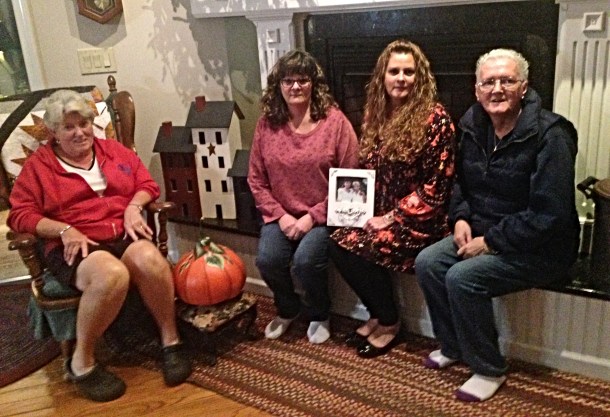
Several members of King’s close-knit family gathered this week in Charlotte Tuttle’s home in Rutland, sitting around the kitchen counter and sharing stories of the woman who has been referred to in court or filings for years as the “victim,” “alleged victim,” or “the deceased.”

The family members say King was much more than those words.
They talked of her tough upbringing in a family with little money, to raising two children of her own with her husband, and then becoming a grandmother of six before her death at age 53.
“She loved her grandchildren,” said Barbara Tuttle, another of King’s sisters.
“That’s the only reason she went to work at Price Chopper,” Barbara Tuttle added, “so she would have extra spending money and every week she would choose a different grandchild to take shopping and spend that money on – the grandchild of the week.”
King also kept a child seat in the back of her Plymouth Neon so she would always be ready to take one of the grandkids somewhere. That’s the vehicle she was in when police said she was carjacked by Fell and Lee.
And according to statements provided to police from the men, they tossed that car seat out of the vehicle after they took her hostage and headed out of Vermont. Fell was armed with a shotgun at that time, which was later determined not to be loaded, court records stated.
King had no way of knowing that at the time.
Her family members this week described her as extremely sensitive, at times prompted to send money in response to seeing commercials or television reports on people suffering from tough times.
“When my brother was in Vietnam they started putting Vietnam clips on the evening news and she could not watch that on TV,” Charlotte Tuttle said of King. “She knew he was over there and she couldn’t look at it.”
“She used to send money to ‘Save the Children,’” Hibbard added of her mother.
King herself knew of coping with financial straits.
She was born in Middlebury and raised in Rutland, the second oldest of four children of Clayton and Shirley Turner. The three girls would sleep in one bed, with old clothes used as blankets to stay warm, the family members said.
After Clayton Turner left the Army following service in France and England in World War II, they said, he had difficulty holding down a job, and abused alcohol.
“If it hadn’t been for the Salvation Army we would have never had a Thanksgiving dinner, a Christmas dinner, or a gift under the tree,” Charlotte Tuttle said.
“That’s the truth,” Barbara Tuttle, her sister, added.
King dropped out of school after becoming pregnant with her first child, Lori, at 16, and married her husband Norman King. At 19, she had her second daughter, Karen.
Terry King worked a series of part-time jobs over her life, while, family members said, her husband made a good living driving trucks.
Both of King’s daughters, Karen Worcester and Lori Hibbard, say that their mother was so young looking that she was often confused for being one of their sisters.
“When we were together, people never knew she was our mother,” Worcester, King’s daughter, recalled. “I can remember being at the mall with my mother and a friend coming up talking to me about drinking the night before not knowing my mother was right next to me.”
Worcester added of her mother, “Me and my sister were her best friends.”

King was also slight, about 5 feet tall, and 90 pounds “soaking wet,” her family members said.
“Her hair was her thing every four to six weeks at the hairdresser,” Hibbard said of her mother. “She liked Reba McEntire (hair) and always wanted her hair like that, but never quite got it.”
The family members said Terry King kept her house so clean “you could eat off the floors.” She never drank or smoke, they added.
King’s family said she enjoyed family cookouts, fishing and playing cards.
The Kings lived in several different location in and around Rutland, and before her death had moved into a home in nearby North Clarendon across the street from Barbara Tuttle, her sister.
As King was being driven out of the town on Route 7 by her captors, her family said she would have passed right by that home.
“Once they started driving out of the city I’m sure she started panicking,” Hibbard said of her mother.
King was a person who followed routines.
When she worked the early morning shift at Price Chopper, King often stopped at Dunkin’ Donuts on South Main Street in Rutland for coffee and doughnuts.
And Nov. 27, 2000, was no different.
Police say she made her regular stop for coffee and doughnuts and then made the roughly half-mile trip to the supermarket to begin her shift at 4 a.m. in the meat department.
Just like she had done many times before.
This time, King didn’t make inside. Instead, according authorities, she was confronted by Fell and Lee, who were in desperate search of a vehicle to take and get out of town.
Police said Fell and Lee were fleeing the slayings of Debra Fell, Fell’s mother, and her friend, Charles Conway, only hours earlier in a Rutland apartment just a short walk away from the downtown shopping plaza.
The two men, according to prosecutors, were afraid that Fell’s mother was going to alert authorities that they were in town. That would cause problems because they were wanted by police for crimes in Wilkes-Barre, Pennsylvania, where they were from.
Prosecutors accuse Fell and Lee of killing Debra Fell and Conway, but no charges have been brought in that case because of the stiffer potential sentence in King’s death.

Vermont doesn’t have the death penalty. However, because King was beaten and killed in New York state after her abduction in Rutland, federal prosecutors took jurisdiction of the case and had been seeking the death penalty for Fell until reaching a plea deal earlier this month.
Federal Judge Geoffrey Crawford still must approve that deal at the hearing Friday. It’s an agreement that King’s family members say they do not support, but are resigned to accept.
Several of King’s family members have attended almost all the hearings in the case, pushing for the death penalty for Fell. They say they are upset with the judicial process that stretched the case over more than two decades, and tossed out an earlier jury’s death sentence verdict.
Norman King, King’s husband who is retired from working at Omya in Pittsford, did not want to be interviewed for this story.
The family says he is a private man who doesn’t want to relive the details of his wife’s death, and the scenes of police finding her body off the side of the road.
“He said to me the other day, ‘Lori, how many more times can I watch the TV with them driving her out of the woods like that,’” Hibbard recalled. “He said, ‘I’m just done with it.’”
