

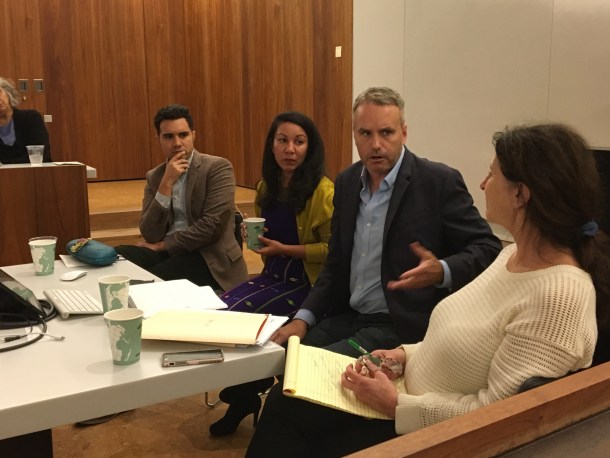
BENNINGTON — Conversations around discrimination issues are never easy, especially amid a divisive political era, but that has to be the goal, panelists agreed during a forum at Bennington College on “Gender and Race in America.”
Jay Diaz, an attorney with the American Civil Liberties Union of Vermont; Rep. Barbara Rachelson, D-Burlington, a member of the House Judiciary Committee, and Kesha Ram, a former Vermont legislator and 2016 candidate for lieutenant governor, led the discussion at the college’s Center for the Advancement of Public Action.
Diaz said the divisive discourse that marks the current era requires pushing back “against negative forces, pushing back against racism and tribalism.”
But some ways of accomplishing that are much more effective than others, he said, adding that there “are also positive stories to tell, of communities coming together.”
With some governmental entities and officials in Vermont “we are not even able to have that conversation,” about race or gender discrimination, Diaz said, but energized communities nevertheless are finding ways “to work around them if we have to.”
Cultural isolation
Ram described wanting to attend Bennington College as a high school student growing up in Los Angeles. But something a black student said to her during a visit to the campus led her to choose the University of Vermont in more diverse and urban Burlington instead.
A stark realization minority students can have in Vermont, and other areas of the country, she said, is that no matter how welcoming a campus community, there are too few others with similar racial, ethnic or cultural backgrounds. She said her own experience was of attending a diverse, 5,000-student high school in a major city.
For many out-of-state students or new residents, “it is a new concept to be reminded of being a minority,” Ram said.
Black men are particularly underrepresented on many campuses nationally, she said, prompting some institutions to recruit for male students “from overseas.”
In terms of perceptions of Vermont among minority populations elsewhere, Ram said that the withdrawal of Rep. Kiah Morris, D-Bennington, from her re-election campaign, after receiving racially motivated threats and online harassment, “was such a loss for the state.”
“But there also are great stories to tell,” she added, referring to the upset electoral victories of minority candidates in several states, including Massachusetts and Florida.
That is encouraging, Ram said, “but we still have a lot of reckoning to do in Vermont.”
Rachelson described her college career during the 1970s and working as a congressional intern in Washington. She said she and other female students were first assigned to work with the staff secretaries answering constituent letters, before demanding to work on policy issues like the male interns.
Things have changed, Rachelson said, but she said Vermont today still does “some weird things around women.”
In the state’s criminal justice system, women on furlough are remanded back to prison for violations of conditions of release at a higher rate than males on furlough, even though women are more often incarcerated for non-violent crimes, she said.
“We still have a lot of work to do on that,” she said.
Rachelson also said a number of women of color she knows report they are almost routinely stopped by police in the greater Burlington area and are watched or followed when out shopping.
Policing issues
Diaz, who has worked on Vermont policing issues, including a pending civil rights suit in federal court on behalf of a black man who was stopped and arrested on a drug charge by Bennington police, said “there are some structural issues” in state law and police policy that must change.
In addition to racial profiling during traffic stops, he said, “there is no mechanism for accountability for the use of force” by police, and little realistic chance of consequences for officers involved in those incidents.
“We need real accountability; otherwise there is no need to change,” Diaz said.
He saw some improvement in police training regarding bias issues, including now required training updates for officers on how to approach a situation involving a minority person.
In general, police forces need policies that no longer emphasize “a power model approach” to maintaining control of a situation, Diaz said, along with training that takes into account often routine reactions among white officers to minority individuals, compared to their reactions to a white person in the same situation.
Widely differing cultural experiences, including those of a minority person more familiar with a city environment, also play a role, Ram said, because it’s likely “people of color carry baggage from encounters with police.”
Negative comments
During testimony before the House Judiciary Committee on traffic stop profiling issues, Rachelson said some police officials and a few fellow lawmakers were insistent that there was no bias among officers in departments in their towns.
That notion was countered, she said, by examinations of traffic stop data among police agencies in the state. Included was a report by college professors Stephanie Seguino and Nancy Brooks, indicating that Bennington police had stopped black drivers out of proportion to their share of the driving population and were more than five times more likely to search black drivers than white drivers.
That report was submitted as part of the civil rights suit filed against Bennington police and the town. Pressed by the ACLU on behalf of Shamel Alexander, a black man who was stopped by BPD officers in 2013 and later convicted of heroin trafficking, the suit seeks as one of its demands changes in police training in Bennington and other police agencies.
Alexander was sentenced to prison, but the Vermont Supreme Court later threw out the heroin evidence found in his possession, ruling that the traffic stop was improperly extended beyond the initial reason for the stop — a minor traffic violation. The charges against Alexander were subsequently dropped, and the suit alleging racial profiling, discrimination and violation of constitutional rights was filed in U.S. District Court.
Personal dialogue
Rachelson said she is sometimes appalled by the negative stereotypical comments she hears, including from state lawmakers, concerning race or gender discrimination issues.
“They have to be held accountable,” she said, which could mean speaking up in opposition, but in the case of lawmakers, should also take place during elections.
She said that in general, “this has all been legitimized by Trump,” and happens “way more over the past two years.”
In personal interactions, Rachelson said she tries to immediately counter an offensive comment about race, gender or other issues, and “not just let it go,” but also tries to do so in a non-confrontational manner.
“There is a heightened sense of emotion on both sides, and people are scared of that emotion,” Diaz said of the current political era, and in many cases a minority person can “feel like they are under attack.”
But conversation must be attempted, he said, adding that conflict resolution approaches can be effective.
“Sometimes the best way to get this done is to change the tone, or to be the bigger person, or to give a little bit to get a little bit,” Diaz said.
He said that with people he profoundly disagrees with he is looking for a common “kernel of humanity” and tries to speak to that, “not focus on what wrong with you.”
Being “aware of our emotions” also is extremely important, he said, in avoiding triggers that would escalate a conversation into an argument.
Ram said that despite the animosity in public discourse today, “I think this is a great time for these conversations, because we really know what people think. For a lot of people of color that is helpful … You can do a lot of things when there is sunlight on something.”
Ram, who served as a Democrat, said she believes the recession of a decade ago and economic upheavals that engulfed many families has bred “tribalism” among some groups that she is hopeful can be overcome in time.
But when it comes to engaging in personal dialogue, Ram advised trying to interact in person, rather than within an online echo chamber of friends.
“Don’t try to do this on social media; that is not a way to start a conversation,” she said. “None of that is really helping.”
Asked what students and others can do, Ram and Rachelson stressed the ease of which a person or group can influence policy in a small state like Vermont, where lawmakers and state officials are comparatively accessible to everyone.
Diaz advised using “whatever skills or knowledge you have” to raise awareness about discrimination issues, including writing letters, organizing online or in person or speaking out.
Referring to her own experience running for office, Ram said even young people can take up that challenge and be successful. She was elected to the House in her early 20s.

