

Editor’s note: This story by Andrew Martin and Tommy Gardner was published in the Stowe Reporter on Sept. 20.
[T]emperatures regularly in the 80s, or even 90s, little rainfall, and lots and lots of sunshine.
Great summer, right?
Not this year, not for hundreds, possibly thousands, of Vermonters who are running short on water.
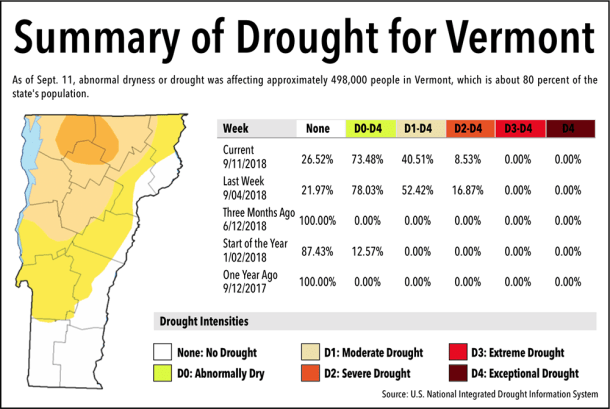
There’s been less green and more brown and yellow in the Green Mountain State this year, caused by one of Vermont’s worst droughts in two decades. Summer officially ended Saturday, but there’s no indication that the dry conditions in three-quarters of the state will break anytime soon.
That means Vermonters, particularly in the northern third of the state, already struggling with dried-up springs and failing wells, could face the bleak prospect that their water systems won’t recover before the ground freezes.
Things are bleakest in eastern Franklin, northern Lamoille and western Orleans counties, says Mark Breen, senior meteorologist at the Fairbanks Museum and Planetarium and one of the “Eye on the Sky” guys heard on Vermont Public Radio every morning.
“At the moment, the drought is classified as severe” in that area, Breen said Monday, but things aren’t much better elsewhere. All of northwestern Vermont — the rest of Lamoille, Orleans and Franklin counties, all of Chittenden County and most of Washington County — are in a moderate drought, and substantial parts of all but Vermont’s two southernmost counties are abnormally dry.
“Over the past six months, many of these locations have seen half their normal precipitation,” Breen said. “The areas that are in a severe drought have seen even less than that.”
When wells run dry
Springs are running dry and wells are failing, as the water table falls and underground aquifers aren’t being replenished.
“We’re doing an average of five or six calls a day,” Steve Owen, owner of Shelburne- and Underhill-based Fresh Water Haulers, said on Monday. “We’re crazy busy.”
How busy? During the five minutes he spoke with a reporter, Owen was paged three times for new water deliveries. His trucks can deliver about 4,500 gallons to replenish someone’s well or perk up their pond, but he’s scrambling to keep up with demand.
He focuses on customers in Chittenden, Franklin, Lamoille and Addison counties, but he’s getting calls from people much farther away — and just can’t help them.
“I’ve been saying it’s bad for the last six years. This year is just worse,” Owen said.
“We’re having one of the busiest years in recent memory,” said Jeffrey Williams, vice president of Jericho-based Spafford and Sons Water Wells.
“We’ve seen springs and shallow wells dry up, and some deeper drilled wells are just limping along,” he said.
He and his crews have been drilling new wells, or deepening old ones, after shallow water systems failed, and still the calls keep coming. Spafford’s backlog is normally three weeks, but its waiting list is much longer right now and the company has started pulling crews from its station near Middlebury to cover the area with severe drought.
Drillers from Morrisville-based N.A. Manosh Corp. have also been extremely busy, especially in Eden, Berkshire and Montgomery, where it seems like “whole roads, the entire area, seems to be drying up,” owner Nick Manosh said — “eight or nine people all needing help” on the same road.
He’s getting more work in sections of Johnson, and a lot of calls from Huntington, Williston and Shelburne in Chittenden County and from parts of Washington County.
“We’ve gone as far as Strafford, Vermont, and we’ve gotten calls from as far away as Maine,” Manosh said.
Both well-drilling companies have been getting calls for help all summer, but “the threat of going into winter without water is starting to set in, and people are beginning to push the panic button, especially this last week,” said Williams at Spafford and Sons.
The possibility of the drought persisting until winter arrives is panic-inducing because, once the ground freezes, water can’t “penetrate down to the aquifer, and the springs won’t come back,” Manosh said. “Even if we get some snow, and it thaws, if the ground is still frozen, that water won’t penetrate.”
Manosh worries that some people are clinging too long to the hope that their systems will recover.
“We’re putting out a couple of hundred estimates a week for this type of work,” Manosh said, “A lot of people are hoping some rain will get them back to being OK, and that’s not typically the case.
“I think we could get a real influx of calls later in the fall” if the drought doesn’t ease up, Manosh said.
Municipal water OK
Most municipal water systems seem OK.
The village of Jeffersonville asked customers earlier this summer to conserve water until its reservoirs were replenished. A major leak in the system was found and fixed in August, but residents were still being asked to use as little water as possible.
Other municipal system operators are upbeat.
“We have a really robust water supply,” said Craig Myotte, general manager at Morrisville Water & Light. Morrisville’s system is fed by wells and serves about 1,000 customers. Myotte knows other local municipal systems have struggled in recent years, such as 2016, but not Morrisville.
Waterbury is in fairly good shape, said municipal manager Bill Shepeluk. That 1,000-customer public system draws from several surface sources, with wells as backups.
“We have been running the wells of late, but there are no issues with public supply,” Shepeluk said.
Stowe’s public system, which serves about 1,300 customers, is fed by two principal wells. The water level in one is “about 10 feet lower than it was the same time last year,” said Dick Grogan, the town’s water superintendent and chief water operator. “We’re watching it, it’s a little lower than normal,” but the other principal well is going strong and there are no plans to ask people to conserve water.
“I think people with surface systems, they’re really struggling,” Grogan said. His own pond is three and a half feet lower than it normally is this time of year, the lowest it’s been in the eight years he’s had it.
Waterville’s water board, which operates the spring-fed municipal system that serves 60 customers in Waterville village, asked people earlier this month to be mindful of how much water they’re using.
“We’ve been pretty fortunate; we haven’t run out,” said Tim Burgess, head of the town water board. “We’re still asking people to conserve water, though.”
Private springs or wells have dried up for several Waterville residents, and the water board doesn’t want to face that problem. It’s coming up with a contingency plan in case the municipal system does falter later this fall.
“We’re not in trouble, we seem to be in good shape, but let’s not get in trouble,” Burgess said.

Hydropower slowdown
Low water levels are making it difficult to produce electricity at local hydropower dams.
“We’re below generating levels on the Lamoille River,” Myotte said. “Basically, we’re just passing everything through” without making any electricity. The utility has two hydro dams on the Lamoille in Morrisville and another at the dam at Green River Reservoir, but water levels are too low to make power, Myotte said. “Other than a couple quick storms, we haven’t had much precipitation” that would replenish the water levels.
No threat to snowmaking
Local ski area operators aren’t worried about not having enough water to make snow this winter.
“What drought?” Smugglers’ Notch Resort snowmakers said when asked about this coming winter’s water supply, said resort spokesman Mike Chait. Plain fact is, as long as the Lamoille River keeps flowing, so will the water at Smuggs.

Two years ago, the resort completed a pipeline to, and a pumphouse at, the river. The area where the resort draws is about 14 feet deep, so snowmakers aren’t worried at all.
Chait knows, as some Cambridge and Jeffersonville residents eye their wells, the resort is fortunate with its consistent source.
Starting around Oct. 1, the resort will begin topping off its reservoirs in preparation for cold weather.
“This is the second time in three years that pipeline’s saved our (butt),” Chait said, referring to 2016’s dry summer. “The Lamoille never stops flowing.”
Crews at Stowe Mountain Resort aren’t worried, either, said Jeff Wise, the resort’s spokesman.
“‘Peregrine Lake’ on Spruce Peak is designed to provide water storage for our snowmaking operations,” Wise said in an email Tuesday. “This reservoir is full and capable of providing coverage to open all our snowmaking trails.”
Jeff Crocker, a river ecologist with the Vermont Department of Environmental Conservation, said it’s still a little early to worry about snowmaking. Autumn tends to get wetter as the leaves fall, even in drought years, he said.
The rivers are lower than usual, though, which isn’t good news for fish, because of the narrowing stream beds and the resultant higher water temperatures. According to Crocker, they seek cold water, and there’s not much of that in some water bodies.
“It’s definitely put some stress on fish and other biota that live in the streams,” he said.
Bob Shannon, owner of The Fly Rod Shop in Stowe, said he’s had to get creative with his fishing tours this summer. He tells clients to bring their sneakers, because they may have to hike to some higher-elevation, out-of-the-way holes to find fish.
Even reliably deep bodies of water are shallow this year, including the Waterbury Reservoir.
“The reservoir’s looking a little bony right now,” Shannon said.
Crocker couldn’t say whether this year’s drought is a climate change-related harbinger of years to come, or part of the typical wet-dry, wet-dry two-year cycles anecdotally common in Vermont. And, he pointed out, Vermont south of Route 4 has had plenty of rain this summer.
“Climate uncertainty is certainly upon us,” Crocker said.

One for the record books
Most people agree this is the worst drought since at least 2002. Breen says one weather station in Cornwall, near Middlebury, had just 3 inches of rain in July and August of 2002; this year, the total was 5.5 inches.
Manosh agrees things were dry during the first few summers this century, but the number of water problems this year is more severe. He has three drilling crews and five service crews out every day, and the company’s waiting list is still a couple of weeks long.
Manosh is drilling a well on Foote Brooke Road in Johnson for a property that drew water from the same spring for five decades until it failed this year.
“Some of these springs, they’ve been producing for 50 or 60 years, and they’re drying up now,” Manosh said.
Long-term outlook
Breen doesn’t expect a soggy fall, but he doesn’t expect a hot, dry end to 2018, either.
“There aren’t any strong indications for either extremely dry or wet conditions” this fall, he said.
He expects conditions to ease.
“It’s not necessarily just the amount of rain,” Breen said; it’s also about what’s drawing water out of the ground. Outside of people, the biggest draw on Vermont’s groundwater are the trees and grass that give the Green Mountain State its name.
“The biggest water demand is the growing season,” Breen said. “As we get into October and the leaves fall off the trees, the demand for water drops tremendously.”
That may be true, but the worries of many Vermonters are only growing with no rain to dampen them.
“We need rain before the ground freezes, that’s for sure,” said Owen at Fresh Water Haulers.
“Some people are going to be out of water with snow on the ground if things don’t recover soon,” Williams agreed.
